
Bennings Green Tint
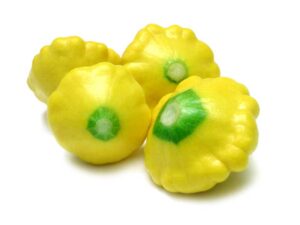
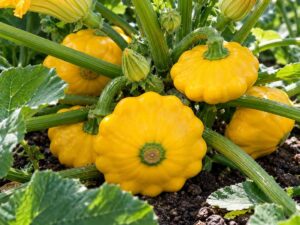
Pale green scalloped fruit suited to young harvesting, grilling, roasting, stuffing and fresh-market sales.
Squash seed buying and growing guide
Squash are warm-season fruiting vegetables belonging to the cucurbit family. Varieties differ considerably in plant habit, fruit shape, skin colour, flesh texture, maturity period and whether the fruit is harvested young or allowed to mature fully.
Seedmart supplies squash seeds in Australia for backyard gardeners, container growers, market gardeners and commercial vegetable producers. The range includes scallop and pattypan squash, compact bush types, Gem squash, Sweet Dumpling and Vegetable Spaghetti.
The best squash seed will depend on your available growing space, local season, preferred fruit size, intended kitchen use and whether you require a fast summer squash or a mature squash with firmer skin and longer storage potential.
Squash grows vigorously during warm weather and can produce repeated fruit under suitable conditions.
Choose from scalloped, round, ribbed, oval and elongated squash varieties.
Summer squash can continue producing when young fruit is picked regularly.
Select compact bush varieties for limited spaces or trailing types for larger garden areas.
Use squash for roasting, grilling, stuffing, soups, baking, stir-fries and vegetable-based pasta dishes.
Choose smaller packs for household growing or larger quantities on selected varieties for commercial production.
Squash varieties should be selected according to plant size, fruit maturity and intended use. Bush summer squash suits frequent harvesting from compact plants, while trailing and mature-fruited types need additional space and a longer growing period.
| Growing Goal | Variety or Type to Consider | Why Choose It? |
|---|---|---|
| Pale green pattypan fruit | Bennings Green Tint | Produces scalloped pale green fruit that is generally harvested young and tender. |
| Golden scallop squash | Golden Scallopini | Produces bright yellow scalloped fruit for fresh-market colour and repeated summer harvesting. |
| Compact bush production | Early White Bush | A bush-type squash suited to gardeners wanting less sprawling growth than strongly trailing varieties. |
| Small round mature squash | Gem Squash | Produces compact rounded fruit commonly harvested at a more developed stage than tender pattypan squash. |
| Small decorative mature fruit | Sweet Dumpling | Produces ribbed individual-sized fruit with distinctive colouring and sweet mature flesh. |
| String-like mature flesh | Vegetable Spaghetti | Develops mature flesh that separates into strands after cooking. |
| Small-space growing | Bush or compact squash varieties | Require less horizontal space and are easier to manage in raised beds and large containers. |
| Frequent fresh-market harvests | Pattypan and summer squash varieties | Young fruit can be picked repeatedly before skins and seeds become coarse. |
Pale green scalloped fruit suited to young harvesting, grilling, roasting, stuffing and fresh-market sales.
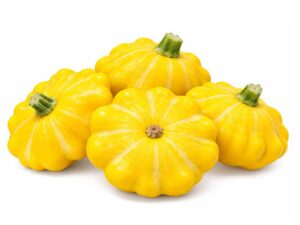
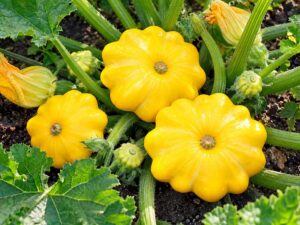
Bright yellow pattypan-style fruit adds strong colour to mixed squash harvests and market displays.
A compact summer-squash type that can suit smaller gardens and organised row production.
Gem squash produces small rounded fruit with a firm shell and substantial mature flesh.
Small ribbed fruit develops firm mature flesh and can be harvested for roasting, baking and stuffing.
Mature fruit develops flesh that separates into long strands after cooking.
The terms summer squash and winter squash describe the stage at which the fruit is normally harvested rather than the season in which the plants grow. Both groups are warm-season crops.
| Summer Squash | Winter or Mature Squash |
|---|---|
| Harvested while the fruit is young and the skin remains tender. | Left on the plant until the fruit and seed mature more fully. |
| Usually has soft skin and immature seeds. | Generally develops firmer skin and more mature seeds. |
| Requires frequent picking during peak production. | Requires a longer growing period before harvest. |
| Commonly used fresh soon after harvesting. | Some varieties can be cured and stored after harvest. |
| Includes pattypan, scallop and many bush squash varieties. | Includes Gem, Sweet Dumpling and Vegetable Spaghetti types. |
Winter squash is not normally grown as a winter crop. The plants require warm conditions, but the mature fruit can often be stored and used during cooler months.
Squash, pumpkins and zucchini belong to the cucurbit family and are closely related. The names are based largely on cultivated type, appearance, harvest stage and regional usage rather than a simple botanical division.
| Squash | Pumpkin | Zucchini |
|---|---|---|
| A broad term covering numerous summer and mature-fruited cucurbits. | Usually refers to larger mature-fruited types with firm skins and developed flesh. | A summer squash normally harvested while long or rounded fruit remains young and tender. |
| May have bush or trailing growth. | Many varieties have strongly trailing vines. | Many common varieties have compact or semi-bush growth. |
| Includes pattypan, Gem and Vegetable Spaghetti. | Includes many butternut, Kent, Queensland Blue and similar mature types. | Includes green, yellow and other tender summer-squash varieties. |
Searching for zucchini seed? Zucchini is a type of summer squash, but Seedmart maintains a separate zucchini seed category for dedicated zucchini varieties.
Squash needs warm soil, frost-free conditions and a sufficiently long growing season. Planting time varies according to climate, local frost risk and the heat and humidity expected during flowering and fruit development.
| Australian Climate | General Sowing Approach | Important Considerations |
|---|---|---|
| Tropical | Sow during warm but comparatively settled and less humid conditions. | Avoid periods of prolonged heavy rain, waterlogging and severe wet-season disease pressure. |
| Subtropical | Sow from late winter through spring and again during suitable warm periods. | Protect young plants from cold nights and manage fungal disease during humid weather. |
| Temperate | Sow after frost risk has passed and the soil has warmed in spring. | Starting seed under protection can extend the growing period for mature squash. |
| Cool temperate | Start seed indoors or under protection before transplanting after frost. | Select early varieties and use a warm, sheltered position. |
| Arid and inland | Sow after frost risk declines and before the most severe summer heat. | Provide reliable irrigation, mulch and protection from hot drying winds. |
These planting periods are general guides. Local elevation, frost dates, seasonal rainfall and variety maturity can change the appropriate sowing time.
Squash seed germinates most reliably in warm growing media. Cold soil can delay emergence and increase the risk of seed decay.
Keep the growing medium moist without allowing it to remain saturated around the large seed.
Sow squash seed approximately 20–30 mm deep or follow the instructions supplied for the individual variety.
Squash seedlings develop rapidly and should be transplanted before they become root-bound.
How long do squash seeds take to germinate? Squash commonly begins germinating within approximately 5–10 days under warm, evenly moist conditions.
Avoid overwatering squash seed. Cold, saturated seed-raising mix is a common cause of rotting before emergence.
Squash can be direct-sown into warm prepared soil or raised in pots before transplanting. Direct sowing avoids root disturbance, while protected propagation can provide an earlier start in cooler regions.
| Direct Sowing | Raising Seedlings |
|---|---|
| Seed is planted where the squash will mature. | Seed is started in pots or large cells under protection. |
| Avoids transplant disturbance. | Allows greater control over temperature and early watering. |
| Requires warm soil and protection from snails and rodents. | Seedlings can be protected until outdoor conditions improve. |
| Useful in warm climates and established garden beds. | Useful in temperate and cool climates with short growing seasons. |
| Extra seedlings may require thinning. | Plants must be transplanted before becoming root-bound. |
Spacing depends strongly on whether the variety has compact bush growth or vigorous trailing vines.
| Plant Type | General Spacing | Considerations |
|---|---|---|
| Compact bush squash | Approximately 60–90 cm apart | Allow room for broad leaves and access to developing fruit. |
| Large bush or semi-trailing squash | Approximately 90–120 cm apart | Wider spacing improves airflow and harvesting access. |
| Trailing squash | Approximately 1–2 metres apart | Allow additional room for vines to extend across the ground. |
| Trellised plants | Depends on variety and support system | Maintain enough root space and airflow even where vines grow vertically. |
| Commercial rows | Depends on machinery and crop specification | Allow room for cultivation, spraying, pollinator access and harvesting. |
Follow individual product directions where they differ from these general spacing recommendations.
Squash can grow in containers, but each plant requires substantial root space, sunlight and moisture.
Potted squash dries quickly and requires closer irrigation and fertiliser management than plants growing in open soil.
Can squash grow in pots? Yes, particularly compact bush and small-fruited varieties. Large trailing squash requires an exceptionally substantial container and sufficient surrounding space.
Squash generally performs best with at least six to eight hours of direct sunlight. Strong light supports vigorous foliage, flowering and fruit development.
In extremely hot inland conditions, temporary protection from severe afternoon heat may reduce stress. Deep shade, however, can limit flowering and fruit production.
Squash does not always require a trellis. Bush varieties are normally grown on the ground, while selected trailing varieties can be trained vertically where the support is strong enough.
| Growing Habit | Trellis Suitability | Considerations |
|---|---|---|
| Compact bush squash | Usually unnecessary | Plants form a broad crown rather than long climbing vines. |
| Small-fruited trailing squash | Often suitable | Use strong mesh or a secure frame and guide vines carefully. |
| Large-fruited trailing squash | Possible with substantial support | Heavy fruit may require individual slings to prevent stem damage. |
| Spaghetti-type squash | Can be trained where support is adequate | Allow room for vigorous vines and support developing fruit. |
Squash vines do not attach as securely as some climbing vegetables. Guide and tie vines loosely rather than expecting every variety to climb without assistance.
Growing time varies with variety, temperature, planting method and whether fruit is harvested young or allowed to mature fully.
| Crop Stage or Type | Indicative Period | General Characteristics |
|---|---|---|
| Seed germination | Approximately 5–10 days | Rapid emergence from warm, evenly moist soil. |
| Seedling development | Approximately 3–5 weeks | Plants establish quickly and should not remain in small pots too long. |
| Early summer squash harvest | Approximately 45–60 days | Young tender fruit harvested shortly after flowering and fruit set. |
| Gem and small mature squash | Approximately 70–100 days | Fruit requires time to develop firmer skins and mature flesh. |
| Sweet Dumpling and Vegetable Spaghetti | Approximately 80–110 days | Mature-fruited types requiring a longer warm growing period. |
These periods are broad guides rather than guaranteed maturity dates. Review individual product information for variety-specific guidance.
Squash plants usually produce separate male and female flowers on the same plant. Male flowers commonly appear first and provide pollen, while female flowers have a small immature fruit behind the petals.
| Male Squash Flower | Female Squash Flower |
|---|---|
| Develops on a relatively slender stem. | Has a small swollen immature fruit behind the flower. |
| Produces pollen but does not develop into fruit. | Can develop into fruit after successful pollination. |
| Often appears before female flowers. | Usually becomes more common as the plant matures. |
| Can be used as the pollen source for hand pollination. | Must receive compatible pollen while receptive. |
Male flowers dropping is normal. They release pollen and then decline. Only successfully pollinated female flowers develop into squash fruit.
Hand pollination may help when female flowers are developing but insect activity is limited. Perform the process in the morning while newly opened flowers are fresh.
The female flower may not have received enough viable pollen to support fruit development.
Cold nights or severe heat can interfere with flower development and pollen performance.
Drought or waterlogging can cause young fruit to yellow and stop growing.
Root damage, disease, poor nutrition and limited sunlight can reduce fruit retention.
Wet, windy or unsuitable weather can reduce insect visits during the short flower-opening period.
A stressed plant may not retain every developing fruit when it is already carrying a substantial load.
Squash requires consistent moisture during active growth, flowering and fruit development. The correct frequency depends on soil, temperature, rainfall, wind and plant size.
| Growing Situation | Watering Approach | What to Avoid |
|---|---|---|
| Newly sown seed | Keep the soil evenly moist until emergence. | Cold, saturated soil or complete surface drying. |
| Young seedlings | Water deeply enough to support expanding roots. | Repeated severe wilting and shallow surface watering. |
| Flowering plants | Maintain consistent root-zone moisture. | Large fluctuations that contribute to flower and fruit loss. |
| Developing fruit | Continue deep regular watering according to soil conditions. | Waterlogging and prolonged drought. |
| Container plants | Check frequently because pots dry rapidly. | Leaving containers permanently standing in water. |
Where possible, direct water towards the soil rather than repeatedly wetting the foliage. Mulch can reduce evaporation and soil splash around the plant.
Summer squash is normally harvested while the skin is tender, the seeds remain immature and the fruit has reached a useful size for the variety.
| Fruit Condition | What It Means | Recommended Action |
|---|---|---|
| Small and tender | The skin is soft and the immature seeds are fine. | Harvest for tender texture and repeated production. |
| Full-sized but still glossy | The fruit has expanded but remains actively developing. | Harvest promptly before the skin and seeds become coarse. |
| Oversized with hardening skin | The fruit has remained on the plant beyond the preferred summer-squash stage. | Use promptly if suitable and remove it to encourage further fruit production. |
Check summer-squash plants frequently during warm weather. Fruit can increase in size rapidly and may pass the preferred harvest stage within several days.
Mature squash such as Gem, Sweet Dumpling and Vegetable Spaghetti should remain on the plant until the fruit has developed its expected colour, firm skin and mature stem.
| Harvest Indicator | What to Look For | Why It Matters |
|---|---|---|
| Mature colour | The fruit has developed the characteristic colour of the variety. | Immature fruit may have poorly developed flesh and reduced storage life. |
| Firm skin | The rind resists light pressure from a fingernail. | A firm skin protects the fruit during handling and storage. |
| Drying stem | The stem becomes firmer, corkier or less green. | Stem maturity indicates that fruit development is approaching completion. |
| Declining vines | Healthy vines begin ageing naturally near the end of the crop. | Natural decline often coincides with mature fruit. |
Cut fruit from the plant using clean secateurs or a sharp knife. Leave a section of stem attached to mature squash, as breaking the stem away can create a wound that increases storage losses.
Do not carry mature squash by the stem. A broken stem can damage the fruit and reduce its storage potential.
Some mature squash benefits from a short curing period after harvest. Curing helps firm the outer skin and dry minor surface wounds before storage.
Not every squash stores for the same period. Storage life depends on variety, maturity, skin condition, curing, temperature, humidity and handling.
The soil may be too cold, saturated, dry or compacted around the seed.
Male flowers commonly appear first. Female flowering often increases as the plant becomes larger and conditions improve.
Incomplete pollination, heat or moisture stress can stop young fruit development.
Powdery mildew commonly develops as squash foliage ages or where conditions favour disease.
Large leaves lose moisture rapidly and may wilt temporarily, but repeated or persistent wilting indicates stress.
Wet soil contact, skin damage, poor airflow and disease can contribute to decay.
Incomplete pollination, physical damage and interrupted growth can produce irregular fruit.
Insufficient sunlight, excess nitrogen, plant immaturity and temperature stress can restrict production.
Squash can share garden space with crops that have compatible warm-season requirements. Its large leaves and spreading vines can shade smaller plants, so spacing remains important.
| Planting Option | General Compatibility | Considerations |
|---|---|---|
| Sweet corn | Shares warm-season growing conditions | Allow enough distance so neither crop severely shades the other. |
| Climbing beans | Can share a larger warm-season planting area | Provide separate supports and avoid tangled vines that restrict access. |
| Radish and fast greens | Can mature before squash vines cover the soil | Harvest early crops before the squash canopy expands. |
| Herbs and flowers | May increase garden diversity and attract pollinating insects | Select plants suited to similar heat and irrigation requirements. |
| Other cucurbits | Have similar soil and seasonal requirements | They share powdery mildew, viruses and several insect pests. |
Rotate cucurbit crops where practical. Avoid repeatedly planting squash, zucchini, pumpkin, cucumber, melon and related crops in the same soil.
Smaller quantities suit gardeners growing several plants, comparing fruit types or trialling an unfamiliar squash variety.
Larger quantities may suit growers producing summer squash, mature storage fruit or repeated seasonal plantings.
Compare commercial value by more than seed price. Germination, plant habit, fruit uniformity, harvest frequency, labour, grading losses and customer demand all influence the real value of a squash crop.
Commercial squash production requires careful variety selection, crop scheduling and harvest planning. Plant habit, pollination, fruit specification, harvest frequency and market demand all affect production efficiency.
Rapid, even establishment helps create uniform plants and a more predictable harvest period.
Bush and trailing varieties require different row spacing, cultivation and harvesting systems.
Select varieties according to fruit shape, colour, harvest size, maturity and target market.
Summer squash may require picking several times each week during peak production.
Australian squash-seed availability can vary. Commercial growers should confirm current stock, pack size, treatment status and required quantity before finalising planting schedules.
Sow squash seed approximately 20–30 mm deep in warm, moist and free-draining soil or seed-raising mix. Plant outdoors after frost risk has passed, provide full sun and fertile soil, maintain consistent moisture and allow enough room for the variety’s mature growth habit.
Squash seed commonly germinates within approximately 5–10 days under warm, evenly moist conditions.
Sow squash seeds approximately 20–30 mm deep. Use the individual product directions where a different depth is specified.
Yes. Direct-sow after frost risk has passed and the soil has warmed. Seed can also be raised in pots where an earlier protected start is required.
Squash is planted for warm, frost-free conditions. In temperate and cool regions, sow mainly from spring into early summer. Tropical and subtropical growers should avoid the most stressful periods of cold, extreme heat or prolonged heavy rain.
Squash generally performs best with at least six to eight hours of direct sunlight each day.
Yes. Use a very large container with effective drainage. Compact bush and small-fruited varieties are easier to manage in pots than vigorous trailing squash.
Compact bush squash may be spaced approximately 60–90 cm apart. Large bush and trailing varieties generally require substantially more room.
Not always. Bush varieties are normally grown without a trellis. Small-fruited trailing squash can be trained vertically where a strong support is provided.
Summer squash may begin producing within approximately 45–60 days. Mature squash commonly requires around 70–110 days, depending on variety and conditions.
Summer squash is harvested while the fruit is young, the skin remains tender and the seeds are immature. Pattypan and scallop squash are examples.
Winter squash is allowed to develop mature flesh, seeds and a firm skin before harvesting. The name refers to its mature storage use rather than winter plant growth.
Yes. Zucchini is a type of summer squash normally harvested while the fruit remains young and tender.
Squash and pumpkin are closely related cucurbits, and the common names overlap. Pumpkin generally refers to mature, firm-skinned fruit, while squash is used more broadly for both tender and mature types.
Pattypan is a scalloped summer squash with a flattened, round shape. It is generally harvested while young and tender.
Gem squash is a small round squash with a firm shell and developed flesh. It is normally harvested at a more mature stage than tender pattypan squash.
Spaghetti squash is a mature squash whose cooked flesh separates into long strands. Vegetable Spaghetti is a variety of this general type.
Male flowers commonly appear before female flowers, particularly while plants are young. Female flowering usually increases as the plant develops and growing conditions become suitable.
A male flower grows on a slender stem. A female flower has a small immature squash immediately behind the petals.
The fruit may not have been fully pollinated or the plant may be affected by heat, cold, moisture stress or poor health.
Yes. Transfer fresh pollen from a newly opened male flower to the central stigma of an open female flower during the morning.
Harvest summer squash while the fruit is young, glossy and tender. Pick regularly before the skin and seeds become coarse.
Mature squash generally develops its characteristic colour, firm skin and a hardening or drying stem. The fruit should no longer appear soft and immature.
Cut squash from the plant using clean secateurs or a sharp knife. Leave a sound section of stem attached to mature storage fruit.
Seed can be saved from fully mature fruit of suitable open-pollinated varieties. Squash varieties can cross-pollinate with compatible cucurbits, so isolation is required where varietal purity is important. Seed from hybrid varieties may not reproduce the parent accurately.
Squash seed for Australian growers
Seedmart supplies squash seed for backyard gardens, container growing, market gardens and larger vegetable production. The range includes scallop, pattypan, bush, Gem, Sweet Dumpling and Vegetable Spaghetti types, with larger quantities available on selected lines.
Review the individual product pages for current availability, pack options, plant habit, fruit characteristics and variety-specific growing information before ordering.