
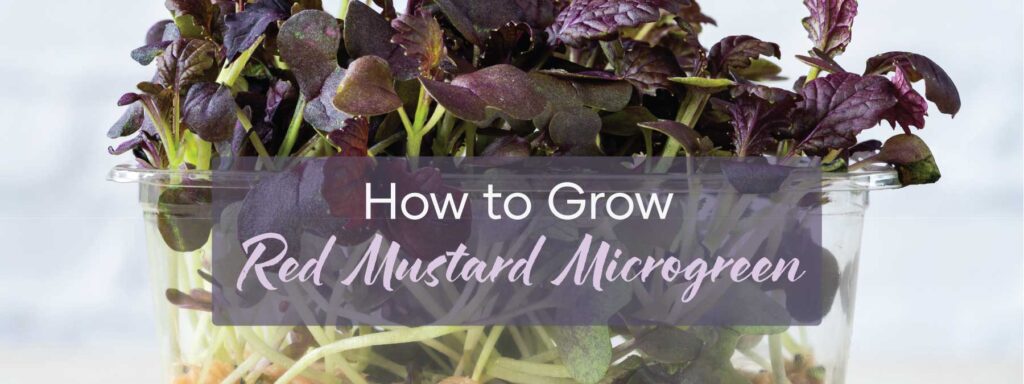
Red Mustard microgreens are fast-growing, colourful microgreens with a distinctive peppery mustard flavour. Their red-purple leaves and green stems make them an attractive addition to salads, sandwiches, wraps, grain bowls and garnishes.
If you’re wondering how to grow Red Mustard microgreens, they are a good choice for beginners. The small seeds do not need soaking, they germinate quickly and you can usually harvest a tray in around 8–12 days, depending on temperature, light and growing conditions.
This step-by-step guide explains how to grow Red Mustard microgreens at home, including how much seed to use, the best growing medium, how long to keep the tray in blackout, when to expose the seedlings to light, how to water them and when they are ready to harvest.
Red Mustard Microgreens at a Glance
What Are Red Mustard Microgreens?
Red Mustard microgreens are young mustard seedlings harvested shortly after germination. They are grown densely in shallow trays and harvested while the plants are still young, usually after their cotyledons, or seed leaves, have fully opened.
Unlike mature mustard greens, which develop large leaves and a stronger texture, microgreens are harvested while the stems and leaves are still tender.
Red Mustard is particularly popular because of its red-purple colouring and spicy mustard flavour. Colour can vary according to variety, temperature, light levels and growing conditions.
The young leaves can be eaten fresh and have a stronger flavour than mild microgreens such as broccoli, sunflower or peas.
What Do Red Mustard Microgreens Taste Like?
Red Mustard microgreens have a fresh, peppery mustard flavour. They can provide quite a noticeable kick, so you do not need many to add flavour to a meal.
They work particularly well with:
- Salads and salad mixes
- Sandwiches and wraps
- Avocado toast
- Eggs and omelettes
- Rice and grain bowls
- Asian-style dishes
- Curries
- Roasted vegetables
- Fresh garnishes
They can also be mixed with milder varieties to create a more balanced microgreen mix.
Different Varieties of Red Mustard Microgreens
There are several Red Mustard varieties that can be grown as microgreens, ranging from broad-leaf types with deep purple colouring to finely cut and frilled varieties. Although their growing requirements are similar, different red mustard cultivars can vary in leaf colour, shape, flavour, growth habit and mustard intensity.
Popular varieties include Red Giant, Crimson Tide, Red Garnet, Osaka Purple and Ruby Streaks mustard. Some are particularly useful for producing strong red and burgundy colour, while others are chosen for their unusual leaf shape or spicy flavour.
Red Giant Mustard
Red Giant Mustard is one of the best-known red mustard varieties. It produces broad leaves with attractive green, burgundy and reddish-purple colouring and has a distinctive spicy, peppery mustard flavour.
Red Giant can be grown as both a microgreen and a mature Asian mustard green. As a microgreen, its broad cotyledons, colour and strong flavour make it useful for salads, sandwiches, garnishes and colourful microgreen mixes.
Crimson Tide Mustard
Crimson Tide Mustard is an attractive red mustard variety with deeply cut, frilled foliage that develops red, burgundy and purple tones.
Its finely divided foliage gives Crimson Tide a distinctly different appearance from broad-leaf varieties such as Red Giant. As a microgreen, it provides a peppery mustard flavour together with strong visual contrast, making it particularly useful for garnishes and mixed microgreen trays.
Colour intensity can vary with light, temperature and maturity. Young plants may initially show more green before stronger red and purple colouring develops.
Red Garnet Mustard
Red Garnet Mustard is grown for its rich red to burgundy colouring and spicy mustard flavour. Its strong colour makes it an attractive variety for salads, garnishes and microgreen mixes where visual contrast is important.
As with other red mustard microgreens, the final colour can vary according to growing conditions, particularly light levels and the stage at which the plants are harvested.
Osaka Purple Mustard
Osaka Purple Mustard is a Japanese mustard variety known for its broad foliage and attractive purple-red and green colouring.
It has the characteristic peppery flavour of mustard greens and can be grown as either a microgreen or a mature leafy vegetable. Its combination of green and purple tones makes it a useful choice for colourful microgreen mixes.
Ruby Streaks Mustard
Ruby Streaks Mustard is particularly distinctive because of its finely divided foliage. As the plants develop, they produce deeply cut leaves with attractive red-purple and green colouring.
It has a spicy mustard flavour and is popular where both colour and unusual leaf texture are important. Ruby Streaks provides a useful contrast to the rounder and broader leaves of varieties such as Red Giant and Osaka Purple.
Red Mizuna and Other Red Mustard Types
You may also encounter mustard varieties described as Red Mizuna, Purple Mizuna, red-stemmed mustard or purple mustard. Cultivars within this broader group can differ considerably in leaf shape, stem colour, mature appearance and flavour.
Many have narrow, serrated or deeply divided foliage rather than the broad leaves associated with varieties such as Red Giant.
When buying seed, check the named cultivar rather than relying solely on terms such as “red mustard”, as different mustard varieties can produce noticeably different microgreens.
Which Red Mustard Variety Is Best for Microgreens?
The best Red Mustard variety depends on the colour, flavour and appearance you want.
- Red Giant Mustard: A good all-round choice for broad leaves, red-purple colour and strong mustard flavour.
- Crimson Tide Mustard: Best suited to growers looking for deeply cut, frilled foliage and strong visual contrast.
- Red Garnet Mustard: A useful choice when rich red and burgundy colouring is a priority.
- Osaka Purple Mustard: Produces broad foliage with attractive purple-red and green tones.
- Ruby Streaks Mustard: Particularly useful for finely divided foliage, texture and colour in microgreen mixes.
For mixed microgreen trays, red mustard can also be combined with milder green varieties. This provides a contrast in colour, leaf shape and flavour while preventing the stronger mustard flavour from dominating the mix.
Do Different Red Mustard Varieties Grow Differently?
Most Red Mustard microgreen varieties can be grown using the same basic method. The seeds generally do not require soaking and are sown directly onto a moist growing medium before being covered for a short germination period.
Once germinated, move the seedlings into bright light, maintain good airflow and keep the growing medium evenly moist. Bottom watering is useful once the roots are established because it reduces the amount of water sitting on the foliage.
Individual cultivars can differ slightly in germination speed, growth rate, height, leaf development and colour, so harvest according to the development of the crop rather than relying on an exact number of days.
For microgreens, harvest when the cotyledons are fully open and the plants have developed the colour, height and flavour you prefer. If you allow varieties such as Crimson Tide and Ruby Streaks to develop further, their characteristic cut or frilled true leaves become increasingly apparent.
Why Grow Red Mustard Microgreens?
Red Mustard is a fast-growing microgreen, with research showing high germination within the first three days of growing.
- Fast-growing crop
- No seed soaking required
- Suitable for beginners
- Can be grown indoors
- Suitable for small spaces
- Distinctive spicy mustard flavour
- Attractive red-purple foliage
- Can be grown throughout the year indoors
- Suitable for soil, coco coir and growing mats
How to Grow Red Mustard Microgreens in 7 Simple Steps
- Prepare a clean shallow growing tray.
- Sow Red Mustard microgreen seeds evenly over the surface.
- Mist the seeds and cover the tray for approximately 2–3 days.
- Remove the cover once most seedlings have germinated.
- Move the tray into bright light and begin bottom watering.
- Grow until the cotyledons are fully open and the crop is around 5–8 cm tall.
- Harvest with clean scissors, usually around 8–12 days after sowing.
The exact growing time will vary. Temperature, airflow, light, seed density and the growing medium can all affect how quickly your microgreens develop.
What You Need to Grow Red Mustard Microgreens at Home
- Red Mustard microgreen seeds
- A shallow growing tray with drainage holes
- A second tray, lid or dark cover for germination
- Growing medium such as coco coir, hemp mat or fine organic potting mix
- Spray bottle
- Clean water
- A bright windowsill or suitable grow light
- Clean scissors for harvesting
You do not need expensive equipment. A small food-safe container can also work for a trial batch, provided you can manage drainage and moisture properly.
The original Seedmart growing trial used a small 500 mL container, which is a simple way to experiment with Red Mustard before moving to larger microgreen trays.
Do Red Mustard Microgreen Seeds Need to Be Soaked?
No. Red Mustard microgreen seeds do not need to be soaked before sowing.
Mustard seeds are small and germinate readily when kept in contact with a moist growing medium. Pre-soaking is unnecessary and can make the small seeds more difficult to spread evenly.
Instead, prepare your growing medium, sow the dry seeds evenly and mist them thoroughly after planting.
How Much Red Mustard Seed Should You Use?
For a standard 10 x 10 inch microgreen tray, approximately 5–7 g of Red Mustard seed is a useful starting point.
The exact amount may need adjusting slightly for your tray, growing medium and preferred crop density.
Aim for an even layer of seed across the surface. Dense sowing is normal for microgreens, but the seeds should not be piled heavily on top of each other.
For very small containers, reduce the amount proportionally.
Overcrowding can:
- Restrict airflow between seedlings
- Keep the surface excessively wet
- Encourage uneven growth
- Increase the risk of mould or damping off
Best Growing Medium for Red Mustard Microgreens
Red Mustard microgreens can be grown in several different growing mediums.
Coco Coir
Coco coir is an excellent option for home microgreen growing. It holds moisture well while remaining relatively light and easy for small roots to penetrate.
Add approximately 2–3 cm to the tray and moisten it before sowing.
Organic Potting Mix or Seed-Raising Mix
A fine, good-quality organic potting or seed-raising mix can also be used.
Avoid very coarse potting mixes containing large pieces of bark or wood, as these can make it difficult to spread the small Red Mustard seeds evenly.
Hemp Growing Mats
Hemp growing mats are convenient for small indoor crops and provide a cleaner harvest because there is less loose growing medium around the stems.
Make sure the mat is completely moistened before sowing.
Reusable and Hydroponic Growing Mats
Red Mustard can also be grown using suitable reusable or hydroponic microgreen mats.
When growing without a soil-based medium, monitor moisture carefully because different mats vary considerably in how much water they retain.
Best Temperature for Growing Red Mustard Microgreens
Red Mustard microgreens generally perform well in normal indoor temperatures of approximately 18–24°C.
Temperature affects both germination and the speed of growth.
In cooler conditions, germination and growth may take longer. In hot and humid conditions, trays can become more susceptible to mould and other problems, particularly when airflow is poor.
This is particularly worth watching during warmer weather in subtropical areas such as Brisbane.
During hot or humid conditions:
- Do not overwater
- Keep air moving around the trays
- Avoid leaving foliage continuously wet
- Do not overcrowd the seed
- Keep trays away from hot direct afternoon sun
Step 1: Prepare Your Growing Tray
Start with a clean tray or container.
Cleaning growing equipment between crops reduces the amount of old organic material, roots and plant debris that can harbour mould or other microorganisms.
If using coco coir or potting mix, add approximately 2–3 cm of growing medium.
Moisten the medium before planting. It should feel evenly damp but should not be saturated or waterlogged.
Gently level the surface so the small mustard seeds can be spread evenly.
If you are using a hemp or reusable growing mat, place the mat flat inside the tray and wet it thoroughly before sowing.
Step 2: Sow the Red Mustard Microgreen Seeds
Sprinkle your Red Mustard microgreen seeds evenly across the surface.
Try to produce an even layer without leaving large empty spaces or dense piles of seed.
The seeds do not need to be buried.
Once the seeds have been spread across the medium, use a spray bottle to mist them thoroughly with clean water. This moistens the seed coat and helps the seeds settle against the growing surface.
Do not soak Red Mustard seeds before sowing.
Step 3: Cover the Tray for Germination
After sowing, place a second tray, lid or dark cover over the growing tray to create a blackout period.
Keep the tray covered for approximately 2–3 days, or until most of the seeds have germinated and the young shoots are beginning to push upwards.
During this period, check the tray once or twice daily.
If the surface is beginning to dry out, mist it lightly with water. It should remain moist but not saturated.
Do Red Mustard Microgreens Need Weight During Blackout?
Usually, Red Mustard does not need to be heavily weighted during germination.
Larger microgreen seeds such as peas and sunflower are commonly weighted to improve seed-to-medium contact and encourage stronger rooting. Small mustard seeds normally establish well without this step.
A tray placed lightly over the top is generally sufficient to maintain darkness and humidity.
Step 4: Move the Red Mustard Microgreens into Light
Once most of the seedlings have germinated, remove the blackout cover.
The young seedlings may initially appear pale or yellow. This is normal after germination in darkness.
Move the tray to a location with bright light. You can use:
- A bright windowsill
- A well-lit indoor growing area
- An LED grow light
The seedlings will begin developing their normal leaf colour after exposure to light.
Red varieties can vary in colour. Some seedlings may initially appear greener before developing stronger red or purple tones.
Avoid very hot direct sunlight through glass, particularly during warm weather, because shallow microgreen trays can dry rapidly.
Step 5: Water and Grow Your Red Mustard Microgreens
Once the seedlings are established, bottom watering is generally preferable to repeatedly spraying the foliage from above.
Place a small amount of water into the bottom tray and allow the growing medium to draw the moisture upwards.
This helps keep the leaves and stems drier while supplying moisture directly to the roots.
Check the crop at least once a day. Depending on temperature and airflow, watering may be required once or twice daily.
Do not water according to a rigid schedule. Instead, check the growing medium.
For best results:
- Keep the growing medium evenly moist
- Do not leave the tray waterlogged
- Provide good airflow
- Use bright, even light
- Rotate the tray if seedlings are leaning towards a window
- Avoid leaving the leaves continuously wet
Step 6: When to Harvest Red Mustard Microgreens
Red Mustard microgreens are generally ready for harvest in approximately 8–12 days after sowing, although faster or slower crops are possible.
Rather than relying only on the number of days, look at the plants themselves.
A good time to harvest is when:
- The seedlings are approximately 5–8 cm tall
- The cotyledons are fully open
- The leaves have developed good colour
- The stems are upright and tender
- The crop has the flavour and appearance you prefer
Microgreens can be harvested around the cotyledon stage or as the first true leaves begin to appear.
For tender Red Mustard microgreens, there is usually no benefit in leaving the crop growing for a long period after this point. As the plants mature, the texture and appearance begin to change.
Step 7: How to Harvest Red Mustard Microgreens
Use clean, sharp scissors or a clean knife to cut the stems just above the growing medium.
Avoid pulling the plants from the tray by their roots, as this can bring coco coir, soil or other growing medium into your harvest.
You can harvest the whole tray at once or cut only what you plan to use.
For the best eating quality, harvest the microgreens while they are fresh and crisp.
How to Store Red Mustard Microgreens
Freshly harvested Red Mustard microgreens can be stored in the refrigerator if you do not plan to use them immediately.
For best storage:
- Harvest with clean scissors
- Keep the harvested microgreens as dry as practical
- Remove damaged or wilted seedlings
- Place them in a clean container
- Add a sheet of paper towel to absorb excess moisture if required
- Refrigerate promptly
- Use while fresh and crisp
Excess moisture can shorten storage life, so avoid placing dripping-wet microgreens directly into a sealed container.
How to Use Red Mustard Microgreens
Red Mustard microgreens are best used when you want to add both colour and a peppery mustard flavour.
Try them:
- Mixed through salads
- On sandwiches and rolls
- In wraps
- On avocado toast
- With scrambled eggs or omelettes
- On burgers
- Over rice or grain bowls
- As a garnish for curries
- With roasted vegetables
- Mixed with milder microgreens
Because the flavour is stronger than many common microgreens, start with a small amount and add more according to taste.
Red Mustard Microgreens vs Green Mustard Microgreens
Both Red Mustard and green mustard can be grown using very similar methods, but they differ in appearance and may differ somewhat in flavour depending on the variety.
If appearance is important, Red Mustard is particularly useful for adding contrasting colour to mixed microgreen trays.
Can You Grow Red Mustard Microgreens Without Soil?
Yes. Red Mustard microgreens can be grown without soil using suitable hydroponic growing mats.
Options include:
- Hemp growing mats
- Reusable microgreen mats
- Other suitable hydroponic growing media
For beginners, coco coir or a fine growing mix can be slightly more forgiving because these media hold moisture well.
Whichever method you choose, the most important factors are consistent moisture, good seed contact with the growing surface, sufficient light after germination and good airflow.
Tips for Growing Red Mustard Microgreens Indoors
Red Mustard is well suited to indoor growing, but a few simple practices can improve the crop considerably.
- Start with clean trays and equipment
- Do not soak the seeds
- Sow evenly rather than creating thick clumps
- Keep the tray moist during germination without saturating it
- Move seedlings into bright light promptly after blackout
- Bottom water after the seedlings establish
- Maintain good airflow around the crop
- Avoid very hot direct sunlight
- Start a new tray regularly if you want a continuous harvest
Growing Red Mustard Microgreens in Warm and Humid Weather
Red Mustard can be grown throughout the year indoors, but warm and humid conditions require more attention to airflow and watering.
This is particularly relevant for growers in subtropical and tropical parts of Australia.
During humid weather, the growing medium may dry more slowly and moisture can remain trapped between densely planted stems.
To reduce problems:
- Use a tray with adequate drainage
- Do not leave standing water underneath the crop for long periods
- Increase airflow around the trays
- Avoid excessive seed density
- Bottom water rather than continually wetting the leaves
- Check moisture before automatically adding more water
Common Problems When Growing Red Mustard Microgreens
Mould on Red Mustard Microgreens
Mould problems are more likely when the crop is overcrowded, continuously wet or growing in an area with poor airflow.
If mould develops:
- Reduce excessive watering
- Improve airflow
- Check that the tray drains properly
- Reduce the sowing density on your next crop
- Clean trays thoroughly before reusing them
Do not eat microgreens that are visibly mouldy or spoiled.
White Fuzz Around the Roots
Fine white hairs close to the roots are not always mould.
Microgreen seedlings naturally produce root hairs, particularly when searching for moisture. Root hairs usually appear evenly around healthy roots and may seem to disappear when wet.
Mould tends to spread irregularly across seeds, stems or growing medium and may develop a musty smell or continue spreading.
If you are unsure whether growth is mould, it is safer not to eat the affected crop.
Red Mustard Microgreens Are Yellow After Blackout
Pale or yellow seedlings immediately after blackout are normal.
The seedlings have been growing without light. Once the cover is removed and the tray is placed in adequate light, the cotyledons will begin developing their normal green and red-purple colouring.
Red Mustard Microgreens Are Mostly Green
Red Mustard does not necessarily emerge with its final colour immediately.
Colour develops as the seedlings mature and can vary according to variety, light intensity, temperature and growing conditions.
Some green colouring is normal even in red mustard varieties.
Seedlings Are Tall and Weak
Long, thin seedlings that lean heavily towards a window usually need more light.
Move the tray into a brighter position or provide an appropriate grow light.
If natural light comes primarily from one direction, rotate the tray regularly for more even growth.
Red Mustard Microgreens Are Wilting
Because microgreens are grown in shallow trays, they can dry out surprisingly quickly.
If seedlings are wilting and the growing medium feels dry, water them promptly from underneath.
During warm weather, trays may need checking more than once each day.
Seeds Are Not Germinating Evenly
Uneven germination can be caused by:
- Uneven moisture
- Poor seed-to-medium contact
- Seeds being sown in clumps
- Growing medium drying out during germination
- Temperatures being too hot or too cold
Level the growing medium carefully before sowing and keep it consistently moist during the first few days.
Frequently Asked Questions About Growing Red Mustard Microgreens
How long do Red Mustard microgreens take to grow?
Red Mustard microgreens are generally ready to harvest in approximately 8–12 days, although growing time can vary with temperature, light and growing conditions.
Do Red Mustard microgreen seeds need soaking?
No. Red Mustard seeds are small and do not need to be soaked before sowing.
How long should Red Mustard microgreens stay in blackout?
Approximately 2–3 days is a useful starting point. Remove the cover once most seeds have germinated and the seedlings are beginning to push upwards.
Do you need to put weight on Red Mustard microgreens?
Usually not. Small mustard seeds generally establish without the heavy weighting sometimes used for larger microgreen seeds such as sunflower and peas.
How much Red Mustard seed should I use for a 10 x 10 tray?
Approximately 5–7 g per 10 x 10 inch tray is a useful starting rate. Adjust slightly according to the size of your seed, growing medium and preferred crop density.
What is the best growing medium for Red Mustard microgreens?
Red Mustard can be grown in coco coir, fine organic potting or seed-raising mix, hemp mats and other suitable microgreen growing media.
Can Red Mustard microgreens be grown indoors?
Yes. Red Mustard microgreens are well suited to indoor growing and can be grown on a bright windowsill or under suitable grow lights.
Can you grow Red Mustard microgreens all year round?
Yes. When grown indoors where temperature, moisture and light can be managed, Red Mustard microgreens can be grown throughout the year.
How often should I water Red Mustard microgreens?
Check the tray at least daily and water according to how quickly the growing medium dries. Many trays require watering once or twice a day, but this varies considerably with temperature, humidity, airflow and the type of growing medium.
The medium should remain moist without becoming waterlogged.
Should I spray or bottom water Red Mustard microgreens?
Misting is useful immediately after sowing and during early germination. Once the seedlings have established roots, bottom watering is generally preferable because it supplies water without continually wetting the leaves and stems.
When should I harvest Red Mustard microgreens?
Harvest when the cotyledons are fully open, the crop has developed good colour and the stems are approximately 5–8 cm tall. This commonly occurs around 8–12 days after sowing.
Do Red Mustard microgreens regrow after cutting?
Red Mustard microgreens are normally treated as a single-cut crop. For a continuous supply, sow another tray rather than relying on regrowth.
Why are my Red Mustard microgreens not very red?
Colour intensity can vary naturally with the variety, maturity, temperature and amount of light the crop receives. Young seedlings may initially appear greener and develop stronger red-purple colour as they grow.
Are Red Mustard microgreens easy to grow?
Yes. Red Mustard is a good microgreen for beginners because the seeds do not require soaking, germination is relatively quick and the crop can be grown using a simple indoor setup.
Where to Buy Red Mustard Microgreen Seeds in Australia
For reliable results, use seed supplied specifically for growing rather than seed intended as a culinary spice.
Seedmart supplies Red Mustard Microgreen Seeds for home and commercial microgreen growers, with packet and bulk quantities available.
You can also browse our full range of microgreen seeds if you would like to grow several varieties or create your own microgreen mixes.
Learning how to grow Red Mustard microgreens is straightforward. Sow the dry seeds evenly over a moist growing medium, keep them covered for the first few days, move them into bright light after germination and keep the roots consistently moist without waterlogging the tray.
Within roughly 8–12 days, you can have a tray of colourful, peppery Red Mustard microgreens ready to harvest.
Once you have established the right seed density and watering routine for your growing conditions, Red Mustard is an easy variety to include in a regular indoor microgreen growing cycle.