
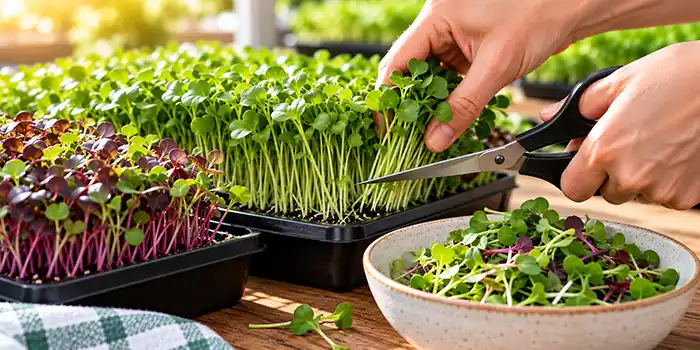
Knowing when to harvest microgreens is partly about plant development and partly about the crop you want to produce.
Many microgreens are harvested once their cotyledons have fully opened, while others are allowed to develop their first true leaves. Pea shoots and wheatgrass are different again: they are normally harvested according to shoot or blade development rather than the appearance of a typical pair of cotyledons.
Harvesting at the right stage is only half the job. How you cut, handle, wash, dry and refrigerate microgreens can make a substantial difference to their quality after harvest.
What Do Microgreens Look Like When They Are Ready to Harvest?
A germinating seedling initially produces its cotyledons, commonly called seed leaves. These are followed by the plant’s first true leaves.
For many common microgreens, the useful harvest window begins once the cotyledons have opened and developed good colour. The crop can often be allowed to continue until the first true leaves begin emerging.
There isn’t one compulsory harvest day.
Species, temperature, light, seeding density and the size and flavour you want all influence the appropriate harvest point.
Cotyledons vs True Leaves
Cotyledons
These are the first seed leaves produced by the developing seedling.
- Usually simple in shape
- Appear before true leaves
- Often form the main canopy of a young microgreen crop
- Many fast crops can be harvested at this stage
True Leaves
True leaves develop after the cotyledons and begin to resemble the mature plant’s foliage.
- Appear after the seed leaves
- Shape varies considerably by species
- Often indicate the crop is entering a later microgreen stage
- Can change flavour, texture and appearance
Do Microgreens Have to Have True Leaves Before Harvest?
No.
Many commercial microgreens are harvested with fully developed cotyledons before much true-leaf growth has occurred.
Others are grown until the first true leaves are visible.
The best stage depends on the variety and the product you want. Waiting longer doesn’t automatically make the crop better.
Typical Microgreen Harvest Stages
| Crop | Typical Harvest Stage | What to Look For |
|---|---|---|
| Broccoli | Cotyledons developed to early true-leaf stage | Open green cotyledons and an even upright canopy |
| Radish | Developed cotyledon stage | Full canopy, good colour and tender stems |
| Kale | Cotyledon to early true-leaf stage | Developed cotyledons and desired leaf colour |
| Mustard | Cotyledon to early true-leaf stage | Developed canopy and desired flavour intensity |
| Pea Shoots | Young shoot stage | Tender shoots at the desired height and development |
| Sunflower | Developed cotyledon stage | Open cotyledons with most seed hulls shed |
| Fenugreek | Young green shoot stage | Established shoots with developed cotyledons |
| Wheatgrass | Grass blade stage | Healthy upright blades at the desired height |
| Basil | Cotyledon to early true-leaf stage | Developed leaves, good colour and desired aroma |
| Coriander | Developed cotyledon to true-leaf stage | Established foliage with the flavour and appearance you want |
These are harvest stages rather than rigid harvest dates. Growing time varies according to variety and conditions.
How Long Do Microgreens Take to Grow?
Many fast-growing microgreens are ready within roughly 1–2 weeks, while slower crops can take considerably longer.
Fast brassicas and radishes, for example, generally reach harvest much sooner than slower herbs such as basil or coriander.
Temperature also matters. The same seed can take longer to reach harvest during cool conditions than it does under an appropriate controlled temperature.
If a crop is substantially slower than expected, see our Microgreen Troubleshooting Guide.
What Time of Day Should You Harvest Microgreens?
For home growers, the most important thing is to harvest when the crop is in good condition and can be used or refrigerated promptly.
More important than the clock is avoiding a crop that is excessively wet at harvest.
If you’ve just overhead-watered a canopy, allow unnecessary surface moisture to dissipate before cutting where practical.
Commercial growers should develop a consistent harvesting and cooling procedure rather than leaving freshly cut microgreens at room temperature for extended periods.
Should You Water Microgreens Before Harvesting?
Avoid deliberately soaking the foliage immediately before harvesting.
The crop should be adequately hydrated, but that doesn’t mean the leaves and stems need to be wet.
If the root zone is dry and the crop is wilting, deal with that before harvest. If the crop is healthy, avoid unnecessary overhead watering just before cutting.
How to Harvest Microgreens
Prepare Clean EquipmentWash your hands and use a clean, sharp pair of scissors or knife. Commercial growers should follow their documented cleaning and sanitising procedures for food-contact equipment.
Inspect the CropDon’t harvest obviously diseased, decomposing or otherwise unacceptable plant material into the finished product.
Cut Above the Growing MediumCut the stems cleanly above the surface of the growing medium. Avoid cutting so low that potting mix, coir or other substrate enters the harvested crop.
Handle GentlyAvoid crushing, compressing or repeatedly handling the cut microgreens. Damaged plant tissue deteriorates more quickly.
Use or Cool PromptlyUse freshly harvested microgreens promptly or move them into appropriate refrigerated storage.
Where Should You Cut Microgreens?
Cut the stem above the growing medium, leaving the roots behind.
You want enough stem for an attractive, usable crop without cutting into the substrate.
Cutting too low can introduce particles of potting mix, coco coir or other growing material into the harvested product.
Scissors or a Knife?
Both can work.
For small home trays, sharp scissors are simple and provide good control.
A sharp knife can be faster across larger trays, provided the cut is clean.
The important word is sharp. A blunt blade crushes and tears stems rather than making a clean cut.
For larger commercial operations, powered cutting equipment can increase harvesting speed, but growers need to consider the trade-off between labour efficiency and damage to delicate plant tissue.
Should You Pull Microgreens Out by the Roots?
Generally, no.
Microgreens are normally harvested by cutting the edible shoot above the growing medium.
Pulling the entire plant introduces roots and growing medium into the harvested product and makes cleaning and handling more difficult.
This is one of the important differences between microgreens and sprouts. Sprouts are generally consumed with the root and remaining seed, whereas microgreens are cut above the growing medium.
Should You Wash Microgreens After Harvesting?
This needs to be separated into two different questions:
Should microgreens be washed before eating? Fresh produce should be washed appropriately before consumption.
Should a grower wash microgreens immediately after harvest and then store them wet? Not necessarily.
Washing delicate microgreens introduces additional moisture and handling, and can reduce their post-harvest life if they are not dried and cooled correctly.
Home Growers
If you are harvesting microgreens to eat immediately, rinse them under clean, cool running water and drain or dry them before use.
If you’re storing them, keeping the harvested crop dry and washing immediately before use can help maintain quality.
Commercial Growers
Post-harvest washing needs to be part of a controlled food-safety process.
Washing can spread contamination between leaves if water quality and the washing system are not properly managed. Commercial growers should use potable-quality water and follow applicable food-safety procedures.
Don’t Use Soap to Wash Microgreens
For microgreens being washed at home before consumption, clean running water is appropriate.
Don’t wash edible microgreens with household detergent, dishwashing liquid or other cleaning products that are not intended for washing fresh produce.
How to Dry Microgreens After Washing
If microgreens are washed, remove as much excess surface water as practical.
For a small home harvest, allow them to drain thoroughly and gently dry them using clean food-contact materials.
A salad spinner can be useful for some robust microgreens if used gently, but delicate crops can be bruised by aggressive spinning.
The objective is not to desiccate the crop. It is simply to avoid storing leaves covered in free water.
How to Store Microgreens
Harvested microgreens are highly perishable.
For home storage:
- refrigerate promptly
- use a clean food-storage container or bag
- avoid crushing the crop
- avoid storing the leaves dripping wet
- minimise temperature fluctuations
- check for condensation inside the container
A refrigerator provides a much better storage environment than leaving harvested microgreens at room temperature.
How Long Do Microgreens Last in the Fridge?
There isn’t one shelf life for every microgreen.
Under suitable refrigerated storage, many microgreens can remain usable for approximately 5–10 days, while crop, maturity, handling and storage conditions can move shelf life outside that range.
Some research and commercial guidance reports storage approaching 10–14 days under carefully controlled cold conditions, but that shouldn’t be treated as a guarantee for a home refrigerator.
Why Does Condensation Form Inside the Container?
Condensation occurs when moisture in the air reaches a surface cold enough for water to condense.
With microgreens, it can occur when:
- the crop is packaged while wet
- warm harvested produce is placed directly into a closed container
- storage temperatures fluctuate
- the package contains excessive moisture
Repeated movement between cold storage and warmer conditions can make condensation worse.
For commercial growers, maintaining the cold chain is therefore important for both quality and shelf life.
Can You Store Microgreens With Paper Towel?
Some home growers use clean absorbent paper in a storage container to help manage small amounts of excess moisture.
This can be useful, but it shouldn’t be used to compensate for packaging microgreens that are soaking wet.
If the paper becomes saturated, the underlying moisture problem remains.
Can You Harvest Only Part of a Tray?
Yes.
For home growing, harvesting only what you need can be an excellent way to avoid storing cut microgreens unnecessarily.
Use clean scissors and avoid damaging the remaining crop.
Whether the remaining plants continue to improve depends on the species, maturity and growing conditions.
Do Microgreens Regrow After Cutting?
Most common microgreens should be treated as a single-harvest crop.
When the stem is cut below the plant’s growing point, there may be little capacity for useful regrowth.
Some species can produce additional shoots, particularly plants with growth points remaining below the cut, but a second crop is often less uniform and may not justify the extra growing time.
For consistent production, sowing a fresh tray is usually the better approach.
Can You Reuse the Growing Medium?
After harvest, the growing medium normally contains a dense network of roots, pieces of stem, failed seeds and other organic material.
For a clean, consistent microgreen crop, we don’t recommend immediately sowing another dense crop directly into the intact spent root mat.
Organic growing media may instead be composted or incorporated into an appropriate composting or soil system.
See our Best Growing Medium for Microgreens guide for more information.
Harvesting Pea Shoots
Peas are generally harvested as young shoots rather than according to a simple cotyledon stage.
Harvest when the shoots have reached the size, tenderness and appearance you want.
If allowed to become too mature, stems can become more fibrous and the crop changes from a tender microgreen-style shoot towards a more developed pea plant.
Cut above the growing medium with clean scissors or a sharp blade.
Harvesting Sunflower Microgreens
Sunflower is generally most attractive once the thick cotyledons have opened and most hulls have been shed.
Harvesting too early can leave large numbers of hulls attached. Waiting too long allows the crop to become more mature and can alter texture and flavour.
Remove loose hulls before packaging or serving.
Harvesting Broccoli, Kale & Radish Microgreens
Fast-growing brassicas are commonly harvested with fully developed cotyledons or as the first true leaves begin to emerge.
Don’t wait for them to resemble miniature mature vegetable plants.
Once they have formed a healthy canopy, developed good colour and reached the size and flavour you want, they can be harvested.
Harvesting Fenugreek Microgreens
Fenugreek (Trigonella foenum-graecum) develops substantial young shoots and can be harvested once the cotyledons are established and the crop has reached the size and flavour you prefer.
In our Brisbane conditions, fenugreek is also one of the crops we’ve found performs particularly well during warmer weather.
As the plant develops further, its appearance, flavour and texture change, so harvest timing can be adjusted according to how the crop will be used.
Harvesting Wheatgrass
Wheatgrass is harvested as a grass crop rather than at a cotyledon stage.
Cut the blades above the growing medium once they have reached the height and development required for your intended use.
Avoid cutting so low that growing medium or seed material enters the harvest.
In Brisbane, we’ve found wheatgrass substantially more difficult to produce during warm, humid periods because mould becomes harder to manage. Inspect the crop carefully before harvesting rather than assuming that every tray reaching the expected age is suitable to use.
Commercial Microgreen Harvesting
For a commercial grower, harvest is both a horticultural process and a food-handling process.
The harvesting system should consider:
- worker hand hygiene
- clean and sanitised food-contact equipment
- clean harvest containers
- preventing growing medium from entering the product
- removing unacceptable plant material
- minimising unnecessary handling
- rapid movement into appropriate cold storage
- water quality where post-harvest washing is used
- clean packaging
- temperature control during storage and distribution
Microgreens are commonly consumed raw, so food-safety controls shouldn’t begin after the crop has already been harvested. Water, growing medium, equipment, workers and the growing environment all form part of the production system.
Harvest & Storage Troubleshooting
| Problem | Possible Cause | What to Check |
|---|---|---|
| Microgreens wilt soon after cutting | Heat, water loss or delayed cooling | Harvest conditions and refrigeration |
| Leaves become slimy | Excess moisture, deterioration or temperature problems | Surface moisture and storage temperature |
| Condensation in package | Wet crop or temperature fluctuations | Drying, cooling and cold-chain consistency |
| Short shelf life | Crop type, maturity, rough handling, moisture or temperature | Entire harvest and storage process |
| Growing medium in harvested crop | Cutting too close to substrate | Raise cutting height |
| Crushed or bruised leaves | Blunt cutting equipment or rough handling | Blade sharpness and packaging |
| Sunflower hulls in package | Harvested before hulls were adequately shed | Harvest stage and hull removal |
A Simple Home Harvest Routine
Check the CropHarvest when the variety has reached the development, flavour and texture you want.
Use Clean, Sharp ScissorsCut cleanly above the growing medium.
Harvest Only What You NeedIf practical, leave the remainder growing rather than storing unnecessary cut produce.
Wash Before EatingUse clean, cool running water and handle delicate microgreens gently.
Refrigerate Stored MicrogreensKeep harvested greens cool, clean and protected from excess moisture.
Frequently Asked Questions
When are microgreens ready to harvest?
Many microgreens are ready once the cotyledons have fully developed or the first true leaves begin to emerge. Pea shoots, wheatgrass and some herbs are better judged by their particular shoot development.
How many days after planting can I harvest microgreens?
It varies considerably. Many fast crops are harvested within approximately 1–2 weeks, while slower varieties can take longer. Judge the crop by its development as well as its age.
Can you harvest microgreens too early?
Yes. Very young seedlings may have insufficient size, colour, flavour or yield. Sunflowers harvested too early, for example, may retain large numbers of seed hulls.
Can you leave microgreens growing too long?
Yes. As microgreens mature, their texture, flavour, stem structure and appearance change. They eventually move beyond the young microgreen stage.
Should I wash microgreens before storing them?
For home storage, it is often preferable to keep clean harvested microgreens dry and wash them immediately before use. Washing before storage introduces moisture and can reduce shelf life if the crop is not dried and cooled properly.
Should microgreens be washed before eating?
Yes. Treat microgreens as fresh produce and wash them appropriately under clean running water before eating.
How long will microgreens last in the refrigerator?
Shelf life varies by crop and handling. Around 5–10 days is a useful general range under good refrigerated conditions, although some crops and controlled commercial systems may achieve longer storage.
Can microgreens regrow after harvesting?
Some species can produce limited regrowth, but most common microgreens are better treated as a single-harvest crop. A newly sown tray generally produces a more consistent second crop.
Where do I cut microgreens?
Cut the stems above the growing medium, leaving the roots behind. Avoid cutting so low that growing medium becomes mixed into the harvested greens.
Complete Microgreen Growing Guides
Grow Microgreens With Seedmart Australia
Seedmart supplies microgreen seed for home growers and commercial producers, from small trial packs through to bulk quantities.