
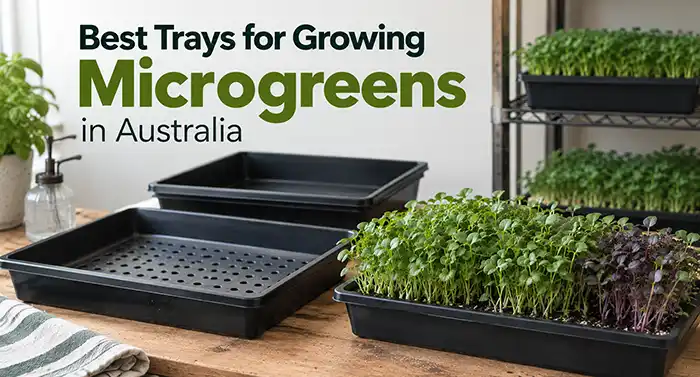
You don’t need specialised equipment to grow microgreens, but choosing the right tray makes sowing, watering, stacking and harvesting considerably easier.
The complication for Australian growers is that much of the information online assumes you are using an American 1020 tray. In Australia, 30 × 35 cm propagation trays, half trays and larger Australian commercial trays are also common.
This matters particularly when calculating how much seed to sow. A seeding rate of “30 grams per tray” is meaningless unless you know the size of the tray.
What Makes a Good Microgreen Tray?
Good DrainageThe growing tray should allow excess water to drain and enable bottom watering.
Suitable DepthMicrogreens generally don’t require the depth needed for mature vegetables and seedlings.
Strong ConstructionA wet tray containing growing medium and a mature crop can become surprisingly heavy.
Easy to CleanReusable trays should tolerate regular washing between crops without cracking or warping.
Microgreen Tray Sizes in Australia
There is no single standard microgreen tray size used throughout Australia.
The American 1020 tray is common in commercial microgreen information and increasingly available here, but Australian propagation trays and locally manufactured commercial systems use different dimensions.
| Tray Type | Approximate Size | Best For | Notes |
|---|---|---|---|
| Seedmart Standard Tray | 30 × 35 cm | Home and small commercial growing | A practical Australian propagation-tray format and the main reference size used in our seeding-density chart. |
| Seedmart Half Tray | 33 × 14 × 5.5 cm | Small batches and testing varieties | Two fit inside a standard 30 × 35 cm tray. |
| 1010 Tray | Approx. 27 × 26 cm externally | Small batches and multiple varieties | Approximately half the footprint of a 1020. Two are designed to fit within a 1020 tray. |
| 1020 Tray | Nominally 10 × 20 inches | Commercial and standardised production | The most common reference tray in North American microgreen growing information. |
| Curly’s Ag Commercial Tray | 58.8 × 31.2 cm externally | Australian commercial production | A larger Australian-made commercial tray with an internal growing area of approximately 55.7 × 27.8 cm. |
| Small Home Trays | Varies | Kitchen and beginner growing | Useful for small harvests, but calculate seed according to actual growing area rather than copying a full-tray rate. |
What Is a 1020 Microgreen Tray?
A 1020 is a rectangular propagation tray measuring approximately 10 × 20 inches, although its exact dimensions vary slightly between manufacturers.
It has become a de facto reference size in North American microgreen production, so many online growing guides quote their seeding rates as grams per 1020 tray.
For example, Bootstrap Farmer’s shallow 1020 tray measures approximately 21 × 10.75 inches externally, with an internal bottom area of approximately 19.75 × 9.5 inches.
That distinction between nominal size, external dimensions and internal growing dimensions is important when comparing trays precisely.
What Is a 1010 Tray?
A 1010 tray is approximately half the footprint of a 1020.
Bootstrap Farmer’s shallow 1010, for example, measures approximately 10.635 × 10.385 inches externally. Two are designed to fit into a standard 1020 tray.
1010 trays are useful when you want to:
- grow smaller quantities
- test new varieties
- grow two different crops in the footprint of one 1020
- reduce waste
- harvest smaller batches more frequently
They can also be easier to handle than a full commercial tray.
Australian 30 × 35 cm Microgreen Trays
Seedmart’s standard growing tray is approximately 30 × 35 cm. It has a smaller growing footprint than a nominal 1020 tray, which is why a seeding rate quoted for a 1020 should not simply be copied into a 30 × 35 cm tray.
This is the tray size used as the main Australian reference in our Microgreen Seeding Density Chart.
For growers who need smaller batches, our 33 × 14 cm half trays allow two varieties to be grown within approximately the same footprint as a standard tray.
Australian Commercial Microgreen Trays
Commercial growers are not limited to the American 1020 format.
Australian manufacturer Curly’s Ag, for example, produces a larger microgreen tray measuring approximately 58.8 × 31.2 × 3.7 cm externally, with internal dimensions of approximately 55.7 × 27.8 × 3 cm.
This gives it a larger growing area than a standard 1020.
That is another reason commercial growers should calculate seeding rates by growing area rather than assuming every tray uses the same quantity of seed.
Shallow vs Deep Microgreen Trays
Microgreens are harvested while young, so most crops do not require the deep root volume needed by vegetables that will grow for months.
Shallow Trays
Shallow trays are generally the most efficient choice for microgreens.
- Use less growing medium
- Reduce media cost per crop
- Make harvesting close to the base easier
- Take up less vertical space
- Work well on multi-level racks
Deeper Trays
A deeper tray can still be useful where you want more growing medium or greater moisture buffering.
- More growing-medium volume
- Can retain moisture for longer
- Useful for some larger crops
- May provide more support around tray edges
Commercial shallow 1020 microgreen trays are commonly around 1–1.25 inches deep, while conventional propagation trays are often around 2.5 inches deep.
Neither automatically produces better microgreens. The main advantage of shallow trays is efficiency.
Do Microgreen Trays Need Drainage Holes?
For a conventional soil, coir or similar growing-medium system, we recommend using a growing tray with drainage holes.
Drainage holes perform two jobs:
- allow excess water to escape, and
- allow water from a lower tray to enter the growing medium during bottom watering.
The simplest setup therefore uses two trays.
With HolesContains the growing medium, seed, roots and microgreen crop.
Without HolesContains water when the crop is bottom watered.
Add From BelowOnce established, water is added to the lower tray rather than poured across the canopy.
Absorb MoistureWater moves into the growing medium through the drainage holes.
For more detail, see our Microgreen Watering Guide.
Why Use Two Trays?
Using a perforated growing tray inside a solid tray makes microgreen production much easier.
During germination, the growing tray can be lifted out when it needs inspecting. Once roots are established, the lower tray becomes a reservoir for bottom watering.
The solid tray also catches drainage and helps keep benches and growing racks cleaner.
What About Mesh-Bottom Microgreen Trays?
Some commercial trays replace a smaller number of drainage holes with a mesh or heavily perforated base.
This provides excellent drainage and allows water to reach the root zone easily. Mesh trays can also suit flood-and-drain systems.
They are particularly common for larger-seeded crops and production systems where rapid drainage is useful.
They are not essential for growing good microgreens. A conventional tray with well-distributed drainage holes works perfectly well for most home and small commercial growers.
Should You Use Shallow Trays for Peas and Sunflower?
You can, but peas and sunflower are larger crops with vigorous root systems and heavier canopies.
Some growers prefer deeper trays for these crops because the extra growing-medium volume provides more moisture capacity and physical support.
Bootstrap Farmer, for example, recommends shallow trays for most microgreens but notes that deeper 2.5-inch trays can be useful for taller crops including pea shoots and sunflower.
This is a production choice rather than an absolute requirement.
Tray Strength Matters More Than It Seems
A dry empty tray weighs very little. A tray filled with moist growing medium and a mature crop is completely different.
Cheap, thin propagation trays can:
- flex when lifted
- twist
- crack around the edges
- split around drainage holes
- become difficult to carry when wet
For someone growing one or two trays occasionally, inexpensive trays may be adequate.
For commercial production, tray durability becomes much more important because the same tray is repeatedly filled, stacked, watered, harvested, washed and reused.
Tray Strength and Commercial Growing
Commercial growers should think about cost per use, not just purchase price.
A more expensive tray that survives repeated production cycles may be cheaper in the long term than a thin tray that regularly cracks and needs replacing.
Strong trays are also easier to handle when loaded. Curly’s Ag, for example, rates its reinforced Australian commercial tray to handle loads up to 21 kg without buckling, while heavy-duty 1020 manufacturers similarly design their trays to resist folding when filled with wet media.
Matching Trays for Weighting and Blackout
Matching trays are particularly useful during germination.
A second tray of the same dimensions can be placed directly over the seed and used for weighting or stacking. Later, a tray can be inverted over the seedlings to provide an unweighted blackout period where required.
Trays that fit together consistently make this process much easier than trying to combine unrelated containers.
See our Weighting & Blackout Guide for crop-specific advice.
Does Tray Colour Matter?
Tray colour is generally much less important than drainage, dimensions, strength and growing conditions.
Black trays are common because they are widely available, block light from the root zone and are easy to integrate into commercial growing systems.
Other colours can also be used successfully.
Some commercial growers use different colours to identify crops, sowing dates or customers, but colour coding is an organisational choice rather than a requirement for healthy microgreens.
Clear Trays
Clear trays can be useful where you want to observe moisture or root development, but they allow light into the root zone.
For routine production, an opaque growing tray is generally simpler.
A clear container can still be useful for demonstrations, experiments or monitoring root growth.
Can You Use Food Containers to Grow Microgreens?
Yes. Small food-safe containers can be adapted for home microgreen growing, provided they are clean and you can create adequate drainage.
This can be useful when experimenting with microgreens before buying a dedicated setup.
However, improvised containers become less convenient as production increases. Standardised trays are easier to:
- stack
- bottom water
- fit under grow lights
- calculate seeding rates for
- move around a growing area
- clean consistently
Best Tray Size for Beginners
A beginner does not necessarily need a full commercial 1020 tray.
Smaller trays have several advantages while you are learning:
- less seed is required
- less growing medium is wasted if something goes wrong
- different varieties can be tested simultaneously
- trays are easier to move and water
- you don’t have to harvest a large quantity at once
A half tray or similar small format is therefore a sensible way to start.
Best Tray Size for Commercial Microgreens
Commercial growers benefit from standardisation.
The best tray is not necessarily the one with the largest growing area. It is the tray that works efficiently with the rest of your production system.
Consider:
- rack dimensions
- number of trays per shelf
- grow-light coverage
- watering method
- seeding equipment
- stacking method
- harvesting workflow
- washing facilities
- how much weight staff can comfortably handle
How Tray Size Affects Seeding Density
Seed requirements should increase or decrease with the usable growing area of the tray.
For example, if a crop uses 30 g of seed in one tray size, that does not mean it should use 30 g in every tray described as a “microgreen tray”.
This is particularly important when converting American 1020 growing instructions to Australian trays.
Our Microgreen Seeding Density Chart for Australian Tray Sizes compares rates for:
- 30 × 35 cm trays
- 1010 trays
- 1020 trays
- Curly’s Ag commercial trays
- smaller home-growing trays
How Tray Depth Affects Watering
Tray depth and growing-medium depth influence how quickly the root zone dries.
A shallow layer of growing medium holds less total water and can therefore dry relatively quickly under warm, dry conditions.
A deeper layer contains a larger moisture reserve but can also remain wet for longer if it is overwatered.
This is another reason not to water microgreens according to a fixed timetable.
Check the growing medium and tray weight before adding water.
Cleaning and Reusing Microgreen Trays
Reusable trays should be cleaned between crops.
After harvesting:
- Remove the root mat and remaining growing medium.
- Remove loose roots and plant material.
- Wash the tray thoroughly.
- Rinse away remaining debris and cleaning residue.
- Allow the tray to dry before storing or reusing it.
Commercial growers should develop a consistent cleaning process appropriate to their production and food-safety requirements.
Durable trays make this easier because they can tolerate repeated washing without splitting or deforming.
How Many Microgreen Trays Do You Need?
For home growing, two or three growing trays plus matching bottom trays can be enough to maintain a regular supply.
Commercial requirements depend on your harvest cycle.
If you sow every day, you need enough trays to cover:
- germination
- blackout where applicable
- growth under lights
- harvest
- cleaning and drying
Always allow spare trays. A commercial system that requires every tray to be in use at all times leaves little room for cleaning, damaged trays or changes in production.
Microgreen Tray Comparison: Quick Guide
| If You Want… | Consider… | Why |
|---|---|---|
| Small home harvests | Half trays or small home trays | Lower seed use and easier handling. |
| Several varieties at once | Half trays or 1010 trays | Separate crops without using an entire large tray. |
| Standard commercial system | 1020 or another standardised commercial tray | Easier to build repeatable seeding, rack and watering systems. |
| Australian commercial production | Australian-made commercial tray systems | Can suit locally available racks, equipment and supply chains. |
| Minimum growing-medium use | Shallow trays | Less medium is required and harvesting is easier. |
| Peas or sunflower with more media | Deeper trays | Provides additional medium volume and support. |
| Bottom watering | Tray with holes + matching solid tray | Allows water to enter the root zone from below. |
| Flood-and-drain production | Perforated or mesh commercial trays | Allows rapid movement and drainage of irrigation water. |
Frequently Asked Questions
What size tray is best for microgreens?
There is no single best size. Smaller trays are convenient for home growers, while standardised larger trays are generally more efficient for commercial production.
What is a 1020 microgreen tray?
A 1020 is a propagation tray nominally around 10 × 20 inches. Exact external and internal dimensions vary slightly between manufacturers.
Is a 1010 tray half a 1020?
Approximately, yes. A 1010 has roughly half the footprint of a 1020, and purpose-designed systems allow two 1010 trays to fit inside a 1020.
Do microgreen trays need holes?
For conventional growing-medium production, we recommend a growing tray with drainage holes nested inside a solid tray without holes. This provides drainage and allows bottom watering.
How deep should a microgreen tray be?
Most microgreens grow well in relatively shallow trays. Commercial shallow microgreen trays are often around 25–32 mm deep. Deeper trays can be useful where more growing medium or support is wanted.
Can I use seedling trays for microgreens?
Yes. Suitable seedling and propagation trays can work very well for microgreens, provided they have adequate growing area, drainage and sufficient strength.
Do I need two trays for microgreens?
Two trays make the process easier. Use a perforated tray for growing and a solid tray underneath for bottom watering and catching drainage.
Are shallow trays better for microgreens?
For most crops, shallow trays are efficient because microgreens are harvested young and do not require a large root volume. They also use less growing medium and make harvesting easier.
Can microgreen trays be reused?
Yes. Good-quality reusable trays can be washed and reused for many growing cycles. Clean them thoroughly between crops and replace damaged or badly degraded trays.
Does tray size change how much seed I need?
Yes. Seed quantity should be adjusted according to usable growing area and the crop being grown. Do not use a 1020 seeding rate unchanged in a substantially smaller tray.
Continue With the Microgreen Growing Guides
Microgreen Seeds for Home & Commercial Growers
Seedmart Australia supplies microgreen seed in pack sizes for home growers, market gardeners and commercial microgreen production.