
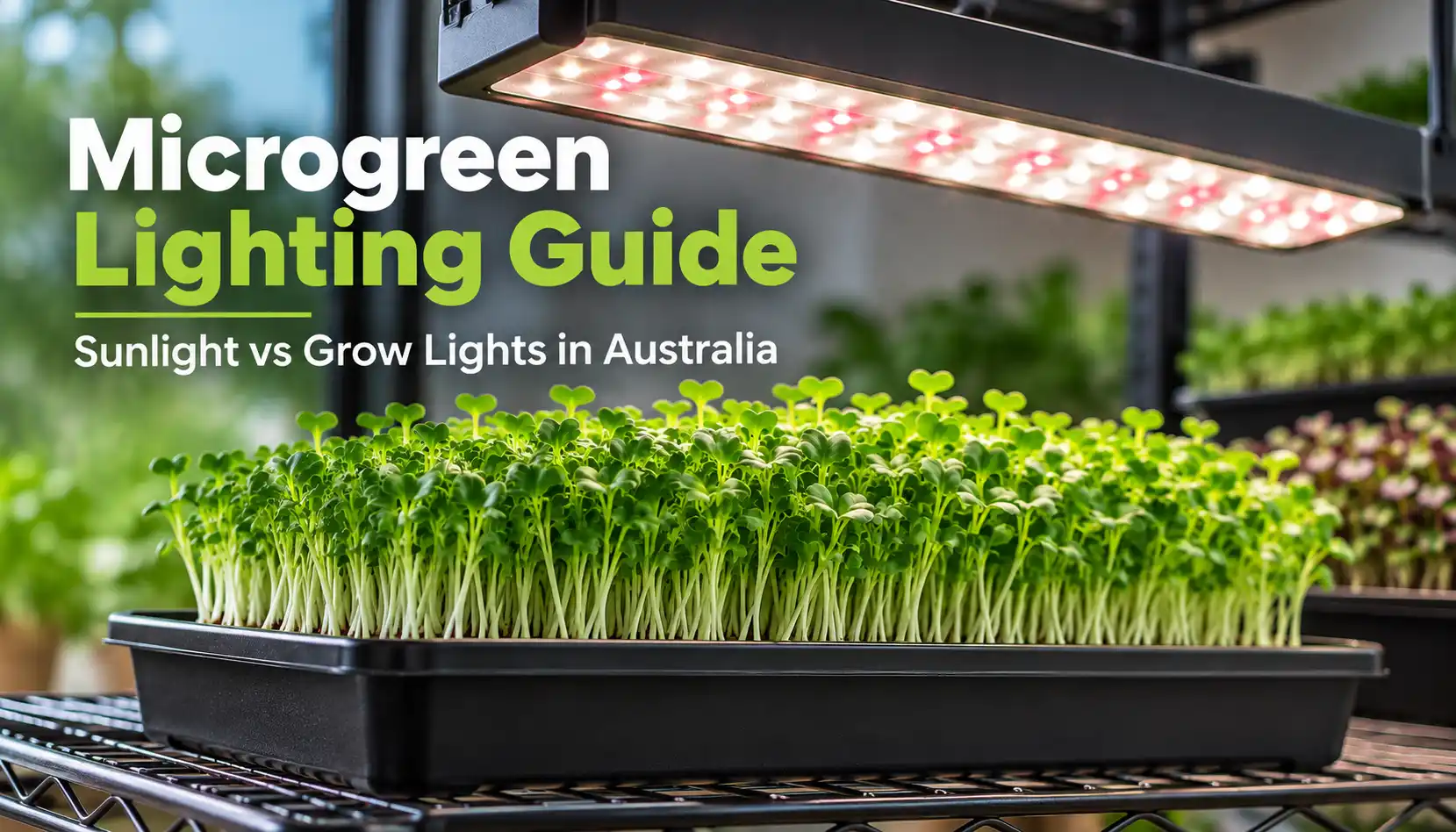
Once microgreens have finished germinating and come out of blackout, they need adequate light to develop green leaves, strong stems and compact growth.
Microgreens can be grown with natural sunlight, artificial grow lights or a combination of both. The best option depends on where you are growing, the season and how consistent you need your crop to be.
When Do Microgreens Need Light?
Most microgreens do not need light while the seed is initially germinating.
Depending on the crop, trays may first spend several days covered, weighted or in blackout. Once that stage is complete, the seedlings are exposed to light.
SowSow seed onto moist growing medium at the appropriate density.
GerminateKeep the crop covered, weighted or stacked as appropriate for the variety.
Optional BlackoutSome crops benefit from additional unweighted darkness after germination.
LightRemove the cover and expose the established seedlings to adequate light.
If seedlings are yellow or pale when they first come out of blackout, this is usually normal. Once exposed to light, they begin producing chlorophyll and generally green up quickly.
See our Weighting & Blackout Guide for more information about when different crops should come out of darkness.
How Much Light Do Microgreens Need?
There are two parts to this question:
- Light intensity – how much useful light reaches the crop at a given moment.
- Photoperiod – how many hours of light the crop receives each day.
These work together. A weak light running for many hours is not necessarily equivalent to an appropriately positioned grow light, while very intense light does not need to run continuously.
For home growers using artificial lighting, around 14–16 hours of light per day is a useful starting point.
Commercial growers should pay more attention to measured light intensity and Daily Light Integral rather than relying only on hours.
What Are PPFD and DLI?
If you are growing microgreens commercially or setting up a larger indoor growing rack, you will frequently encounter the terms PPFD and DLI.
PPFD
Photosynthetic Photon Flux Density measures the amount of photosynthetically active light reaching a surface each second.
It is normally expressed as:
µmol/m²/s
In practical terms, it tells you how intense the useful plant light is at crop level.
DLI
Daily Light Integral measures the total amount of photosynthetically active light the crop receives over the entire day.
It is normally expressed as:
mol/m²/day
DLI therefore combines light intensity with the number of hours the lights operate.
Recent controlled-environment guidance suggests a broad DLI range of approximately 9–16 mol/m²/day for microgreens, although requirements and responses differ between species.
How Many Hours of Light Do Microgreens Need?
A photoperiod of around 14–16 hours per day is a good general starting point under grow lights.
Research on cabbage and Chinese kale microgreens found that 14 hours produced the greatest fresh and dry weight in those particular trials, while chlorophyll, carotenoid and soluble protein levels were highest with 16 hours of light.
This doesn’t mean every microgreen must receive exactly 14 or 16 hours. Crop variety, light intensity and growing conditions all affect the result.
Do Microgreens Need Light 24 Hours a Day?
No. Continuous 24-hour lighting is not necessary for normal home microgreen production.
There is research showing that some microgreen crops can be successfully produced under continuous artificial lighting, and it may have applications in controlled commercial production where growers are optimising light intensity, electricity use and yield.
That does not make 24-hour lighting the default recommendation for a home grower.
A conventional light/dark cycle of around 14–16 hours of light followed by darkness is simpler and works well for general microgreen production.
Can You Grow Microgreens With Sunlight?
Yes. Microgreens can grow very well with natural light.
The difficulty is not that sunlight is unsuitable. It is that natural light is less consistent than artificial lighting.
The amount of light reaching your crop changes according to:
- season
- latitude
- cloud cover
- window direction
- buildings and trees
- distance from the window
- glass and screening
- time of day
This is particularly relevant in Australia because seasonal solar exposure differs substantially between northern, central and southern parts of the country.
Sunlight vs Grow Lights
Natural Sunlight
Advantages
- No electricity required
- Excellent light spectrum
- Simple for small-scale growing
- Can work very well in a bright position
Limitations
- Changes through the year
- Uneven light from one direction
- Cloudy weather reduces available light
- Direct sun through glass can create heat
- Difficult to standardise commercial production
LED Grow Lights
Advantages
- Consistent from day to day
- Easy to control with a timer
- Suitable for growing racks
- Can provide even light across trays
- Independent of weather and season
Limitations
- Initial equipment cost
- Electricity use
- Poor positioning can cause uneven growth
- Very powerful lights can add unwanted heat
Can Microgreens Grow on a Windowsill?
Yes, but a windowsill is not automatically a good growing position simply because it looks bright to us.
Human eyes adapt extremely well to different light levels. A room that appears brightly lit can still provide relatively little useful light to a plant.
A good window position should produce reasonably compact, upright microgreens without the crop leaning strongly towards the glass.
If the seedlings become tall, weak and strongly angled towards the window, they probably need more or more evenly distributed light.
Australian Sunlight: Summer vs Winter
Natural light changes substantially through the Australian year.
The Bureau of Meteorology’s solar exposure data shows generally higher annual solar exposure through central and northern Australia, while southern coastal areas receive less. The seasonal difference becomes particularly pronounced in winter, when the sun is lower in the sky further south.
SummerNatural light is abundant in much of Australia. The bigger problem can be excessive heat and intense direct sun, particularly near north- and west-facing glass.
AutumnLight levels begin declining and growers relying on windows may notice slower or more directional growth.
WinterNatural light becomes more limiting, particularly in southern Australia. Supplemental lighting becomes considerably more useful.
SpringIncreasing day length and solar intensity improve natural growing conditions, but monitor trays as warmer conditions return.
Lighting Microgreens in Different Parts of Australia
VictoriaGreater seasonal variation and lower winter solar exposure.TasmaniaLower winter sun angle and shorter winter days make natural indoor lighting more limiting.Western AustraliaConditions vary enormously, with strong solar exposure and hot summers across many areas.
| Region | Natural Light Considerations | Practical Approach |
|---|---|---|
| Queensland | Strong natural light is available for much of the year, but summer heat can be substantial. | A bright position can work well. Protect trays from excessive direct afternoon sun and heat through glass. |
| NSW & ACT | Good natural light is possible, with greater seasonal variation inland and further south. | Natural light may be sufficient in a suitable position, while supplemental LEDs improve winter consistency. |
| Grow lights are useful for reliable year-round indoor production, particularly in winter. | ||
| Supplemental lighting is particularly useful for consistent winter crops. | ||
| South Australia | Abundant light but very hot summer conditions can cause overheating near windows. | Use bright indirect light or controlled LEDs during periods of extreme heat. |
| Avoid excessive heat at windows and use artificial lighting where greater consistency is required. | ||
| Northern Territory & Tropical North | High solar exposure overall, although wet-season cloud cover can reduce available sunlight. | Heat management, airflow and consistency may be more important than simply seeking maximum sunlight. |
Direct Sunlight or Indirect Light?
Microgreens do not need to bake in direct Australian summer sun to grow well.
Bright natural light can be excellent, but intense sunlight through glass can raise the temperature around a shallow tray surprisingly quickly. The combination of strong sunlight, warm glass and a small volume of growing medium can also increase water demand.
If you use natural light, watch the crop during the hottest part of the day rather than checking only in the morning.
Signs that the position may be too hot include:
- rapid wilting
- dry tray edges
- leaves curling or becoming stressed
- growing medium drying extremely quickly
- one side of the tray deteriorating faster than the other
Move the tray back from the glass, provide filtered light or use grow lights if heat becomes difficult to manage.
What Type of Grow Light Is Best for Microgreens?
Modern LED grow lights are generally the most practical option for indoor microgreens.
You do not necessarily need a specialised purple-looking horticultural light. A good-quality broad-spectrum or white LED designed to provide adequate plant light can work well.
For most home growers, even coverage across the tray is more important than chasing a particular colour of light.
What Colour Light Do Microgreens Need?
Plants use wavelengths across the photosynthetically active range, with red and blue light playing particularly important roles in photosynthesis and plant development.
Research has shown that changing the spectrum can alter microgreen growth, colour and phytochemical composition. However, the response varies between species.
For a home grower, a balanced white or full-spectrum LED is usually the simplest solution. Commercial growers may have reasons to manipulate spectrum more precisely, but it is not necessary to make microgreen production complicated.
How Far Should Grow Lights Be From Microgreens?
There is no universal distance because LED fixtures vary enormously in power, optics and design.
A small LED bar may need to be relatively close to the canopy. A powerful horticultural fixture may need to be much further away.
This is why instructions such as “always keep the light 20 cm above the crop” are unreliable.
Instead, look at:
- the manufacturer’s recommended hanging height
- PPFD at crop level if measurements are available
- how evenly the light covers the tray
- how the seedlings respond
- whether the fixture adds excessive heat
Signs Microgreens Need More Light
Tall, Thin Seedlings
Seedlings stretch when they are searching for adequate light. Increase usable light at crop level.
Crop Leaning to One Side
This commonly occurs near windows where most of the light arrives from one direction.
Persistent Pale Colour
Yellow seedlings immediately after blackout are normal, but they should begin colouring once adequately exposed to light.
Weak, Uneven Growth
Poor light distribution can produce strong growth directly under the fixture and weaker growth around the tray edges.
Can Microgreens Get Too Much Light?
Yes, although with indoor microgreen production the associated heat can sometimes be as important as the light itself.
Very intense light can produce shorter, more compact plants. Research on brassica microgreens has shown that increasing light intensity reduces hypocotyl — stem — length.
That can be useful up to a point, but more light is not automatically better. Higher-intensity lighting also consumes more electricity and may increase heat around the crop.
The objective is enough light to produce healthy, compact microgreens — not the highest intensity your equipment can generate.
Microgreen Lighting Problems: Quick Diagnosis
Crop leaning towards a windowDirectional lightRotate the tray regularly or provide overhead artificial light.Pale immediately after blackoutNormal lack of chlorophyll developmentMove into light and allow the crop to green.Dry or wilted window-side edgeHeat or intense direct sunMove the tray away from hot glass or provide filtered light.Strong centre growth, weak edgesPoor grow-light coverageImprove fixture positioning or use lighting that covers the full tray.
| What You See | Possible Cause | What to Do |
|---|---|---|
| Tall, thin stems | Insufficient light | Increase usable light at crop level or move the light closer if appropriate for the fixture. |
| Remains pale after exposure to light | Possibly inadequate light or another growing problem | Check light level as well as temperature, moisture and crop health. |
| Very short, compact crop | High light intensity may be contributing | Check intensity and fixture distance if more stem length is desired. |
Lighting a Commercial Microgreen Rack
Commercial growers need more consistency than someone producing one tray on a kitchen bench.
Each shelf should receive reasonably uniform light across the complete growing area. A rack that is bright in the centre but poorly lit around the edges will produce inconsistent trays.
For larger systems, it becomes worthwhile measuring PPFD at several points:
- centre of the shelf
- each end
- front and rear
- corners
- at actual canopy height
Virginia Tech’s controlled-environment guidance gives approximately 9–16 mol/m²/day DLI as a general microgreen range and reports using approximately 250 µmol/m²/s for 18 hours in its own system, producing a DLI of about 16.2 mol/m²/day.
This should be treated as useful commercial context rather than a mandatory specification for every species.
Should You Rotate Microgreen Trays?
If the light source is directional, rotating trays can help produce more even growth.
This is particularly useful on windowsills, where the crop will naturally lean towards the strongest light.
A properly designed overhead grow-light setup should reduce the need for rotation, although commercial growers should still check for uneven light distribution across racks.
Lighting and Watering Work Together
Changing light conditions can change water use.
A tray receiving stronger light and more heat may dry more rapidly than the same crop grown under cooler, lower-light conditions.
Do not increase watering automatically when you install a grow light. Check the growing medium and tray weight and adjust according to what actually happens.
See our Microgreen Watering Guide for detailed advice on misting, bottom watering and Australian growing conditions.
Frequently Asked Questions
Do microgreens need a grow light?
No. Microgreens can be grown using natural sunlight if the position provides enough usable light. Grow lights provide greater consistency and are particularly useful indoors, during winter and on multi-level growing racks.
How many hours of light should microgreens get?
Around 14–16 hours per day is a practical starting point under artificial lighting. The appropriate photoperiod also depends on light intensity and crop variety.
Can I leave microgreen lights on for 24 hours?
Microgreens can be grown under continuous lighting in controlled systems, but 24-hour lighting is not necessary for normal home production. A 14–16 hour photoperiod is a simpler starting point.
Can microgreens grow beside a window?
Yes, provided the window supplies adequate light. Watch for leaning, stretching and excessive heat from direct sunlight through glass.
Do microgreens need direct sunlight?
No. They need adequate usable light, but that does not have to mean intense direct sunlight. Bright natural light or suitable artificial lighting can both produce good crops.
Why are my microgreens tall and thin?
Insufficient light is one common cause. Excessive blackout can also produce elongated seedlings, so consider both the blackout period and the light available after the crop is uncovered.
Why are my microgreens yellow?
Microgreens are commonly yellow when first removed from blackout because they have not yet developed much chlorophyll. They should begin greening after exposure to adequate light.
What colour grow light should I use?
A good-quality white or broad-spectrum LED is a practical choice for most growers. Specialised red and blue spectra can influence growth and crop characteristics but are not essential for straightforward home production.
How close should LED lights be to microgreens?
There is no universal distance. Follow the fixture manufacturer’s recommendations and assess light intensity and coverage at crop level. The correct distance depends on the output and design of the light.
Continue With the Microgreen Growing Guides
Microgreen Seeds for Home & Commercial Growing
Seedmart Australia supplies microgreen seed in pack sizes suitable for home growers through to commercial production.