
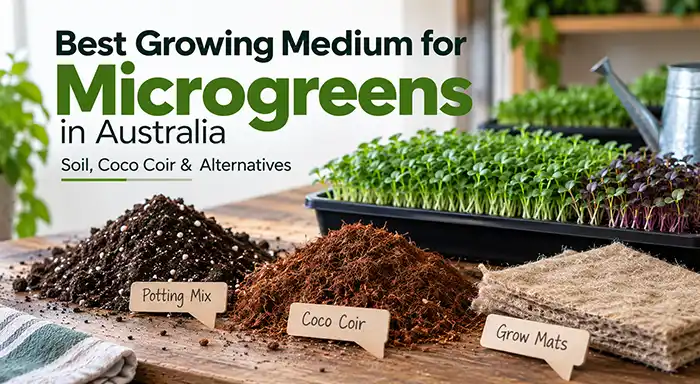
The growing medium beneath your microgreens has a bigger effect than it may appear. It holds water around the roots, provides physical support and influences drainage, aeration and how easily the finished crop can be harvested.
Microgreens can be grown successfully in several different media, including fine potting or propagation mixes, coco coir and fibrous growing mats. There is no single medium that is best for every crop or every growing system.
What Does Growing Medium Do?
Microgreens are harvested young, but they still develop a substantial root system during their short growing cycle.
A good growing medium should provide:
MoistureEnough water-holding capacity to prevent the young root zone from drying too quickly.
DrainageExcess water needs somewhere to go. Constantly saturated media can create poor growing conditions.
AirRoots need oxygen as well as moisture. A compacted, waterlogged medium reduces air around the roots.
SupportThe medium anchors seedlings as they germinate, establish roots and push upwards.
What Is the Best Growing Medium for Microgreens?
For general home production, there are three practical categories worth considering:
- fine potting, propagation or seed-raising media
- coco coir or coco peat
- fibrous growing mats
All can work. The better choice depends on what you are growing and how you want to manage the crop.
| Growing Medium | Water Retention | Drainage | Ease of Use | Best Suited To |
|---|---|---|---|---|
| Fine Potting / Propagation Mix | Good | Good if correctly formulated | Very easy | General-purpose growing and beginners |
| Coco Coir | Very good | Good | Easy | Home and commercial production |
| Grow Mats | Varies by material | Generally good | Clean and convenient | Soilless systems and selected crops |
| Perlite-Based Systems | Lower on its own | Excellent | More specialised | Hydroponic or controlled systems |
| Compost-Based Mixes | Varies | Varies | Requires more care | Experienced growers using a suitable formulated mix |
Potting Mix and Propagation Mix
A fine potting or propagation medium is one of the easiest ways to grow microgreens.
It tends to be forgiving because a well-formulated mix provides a balance of moisture retention, drainage and air space. It also gives roots a substantial medium to grow through and provides good physical support for larger crops.
For microgreens, look for a product that is:
- fine enough to create a reasonably level seed bed
- free draining
- able to retain moisture without becoming waterlogged
- reasonably uniform
- free of large pieces of bark, sticks or other coarse material
- intended for growing plants rather than being raw garden soil
Can You Use Seed-Raising Mix for Microgreens?
Yes. A suitable seed-raising or propagation mix can work very well for microgreens.
These products are generally designed to provide a fine structure for germinating seed and developing young roots, which also suits microgreen production.
The downside is cost. A premium seed-raising mix may be unnecessarily expensive when filling large numbers of commercial trays.
Home growers using only a few trays may value convenience more than the small difference in medium cost.
Can You Use Regular Potting Mix?
Yes, provided the mix has suitable physical characteristics.
A coarse mix containing large pieces of bark is harder to level and can produce an uneven seed bed. This matters particularly with small seeds such as broccoli, kale, mustard and amaranth.
If the surface is uneven, some seeds can sit in depressions while others remain high and dry. This makes uniform moisture and seed-to-medium contact harder to achieve.
A finer mix is therefore generally easier to work with.
Can You Use Garden Soil?
We don’t recommend ordinary garden soil as the default medium for indoor microgreens.
Garden soil can vary enormously in texture, drainage, organic matter, salinity and biological activity. It can also compact badly when placed in a shallow tray.
A formulated growing medium gives you much greater consistency from one tray to the next.
This becomes increasingly important as you scale production.
Coco Coir for Microgreens
Coco coir is made from coconut husk fibre and is widely used as a soilless growing medium.
It has become popular for microgreens because it is lightweight, relatively clean to handle and holds a substantial amount of moisture while still providing useful air space around the roots.
Advantages of Coco Coir
- Good moisture retention
- Lightweight
- Easy to store in compressed form
- Fine, even surface for sowing
- Works well with bottom watering
- Suitable for many microgreen crops
Limitations of Coco Coir
- Quality varies between products
- Some products may contain excessive salts
- Provides little nutrition on its own
- Compressed blocks need hydrating before use
- Commercial economics depend on landed cost and labour
Coco Coir vs Potting Mix
Neither medium automatically produces better microgreens.
Coco coir is attractive because it is relatively uniform and easy to handle. A good propagation or potting mix can provide more inherent nutrition and may be more forgiving with crops that remain in the tray longer.
Scientific trials have also shown that crop response varies. Different media can change yield, mineral composition and other crop characteristics, and the medium that performs well for one species does not necessarily produce the same result with another.
| Feature | Fine Potting / Propagation Mix | Coco Coir |
|---|---|---|
| Water retention | Good | Very good |
| Drainage | Depends on formulation | Generally good |
| Built-in nutrients | Often contains some | Very little |
| Weight | Heavier | Lightweight |
| Consistency | Depends on product | Usually consistent when using the same product |
| Mess | Moderate | Moderate |
| Small seeds | Very good if fine textured | Very good |
| Large seeds | Very good | Very good |
| Bottom watering | Yes | Yes |
Do You Need to Add Perlite?
Not necessarily.
Perlite is a lightweight mineral material commonly added to growing media to increase air space and drainage.
If your commercial potting or propagation medium already drains well, there is little reason to add perlite simply because a growing guide tells you to.
If you formulate your own medium, perlite can be useful for adjusting its physical properties.
Perlite can also be used more extensively in specialised hydroponic systems. Recent research with amaranth microgreens, for example, found strong establishment and yield in a perlite-based floating system, demonstrating that microgreens do not require conventional soil to grow successfully.
Growing Microgreens on Mats
Microgreen grow mats are thin fibrous sheets used instead of loose growing medium.
They can be made from materials such as:
- hemp fibre
- jute
- coconut fibre
- wood fibre
- other natural or manufactured fibres
Mats are particularly attractive where clean handling and fast tray preparation are priorities.
Advantages of Grow Mats
- Fast tray preparation
- No loose potting medium
- Consistent thickness
- Easy storage
- Cleaner harvest area
- Useful in soilless production
Limitations of Grow Mats
- Can cost more per tray
- Water-holding capacity varies
- Some crops perform better than others
- May require more precise watering
- Little or no nutrient reserve
Silicone Mesh Grow Mats for Microgreens
Silicone mesh grow mats are another option for growing microgreens without soil or loose growing medium.
Unlike hemp, jute, coconut fibre and other absorbent grow mats, a silicone mesh mat does not act as a conventional growing medium. Instead, it provides a reusable surface that supports the seed and developing roots while allowing water to move freely through the mesh.
The mat normally sits inside a tray, with the roots growing through and around the mesh as the crop establishes.
Advantages of Silicone Mesh Mats
- Reusable for many growing cycles
- No loose potting mix or coco coir
- Easy to lift from the tray
- Allows roots to grow through the mesh
- Good drainage
- Can be washed between crops
- Reduces ongoing growing-medium waste
- Useful for soilless and hydroponic-style growing
Limitations of Silicone Mesh Mats
- Does not hold water like coco coir or fibre mats
- Requires more careful moisture management during germination
- Roots depend heavily on water available beneath the mat
- Some very small seeds may be less convenient to grow on coarse mesh
- Crop performance can vary by species
- Needs thorough cleaning between crops
How Do Silicone Mesh Mats Work?
Silicone mesh mats are generally placed in a shallow growing tray and moistened before seed is spread across the surface.
During germination, the main challenge is keeping the seed consistently moist. Silicone itself does not provide the same moisture reserve as coco coir, potting mix or an absorbent fibre mat.
Once roots have developed through the mesh, they can access water beneath the mat. This makes silicone mesh particularly suited to systems where the grower can maintain a controlled water level or irrigate regularly from below.
Which Microgreens Can Be Grown on Silicone Mesh?
Silicone mesh can work well with a range of microgreens, particularly crops that develop vigorous roots and establish quickly.
Results depend on the size of the mesh openings, seed size and growing system. Larger and medium-sized seeds are generally easier to manage than extremely fine seed on a relatively coarse mesh.
If you are changing from coco coir or potting mix to silicone mesh, don’t assume that the same watering routine will work. The lack of an absorbent root-zone medium substantially changes how quickly moisture is available to the seed and roots.
Silicone Mesh vs Fibre Grow Mats
| Feature | Silicone Mesh | Hemp / Jute / Fibre Mat |
|---|---|---|
| Reusable | Yes | Generally no |
| Water retention | Very low | Moderate to high, depending on material |
| Root support | Yes | Yes |
| Loose growing medium | No | No |
| Roots can grow through | Yes | Yes |
| Cleaning required | After every crop | Usually discarded or composted after use where appropriate |
| Ongoing medium cost | Low after initial purchase | New mat required for each crop |
| Moisture management | More precise | More forgiving |
Are Silicone Mesh Mats Better Than Soil or Coco Coir?
They solve a different problem.
Potting mix and coco coir provide both physical support and a moisture-holding root zone. Silicone mesh provides support but very little moisture storage.
For a beginner, coco coir or a suitable propagation mix is generally more forgiving. For an experienced grower who wants to eliminate disposable growing media, reduce waste and operate a controlled soilless system, reusable silicone mesh can be worth considering.
Commercial growers should compare the cost of the mats and cleaning labour against the recurring cost, storage, handling and disposal of loose or disposable growing media.
Are Grow Mats Better Than Coco Coir?
Not universally.
A mat provides convenience and consistency, while coco coir provides a deeper moisture-holding root zone.
The economics also change with scale. A commercial grower should calculate the actual cost per harvested tray, including:
- medium purchase price
- freight
- storage space
- preparation time
- watering requirements
- crop yield
- clean-up labour
A medium that costs slightly more but saves significant labour may still make commercial sense.
Do Microgreens Need Fertiliser?
Many fast-growing microgreens can produce a harvest without additional fertiliser, particularly when grown in a nutrient-containing medium.
The seed itself contains stored energy and nutrients that support early growth.
However, that does not mean fertiliser can never improve microgreen production. The response depends on the crop, medium, production period and nutrient status of the root zone.
Research in controlled soilless production has found that nutrient solutions can increase yield in some combinations of crops and substrates.
Do Coco Coir Microgreens Need Nutrients?
Not necessarily for every crop.
Coco coir contains very little plant nutrition compared with many potting mixes, but microgreens are harvested early and can rely substantially on reserves within the seed.
Fast crops such as radish and many brassicas can therefore be grown successfully in coir using water alone.
Longer-growing crops or commercial growers seeking maximum and highly repeatable yield may benefit from testing an appropriate nutrient program rather than assuming either that fertiliser is essential or that it never helps.
How Deep Should the Growing Medium Be?
Microgreens generally do not need a tray filled to its full depth.
For many crops, approximately 2–4 cm of growing medium is a useful starting point.
The exact depth depends on:
- crop
- tray depth
- medium
- watering method
- temperature
- length of the growing cycle
Small, fast-growing brassicas generally need less root volume than vigorous crops such as peas and sunflower.
How to Fill a Microgreen Tray
Add MediumPlace an even layer of growing medium across the tray.
Level ItSpread the medium into the corners and create a reasonably flat sowing surface.
Firm LightlyGently firm the surface without heavily compacting the root zone.
MoistenBring the medium to an even moisture level before or immediately after sowing.
A flat surface becomes particularly important at high seeding densities because it helps the crop germinate at a similar height across the tray.
Should You Compress the Growing Medium?
Lightly firming the medium is useful. Crushing it into a dense, compact layer is not.
You want enough contact that seeds do not disappear into large air pockets, while maintaining enough pore space for water and oxygen to move through the root zone.
After sowing, crops that benefit from weighting or stacking receive additional pressure during germination.
See our Microgreen Weighting & Blackout Guide for details.
Best Medium for Broccoli, Kale and Radish
Fast-growing brassica microgreens such as broccoli, kale and radish are relatively adaptable.
Good options include:
- fine propagation mix
- fine potting mix
- coco coir
- suitable microgreen mats
Because these crops develop quickly, elaborate fertiliser programs are generally unnecessary for a basic home crop.
The more important factors are even sowing, good seed-to-medium contact and consistent moisture.
Best Medium for Pea Microgreens
Peas produce a vigorous root system and a relatively heavy crop.
A loose growing medium such as coco coir or a suitable propagation/potting mix works well because it gives the roots room to establish and holds moisture between waterings.
Peas can also be grown in soilless systems, but a substantial loose medium is forgiving for home growers.
Because pea seed is large and the crop develops considerable biomass, adequate medium moisture becomes increasingly important as harvest approaches.
Best Medium for Sunflower Microgreens
Sunflower is another large-seeded crop with vigorous roots.
Fine potting/propagation mixes and coco coir are both practical options.
Research comparing alternative substrates has demonstrated that sunflower performance can vary substantially with medium composition. In one trial, a mixture of coconut coir dust and leaf compost produced a higher sunflower yield than the peat-based control.
This illustrates an important point: there is no universal recipe that performs identically across all crops.
Best Medium for Amaranth and Other Fine Seeds
Very small seeds benefit from a fine, even surface.
Amaranth, basil and other small-seeded microgreens can be difficult to establish evenly on a coarse medium because seed falls into gaps between large particles.
Coco coir or a fine propagation medium can make uniform sowing easier.
Avoid burying tiny seeds deeply. They generally need good surface contact rather than a thick covering of growing medium.
Can You Add Compost?
Yes, but compost should not automatically be treated as better because it contains more nutrients.
Compost varies greatly according to its source and processing. Electrical conductivity, salt content, particle size, maturity and nutrient concentration can all affect young seedlings.
Research comparing compost-based substrates for pea and radish microgreens found that some compost-containing mixtures performed well, while spent mushroom compost with high electrical conductivity and salt concentration reduced germination and crop performance.
For this reason, a tested, consistent mix is preferable to adding an arbitrary amount of compost to every tray.
Can You Make Your Own Microgreen Mix?
Yes. Experienced growers can formulate a medium using materials such as coco coir, compost, perlite and other horticultural components.
The objective is not to create the richest possible soil.
You are trying to produce a repeatable medium with:
- good water-holding capacity
- adequate drainage
- adequate air space
- appropriate salinity
- fine enough texture for sowing
- consistent performance from batch to batch
For a home grower, buying a suitable ready-made medium is usually easier than formulating one.
Can You Reuse Microgreen Growing Medium?
We don’t recommend simply sowing another commercial microgreen crop directly into a used root mat.
After harvest, the medium contains a dense network of roots, stem material and undeveloped seeds. Its physical structure and moisture behaviour have also changed.
For home growers, used organic growing medium can often be added to an appropriate composting system or reused elsewhere in the garden rather than immediately resown as another microgreen tray.
Commercial growers should incorporate disposal or recycling into their production workflow.
Growing Medium and Mould
The growing medium is often blamed when mould appears, but mould problems usually involve several interacting factors.
These can include:
- excess water
- very high seeding density
- poor airflow
- high humidity
- damaged or decaying seed
- excessively long covered periods
- organic debris remaining around the crop
A medium that remains saturated for long periods can contribute to poor conditions, but changing media will not compensate for chronic overwatering.
See our Microgreen Watering Guide for more information.
Growing Medium in Hot Australian Conditions
Australian conditions make moisture management particularly important.
In a hot, dry environment, a very shallow layer of medium can lose moisture quickly. Coco coir’s water-holding capacity or a slightly deeper layer of loose medium may make management easier.
In warm, humid conditions, the problem can be the opposite. Covered trays may remain moist for longer, and unnecessary watering can keep the root zone excessively wet.
Hot & Dry
Check shallow trays more frequently. Medium depth and water-holding capacity become more important as evaporation increases.
Warm & Humid
Don’t assume the tray needs water simply because a schedule says so. Check the actual medium before adding more.
The conditions in your grow room are ultimately more important than your postcode.
Growing Medium and Bottom Watering
Once microgreen roots are established, bottom watering is generally preferable to repeatedly wetting the canopy.
A perforated growing tray is placed inside a solid tray, and water is added underneath.
The growing medium then absorbs moisture from below.
Both coco coir and conventional loose propagation media work well with this method.
For the complete setup, see our Best Trays for Growing Microgreens in Australia guide.
How Much Growing Medium Do Commercial Growers Need?
For commercial production, medium depth becomes an economic calculation.
Using even a small amount of unnecessary medium across hundreds of trays per week increases:
- material cost
- freight and storage requirements
- tray weight
- waste volume
- handling time
Rather than automatically filling trays to the top, commercial growers should test the minimum depth that consistently produces the required crop quality and yield.
Record the volume of medium used per tray so that it becomes a measurable production input, just like seed.
Growing Medium Comparison: Quick Guide
| If You Want… | Consider… | Why |
|---|---|---|
| The easiest place to start | Fine propagation or potting mix | Forgiving moisture and root-zone characteristics. |
| A lightweight soilless medium | Coco coir | Good water retention and easy handling. |
| A clean, pre-cut system | Grow mats | Fast preparation and no loose medium. |
| Small-seeded crops | Fine mix or coco coir | Provides a level surface for even seed contact. |
| Peas and sunflower | Loose mix or coco coir | Provides a substantial root zone and good moisture reserve. |
| Commercial production | Test several media | Compare yield, cost, labour and consistency rather than purchase price alone. |
| Hydroponic production | Mats or specialist soilless media | Can integrate with controlled irrigation and nutrient systems. |
Frequently Asked Questions
What is the best growing medium for microgreens?
A fine, free-draining propagation or potting medium and coco coir are both excellent general-purpose choices. The best option depends on the crop, watering system, cost and scale of production.
Can I grow microgreens in coco coir?
Yes. Coco coir is widely used for microgreens because it retains moisture while providing a suitable root environment. Choose a good-quality horticultural product.
Can I use potting mix for microgreens?
Yes. A fine-textured, free-draining potting mix can work very well. Avoid excessively coarse mixes that make it difficult to create an even sowing surface.
Can I use seed-raising mix?
Yes. Seed-raising and propagation mixes are generally well suited to germinating microgreens, although premium products may be relatively expensive for large-scale production.
Do microgreens need fertiliser?
Many fast-growing microgreens can be harvested without additional fertiliser, particularly when grown in a nutrient-containing medium. Fertiliser can affect yield in some crops and production systems, so commercial growers may choose to test it under controlled conditions.
How deep should soil be for microgreens?
Approximately 2–4 cm of growing medium is a useful starting range for many crops. Larger or longer-growing crops may benefit from more medium, while fast, small microgreens can often be produced with less.
Can microgreens grow without soil?
Yes. Coco coir, fibrous mats and other soilless substrates can all support microgreen production. Some commercial systems are completely hydroponic.
Are grow mats better than soil?
Not necessarily. Mats are clean and convenient, but crop performance, water management and cost vary. Loose media are often more forgiving because they provide greater moisture-holding capacity and root volume.
Can I reuse microgreen soil?
We don’t recommend immediately sowing another microgreen crop into an intact used root mat. Home growers can instead consider composting suitable organic media or using it elsewhere in the garden.
Why is my microgreen medium staying wet?
You may be adding water faster than the crop is using it, particularly during cool or humid conditions. Check drainage, medium depth, airflow and actual moisture before watering again.
Continue With the Microgreen Growing Guides
Microgreen Seeds for Home & Commercial Growing
Seedmart Australia supplies microgreen seed for home growers, market gardeners and commercial microgreen production.