
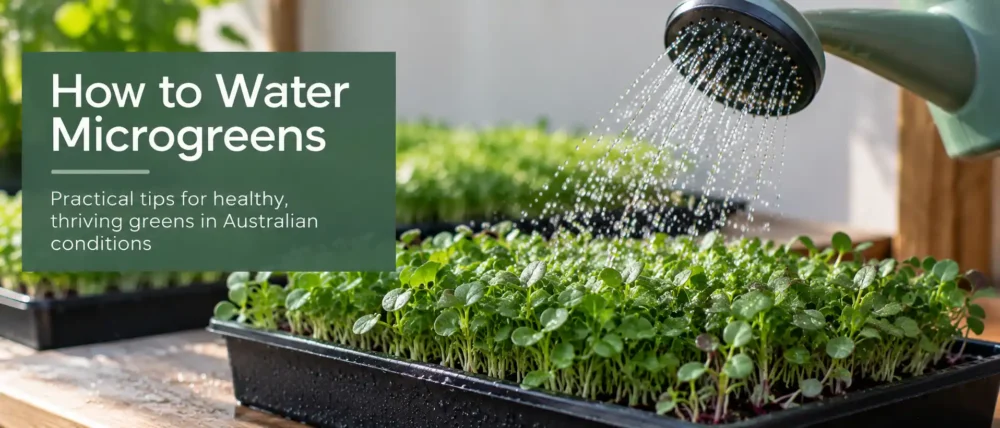
Good microgreen watering is not about following a fixed schedule. The aim is to keep the root zone reliably moist without leaving the crop permanently wet.
Temperature, humidity, airflow, tray size, growing medium and crop maturity all affect how quickly a tray uses water. This matters particularly in Australia, where growing conditions range from humid tropical summers to hot, dry inland climates and cool southern winters.
Microgreen Watering: Quick Guide
At Sowing
Moisten the growing medium evenly before sowing, then lightly water the seed.
During Germination
Keep the seed and surface moist without keeping the tray saturated.
After Establishment
Move primarily to bottom watering once the roots are developed.
Before Watering Again
Check the crop and growing medium instead of watering automatically.
In This Guide
- How often to water
- Misting vs bottom watering
- How to bottom water
- How much water to use
- How to tell when water is needed
- Australian climate advice
- State and regional advice
- Seasonal adjustments
- Crop-specific watering
- Overwatering and underwatering
- Humidity, airflow and mould
- Frequently asked questions
How Often Should You Water Microgreens?
There is no reliable rule that every microgreen tray should be watered once or twice a day.
A tray can remain moist for a long time during cool, humid weather but dry rapidly in hot weather with low humidity or strong airflow. A mature crop of pea shoots can also use far more water than newly germinated broccoli.
Trays Usually Dry Faster When
- Temperatures are high
- Humidity is low
- Air movement is strong
- The crop has a developed canopy
- The growing medium is shallow
- The tray is exposed to warm sun or radiant heat
Trays Usually Dry More Slowly When
- Temperatures are low
- Humidity is high
- Air movement is limited
- The crop is still small
- The medium retains moisture well
- The tray contains more growing medium
Misting vs Bottom Watering
Best during early growth
- At sowing
- During early germination
- During covered germination or blackout
At this stage, the seed is close to the surface and does not yet have a developed root system.
If the surface begins drying, mist or lightly water it.
Best after roots establish
- Once roots have grown into the medium
- Once the crop begins forming a canopy
- Throughout most of the remaining growing period
Water is supplied from underneath and absorbed into the root zone through drainage holes.
How to Bottom Water Microgreens
Use Two TraysThe growing tray has drainage holes and sits inside a solid bottom tray.
Lift the Grow TrayLift or remove the growing tray so water can be added underneath.
Add Water BelowAdd a moderate amount of water to the solid tray.
Allow AbsorptionReplace the growing tray and allow moisture to move upward into the root zone.
Bottom watering becomes especially useful once the microgreens have formed a dense canopy. Overhead water can otherwise be intercepted by leaves rather than reaching the growing medium evenly.
How Much Water Should You Give Microgreens?
There is no useful universal amount such as 250 mL or 500 mL per tray. Tray dimensions, medium depth, crop size and environmental conditions vary too much.
Start with a moderate amount of water in the bottom tray and allow time for the growing medium to absorb it.
If the water disappears quickly and the tray still feels light, add a little more. If substantial water remains underneath for a long period, the tray probably received more than it needed.
How to Tell When Microgreens Need Water
Lift the TrayA dry tray feels noticeably lighter than a well-hydrated tray.
Touch the MediumCheck below the top surface rather than relying only on how the tray looks.
Inspect the EdgesTray edges often lose moisture faster than the centre.
Watch the PlantsLoss of firmness or early wilting means the crop is becoming short of water.
Watering Microgreens in Australian Climates
Australia covers a wide range of climates. For microgreens, the most useful factors are usually temperature, humidity and airflow around the tray, rather than the state name alone.
Tropical and subtropical coastal areas
Heat can increase plant water use while high humidity slows drying of wet leaves and the growing surface.
- Check moisture before watering
- Bottom water established crops
- Avoid repeatedly wetting foliage
- Maintain good air movement
- Space trays adequately
- Avoid unnecessary standing water
Inland Australia and hot southern summers
Shallow trays can dry rapidly, particularly where warm air moves across them.
- Check trays more frequently
- Watch tray edges
- Avoid extremely hot windows
- Protect trays from strong hot airflow
- Rehydrate the entire root zone
Cool southern and winter conditions
Evaporation slows and the growing medium can remain wet considerably longer than it does in summer.
- Reduce watering frequency
- Check before adding water
- Maintain airflow
- Avoid wet foliage
- Watch for saturated growing media
Heated or air-conditioned rooms
Indoor air can be quite dry even when outdoor temperatures are low.
- Do not assume winter always means less watering
- Watch trays near heaters
- Consider drying caused by fans
- Check tray weight rather than the calendar
Australian State & Regional Watering Guide
Use this as a starting guide rather than a fixed watering schedule. Conditions can vary considerably within the same state.
| Region | Typical Conditions | Period to Watch | Watering Approach |
|---|---|---|---|
| Far North Queensland Cairns, Townsville |
Hot and humid | Wet / humid season | Bottom water established crops, maintain airflow and avoid keeping the canopy unnecessarily wet. |
| South-East Queensland Brisbane, Gold Coast, Sunshine Coast |
Warm, humid summers and mild winters | Summer | Heat can increase water use while humidity slows surface drying. Check the tray rather than automatically increasing watering. |
| Inland Queensland | Hotter and generally drier | Hot weather | Expect faster drying, particularly around tray edges and in shallow media. |
| Coastal NSW Sydney and coastal districts |
Variable humidity with warm summers | Warm, humid weather | Bottom water after establishment and reduce watering as temperatures fall. |
| Inland NSW & ACT | Greater temperature swings and dry air | Summer heat and heated winter rooms | Use tray weight as a guide and watch for drying caused by heating and airflow. |
| Victoria | Strong seasonal variation | Summer heat and winter cool | Expect watering frequency to change considerably through the year. |
| Tasmania | Cooler conditions and slower evaporation | Winter | Water conservatively during cool periods and ensure good drainage and airflow. |
| South Australia Adelaide and surrounds |
Hot, dry summers | Summer | Check frequently during hot weather and protect trays from excessive afternoon heat. |
| South-West Western Australia Perth and surrounds |
Hot, dry summers and cooler winters | Summer | Expect substantially higher water demand during summer and slower drying during winter. |
| Inland WA, SA & NT | Very hot and dry | Hot season | Check trays frequently and prevent the root zone from completely drying. |
| Top End Darwin and northern NT |
Warm year-round with wet and dry seasons | Wet season for humidity; dry season for evaporation | Prioritise airflow during humid periods and watch for faster moisture loss during the dry season. |
Adjusting Watering Through the Seasons
SummerCheck trays more often. Heat generally increases water use, while humidity can slow drying of foliage and the surface.
AutumnAs temperatures fall, trays often begin drying more slowly. Do not continue summer watering automatically.
WinterCool conditions usually reduce water demand, although heated indoor rooms can still be dry.
SpringWater demand generally increases as temperatures, light levels and crop growth increase.
Northern Australia: Wet Season vs Dry Season
Wet Season
Warm temperatures combined with high humidity make airflow particularly important.
Avoid unnecessarily wetting established foliage and check whether the growing medium actually needs more water.
Dry Season
Lower humidity can increase evaporation from trays.
Trays may need more frequent checking even though the weather feels more comfortable for growing.
Watering Different Microgreen Crops
Broccoli, Kale & MustardThese crops quickly form a fine, dense canopy. Once established, bottom watering helps keep moisture around the roots rather than on the foliage.
RadishRadish grows quickly and can use water rapidly as the crop develops. Check mature trays regularly during warm weather.
Pea ShootsPeas develop substantial foliage and roots. Water use can increase considerably as the crop approaches harvest size.
SunflowerSunflower develops a substantial root system and canopy. Supply enough water for healthy growth without keeping the medium permanently saturated.
Overwatering vs Underwatering
Signs a Tray May Be Too Wet
- Growing medium remains saturated
- Water continually remains in the bottom tray
- Stems and foliage stay wet
- A stale or unpleasant smell develops
- Algae forms on exposed medium
- Root development appears weak
Signs a Tray May Be Too Dry
- The tray feels unusually light
- The medium is dry below the surface
- Edges begin drying before the centre
- Plants lose firmness
- Leaves or stems begin wilting
- Growth becomes uneven
Watering, Humidity & Mould
Persistently wet growing conditions can contribute to fungal problems, but mould is rarely explained by watering alone.
WaterIs the root zone remaining saturated for long periods?
HumidityDoes humid air prevent the crop and growing surface from drying?
AirflowIs there enough gentle air movement around and above the crop?
DensityIs the crop seeded so densely that airflow through the canopy is restricted?
A Simple Daily Watering Routine
InspectLift the tray and check the growing medium before deciding whether water is required.
Bottom WaterAdd enough water underneath to restore moisture through the root zone.
Check AgainA second inspection may be necessary later in the day during hot or dry conditions.
Avoid Excess WetnessDo not deliberately leave established foliage soaked overnight.
Frequently Asked Questions
Should I mist microgreens every day?
No. Misting is useful during sowing and early germination, but it should be based on whether the seed and growing surface actually need moisture.
Should microgreens be watered from the top or bottom?
Light top watering or misting is useful during early germination. Once roots are established, bottom watering is generally more suitable.
How many times a day should I water microgreens?
There is no universal number. A mature tray during hot, dry weather may need much more frequent watering than a young tray growing under cool conditions.
Should microgreens sit in water?
Water can be added temporarily to the bottom tray so the growing medium absorbs it. Avoid keeping ordinary microgreen trays permanently flooded unless the growing system is designed for this.
When should I switch from misting to bottom watering?
Switch once the crop has developed enough roots to take up water effectively from underneath. The exact timing varies by crop.
Do microgreens need more water during an Australian summer?
Often yes, particularly during hot, dry weather. During humid summer conditions, however, leaves and the growing surface may dry more slowly, so water according to the tray rather than temperature alone.
How should I water microgreens in Brisbane?
Brisbane’s warm and often humid summers can combine relatively high plant water use with slower surface drying. Bottom water established crops, maintain airflow and check the growing medium before adding more water.
How should I water microgreens in Melbourne?
Expect substantial seasonal variation. Hot summer weather can increase water demand sharply, while cooler winter conditions generally slow drying.
How should I water microgreens in Perth or Adelaide?
Hot, dry summer conditions can cause shallow trays to dry quickly. Check trays frequently during heat and protect them from excessive afternoon temperatures.
How should I water microgreens in Darwin or Cairns?
Warm, humid conditions make airflow and surface moisture especially important. During very humid periods, avoid keeping established crops unnecessarily wet.
Continue With the Microgreen Growing Series
Microgreen Seeds for Home & Commercial Growing
Seedmart Australia supplies microgreen seed in pack sizes suitable for home growers through to commercial production.