
Forest Bluegrass Seeds – Bothriochloa bladhii
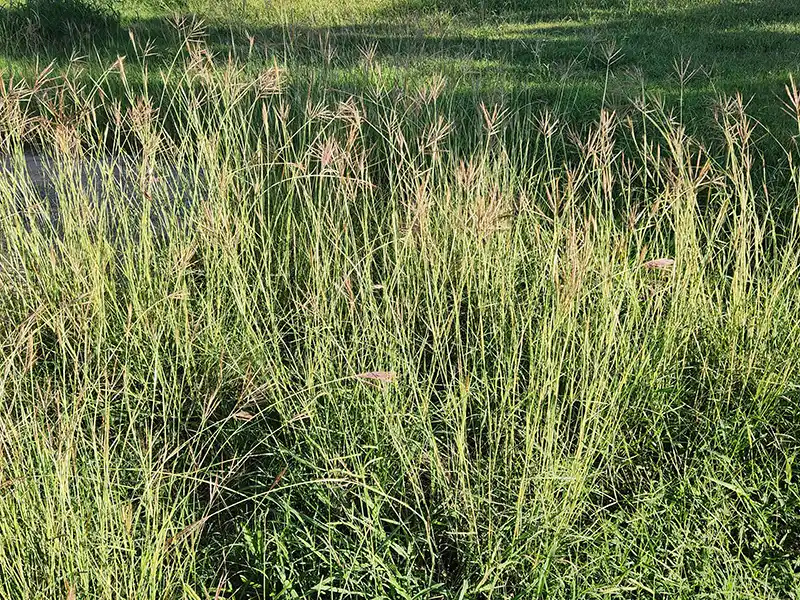
Grow an Australian native perennial grass for native pasture, suitable revegetation projects and naturalistic landscaping. Forest Bluegrass (Bothriochloa bladhii), also known as Burnett Bluegrass, forms substantial tussocks with green to blue-green foliage and reddish-purple seed heads.
The native form, Bothriochloa bladhii subsp. bladhii, occurs in tropical and subtropical woodlands, particularly on heavier soils. Its upright growth provides height and seasonal texture in appropriate native plantings.
Forest Bluegrass Seed Details
| Botanical name | Bothriochloa bladhii |
|---|---|
| Common names | Forest Bluegrass, Burnett Bluegrass |
| Family | Poaceae |
| Plant type | Warm-season perennial grass |
| Growth habit | Tufted, upright tussock |
| Approximate height | Approximately 0.5–1.5 m, depending on growing conditions |
| Foliage | Green to blue-green leaves; may develop reddish tones in dry conditions |
| Seed heads | Branched, reddish-purple flower and seed heads |
| Flowering period | Mainly summer into autumn; varies with rainfall and location |
| Position | Sunny, open position or open woodland setting |
| Soil | Often associated with heavier, fertile woodland soils, including clay soils |
| Uses | Native pasture, suitable revegetation, woodland restoration and naturalistic landscaping |
Why Grow Forest Bluegrass?
- Perennial tussocks add structure to native plantings.
- Colourful seed heads provide seasonal interest.
- Useful in locally appropriate woodland restoration.
- Valued as a productive and palatable native pasture grass.
How to Grow Forest Bluegrass from Seed
Prepare carefully and maintain moisture through germination and early growth. The following steps provide a practical starting point for propagation and direct sowing.
- Prepare the growing medium. Use clean seed-raising mix for trays, or prepare a weed-free seedbed for direct sowing.
- Sow shallowly. Cover lightly with fine mix or soil, ensuring good seed-to-soil contact.
- Water gently. Use a fine spray to settle seed without washing it away.
- Maintain moisture. Check regularly during hot or windy weather.
- Protect emerging plants. Reduce weed competition and protect seedlings from grazing.
- Plant out when established. Harden tray-grown seedlings gradually and water after transplanting.
Forest Bluegrass for Landscaping
Use Forest Bluegrass in informal groups where its mature height can be accommodated. Position taller tussocks behind lower-growing plants and leave access for maintenance.
Allow for seasonal changes in foliage colour and growth. Its tussock habit suits naturalistic planting rather than a closely mown lawn.
Forest Bluegrass for Revegetation and Native Pasture
Select seed that meets the vegetation community and provenance requirements of the project. Confirm the subspecies when specifying native restoration material.
For grazing, allow young plants to establish before introducing livestock. Established native Forest Bluegrass benefits from growing-season rest so plants can recover and set seed.
Foliage and Seed Heads
Upright stems carry branched heads above the leafy tussock. The combination of bluish foliage and dark reddish seed heads gives the plant its characteristic appearance.
Where to Grow Forest Bluegrass
- Suitable native pasture sites.
- Locally appropriate woodland restoration projects.
- Open native gardens with room for mature tussocks.
- Mixed native grass plantings.
When to Sow Forest Bluegrass Seeds in Australia
These indicative periods reflect its warm-season growth. Adjust sowing to local soil warmth, rainfall and frost risk.
| Climate Zone | Sowing Guide | Growing Notes |
|---|---|---|
| Cool | Assess local suitability first | A short growing season may limit establishment. |
| Temperate | Late spring to early summer | Wait for warm soil and maintain moisture. |
| Subtropical | Spring to summer | Match sowing to reliable rain or irrigation. |
| Tropical | Early wet season | Avoid sowing immediately before scouring rain. |
| Arid / Semi-arid | Suitable warm, moist conditions | Confirm local suitability and follow-up water availability. |
Tips for Growing Forest Bluegrass Successfully
- Control weeds before sowing.
- Check batch purity and germination results.
- Match sowing equipment to the supplied seed form.
- Monitor seedlings during establishment.
- Base project sowing rates on seed quality and the intended mix.
Frequently Asked Questions
Is Forest Bluegrass native to Australia?
The native form is Bothriochloa bladhii subsp. bladhii. Check subspecies and provenance when purchasing for restoration.
Is native Forest Bluegrass the same as Swann?
No. ‘Swann’ is a selection of the introduced subspecies Bothriochloa bladhii subsp. glabra.
Is Forest Bluegrass perennial?
Yes. It is a perennial tussock grass.
How long does germination take?
Timing varies with seed condition, temperature and moisture. Refer to batch-specific information rather than relying on a fixed emergence time.
Grow Forest Bluegrass from Seed
Choose a suitable site, prepare the seedbed and provide reliable establishment moisture. Careful planning gives Forest Bluegrass the best opportunity to become part of a lasting native planting.
Reviews
There are no reviews yet.