
Sunflower Grey Striped Seeds – Green Manure & Cover Crop
Botanical Name: Helianthus annuus
Variety: Grey Striped Sunflower
Common Names: Sunflower, Grey Striped Sunflower
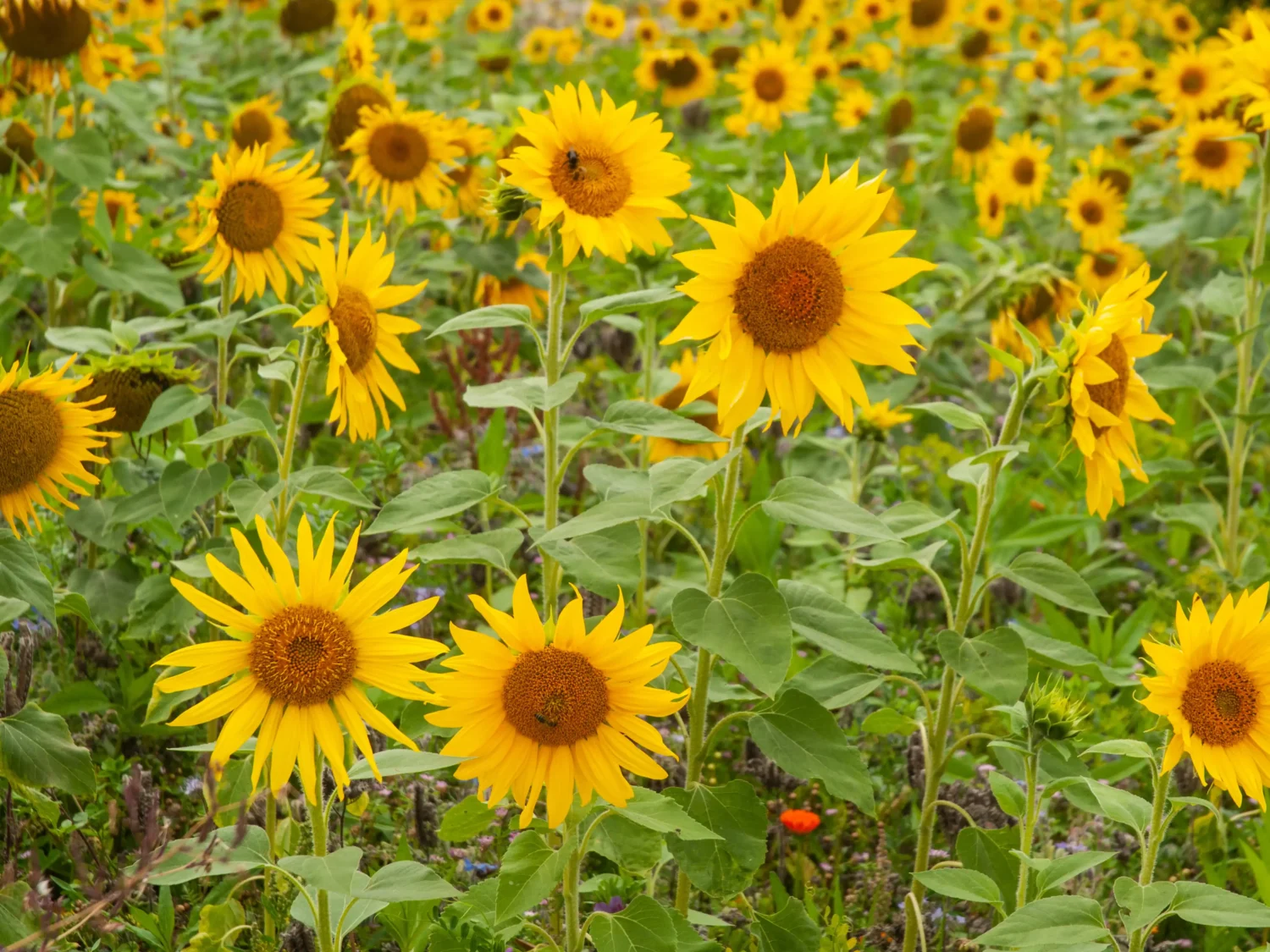
Grey Striped Sunflower is a fast-growing warm-season annual broadleaf crop that can be used for green manure, cover cropping, biomass production and mixed summer cover crops. It produces tall, vigorous plants with broad leaves and a strong taproot system, making it useful where summer ground cover, plant diversity and substantial organic residues are required.
As a cover crop, sunflower develops a deep root system capable of exploring lower soil layers and taking up mobile nutrients. Its vigorous above-ground growth provides useful biomass, while the flowers are highly attractive to bees and other pollinating insects. Sunflower does not fix atmospheric nitrogen, so it is particularly useful when combined with warm-season legumes in diverse cover crop mixtures.
- Fast-growing warm-season annual for green manure and cover cropping.
- Produces tall plants, broad leaves and substantial summer biomass.
- Strong taproot explores deeper soil layers and helps cycle nutrients.
- Provides useful ground cover and plant diversity in summer rotations.
- Flowers provide an excellent food source for bees and other pollinating insects.
- Useful as a structural broadleaf component in multi-species cover crop mixes.
- Can be combined with warm-season legumes and grasses for greater cover crop diversity.
- Performs best in full sun and warm growing conditions.
Plant Details
- Plant Type: Warm-season annual broadleaf cover crop
- Botanical Name: Helianthus annuus
- Variety: Grey Striped
- Growth Habit: Tall, upright and vigorous
- Root System: Strong taproot with extensive lateral roots
- Flowers: Large yellow sunflower heads attractive to bees and other pollinators
- Frost Tolerance: Low; sunflower is a warm-season crop and established plants are damaged by significant frost
- Drought Tolerance: Moderate once established; biomass production is greater where adequate moisture is available
- Best Position: Full sun
- Important Note: Sunflower is not a legume and does not fix atmospheric nitrogen.
Best Uses
- Warm-season green manure
- Summer cover cropping
- Biomass and organic matter production
- Deep-rooted cover crop mixtures
- Nutrient scavenging and cycling
- Pollinator-friendly cover cropping
- Mixed warm-season cover crops
- Increasing plant diversity in rotations
- Paddocks and broadacre plantings
- Vegetable and market garden rotations
- Orchard and horticultural cover crop systems where suitable
Sowing Information
- Best Sowing Time: Spring to summer once soil has warmed and significant frost risk has passed
- Sowing Depth: Approximately 20–40 mm depending on soil type and available moisture
- Position: Full sun
- Soil Type: Adaptable to a range of soils; performs best in reasonably fertile, well-drained soil
- Watering: Maintain adequate moisture during germination and establishment; reliable moisture improves biomass production
- Sow Where: Paddocks, garden beds, market gardens, orchards and summer cover crop rotations
- Companion Crops: Can be combined with warm-season legumes such as cowpea, lablab or sunn hemp and grasses such as millet or forage sorghum
Sowing Rate and Coverage
| Use | Sowing Rate | Approx. Coverage |
|---|---|---|
| Pure Stand / Green Manure | Approx. 8–15 kg per hectare | 1 kg covers approx. 670–1,250 m² |
| Small Areas / Garden Beds | Approx. 0.8–1.5 g per m² | 100 g covers approx. 65–125 m² |
| Mixed Cover Crop Blends | Approx. 2–5 kg per hectare | Reduce the rate according to the proportion of sunflower required in the mixture |
Seed Quantity Guide
| Seed Pack Size | Approx. Coverage at 8 kg/ha | Approx. Coverage at 15 kg/ha |
|---|---|---|
| 100 g | Approx. 125 m² | Approx. 67 m² |
| 250 g | Approx. 310 m² | Approx. 165 m² |
| 500 g | Approx. 625 m² | Approx. 330 m² |
| 1 kg | Approx. 1,250 m² | Approx. 670 m² |
| 5 kg | Approx. 0.63 ha | Approx. 0.33 ha |
| 10 kg | Approx. 1.25 ha | Approx. 0.67 ha |
| 20 kg | Approx. 2.5 ha | Approx. 1.33 ha |
Coverage is a guide only. Sunflower seed size can vary between seed lots, and the optimum sowing rate depends on germination, establishment method, intended stand density and whether sunflower is being grown alone or as part of a cover crop mixture.
When to Sow Sunflower Grey Striped Seeds in Australia
| Climate Zone | Best Planting Time | Suitability | Growing Notes |
|---|---|---|---|
| Cool | Late spring to summer | Good during warm season | Sow after significant frost risk has passed and soil has warmed. |
| Temperate | Spring to summer | Excellent | Well suited to warm-season green manure, cover cropping and mixed summer plantings. |
| Subtropical | Spring to early autumn | Excellent | Long warm growing season allows flexible sowing where adequate moisture is available. |
| Tropical | Suitable warm growing periods | Good where adapted | Avoid periods of excessive rainfall or prolonged waterlogging; sunflower performs best in well-drained soil. |
| Arid / Semi-arid | Spring to summer with rainfall or irrigation | Good with adequate moisture | Established sunflower has useful drought tolerance, but adequate moisture is required for establishment and strong biomass production. |
How to Sow Sunflower Grey Striped Seeds
- Sow once soil has warmed and significant frost risk has passed.
- Prepare a relatively weed-free seedbed with good soil structure.
- Broadcast seed evenly or sow using suitable seeding equipment for larger areas.
- Cover seed with approximately 20–40 mm of soil, adjusting depth for soil type and available moisture.
- Firm the soil lightly to provide good seed-to-soil contact.
- Water after sowing where rainfall is insufficient and maintain adequate moisture during establishment.
- For green manure, terminate while plants are actively growing and before mature seed develops.
- Slash or mow the crop and leave residues on the surface as mulch or incorporate them into the soil according to the needs of the following crop.
Growing Tips
- Sow into warm soil for rapid establishment.
- Full sun is required for strong growth and biomass production.
- Adequate moisture during establishment encourages a vigorous root system and canopy.
- Sunflowers develop substantial stems as they mature; earlier termination produces softer residues that generally break down more readily.
- For green manure, terminate before mature seed develops if volunteer sunflowers are undesirable.
- Allow some plants to flower where pollinator habitat is an objective.
- Combine with legumes such as cowpea, lablab or sunn hemp where biological nitrogen fixation is required.
- Combine with grasses such as millet or forage sorghum to increase structural and rooting diversity in summer cover crop mixtures.
Green Manure and Soil Benefits
Sunflower produces both substantial above-ground biomass and a strong root system. As a green manure or cover crop, this growth can provide soil cover, contribute organic residues and increase plant diversity within cropping rotations.
The deep taproot and lateral root system allow sunflower to explore a substantial volume of soil and take up mobile nutrients from deeper layers. These nutrients are retained in plant biomass and can be returned to the soil surface when the crop is terminated and residues decompose.
Sunflower is not a legume and does not fix atmospheric nitrogen. Where nitrogen fixation is an important objective, combine sunflower with suitable warm-season legumes.
Root System and Nutrient Cycling
Sunflower develops a strong taproot together with an extensive network of lateral roots. This deep-rooted growth habit makes it a useful component of diverse cover crop mixtures where different species are selected to explore different parts of the soil profile.
Sunflower can take up nutrients from deeper soil layers and retain them in its foliage, stems and roots during growth. After termination, decomposition of the crop residues contributes these nutrients and organic material back into the cropping system.
While sunflower roots can contribute to soil structure and biological activity, sunflower should not be presented as a substitute for mechanical remediation of severe soil compaction.
Pollinator and Biodiversity Benefits
If allowed to flower, sunflower provides an abundant floral resource for bees and other pollinating insects. The large flower heads also add structural and botanical diversity to mixed summer cover crops.
Where the primary objective is green manure rather than flowering, the crop can be terminated earlier while stems remain softer and easier to manage.
Sunflower in Cover Crop Mixes
Grey Striped Sunflower is particularly useful as a broadleaf component in warm-season multi-species cover crops.
It can be combined with grasses such as millet and forage sorghum and nitrogen-fixing legumes such as cowpea, lablab and sunn hemp. These mixtures provide a range of plant architectures and rooting habits while reducing reliance on a single cover crop species.
Because sunflower plants become large, relatively low inclusion rates are generally appropriate in diverse mixtures.
Important Notes
- Sunflower is a warm-season annual broadleaf crop.
- It develops a strong taproot and extensive lateral root system.
- Sunflower does not fix atmospheric nitrogen.
- Combine with suitable legumes where nitrogen fixation is required.
- It performs best in full sun and reasonably well-drained soil.
- Adequate moisture is important during germination and establishment.
- Sunflower can use substantial soil moisture as plants become large, which should be considered where water conservation for a following crop is important.
- Terminate earlier where softer, more readily managed green manure residues are preferred.
- Terminate before mature seed develops if volunteer sunflowers are undesirable.
- Allow plants to flower where pollinator habitat is an objective.
Quick Growing Guide
| Feature | Details |
|---|---|
| Plant Type | Warm-season annual broadleaf cover crop |
| Botanical Name | Helianthus annuus |
| Variety | Grey Striped |
| Best Uses | Green manure, cover cropping, biomass production, nutrient cycling and mixed summer cover crops |
| Best Sowing Period | Spring to summer after significant frost risk has passed |
| Sowing Rate | Approx. 8–15 kg/ha for a pure green manure or cover crop stand |
| Mixture Rate | Approx. 2–5 kg/ha depending on the proportion required in the cover crop blend |
| Sowing Depth | Approx. 20–40 mm |
| Sunlight | Full sun |
| Root System | Strong taproot with extensive lateral roots |
| Nitrogen Fixation | No; combine with legumes where nitrogen fixation is required |
| Pollinator Value | High when allowed to flower |
| Management | For green manure, terminate while actively growing and before mature seed develops where volunteer plants are undesirable |
Reviews
There are no reviews yet.