
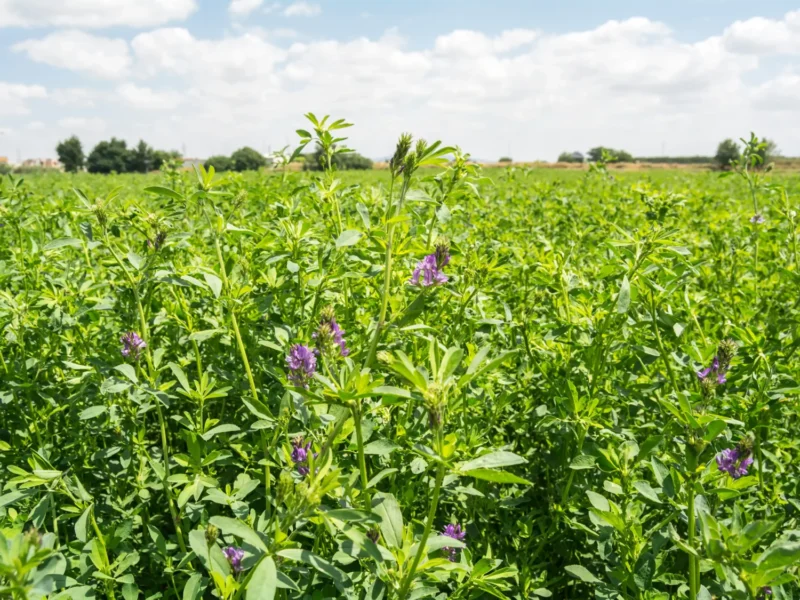


Hunter River Lucerne Seeds
Botanical Name: Medicago sativa
Variety: Hunter River
Winter Activity: Semi-dormant
Hunter River Lucerne is a traditional Australian lucerne variety selected from stands grown in the Hunter River Valley of New South Wales. It became widely adapted to Australian growing conditions and grazing systems and has an important history as one of Australia’s foundational lucerne varieties.
A semi-dormant perennial legume, Hunter River produces nutritious forage during its main growing season while reducing growth during colder winter conditions. Semi-dormant lucernes are particularly valued for persistence and are well suited to grazing, pasture improvement, hay production and longer-term stands where winter production is not the primary objective.
Like other lucernes, Hunter River develops a deep taproot that enables established plants to access moisture deeper in the soil profile. When effectively nodulated with the appropriate rhizobium inoculant, it also fixes atmospheric nitrogen and contributes to soil fertility.
- Traditional Australian Hunter River lucerne variety.
- Semi-dormant perennial forage legume.
- Well suited to grazing, pasture and hay production.
- Good persistence under appropriate grazing management.
- Deep-rooted with good drought tolerance once established.
- Produces nutritious forage for livestock.
- Fixes nitrogen when effectively nodulated with the correct inoculant.
- Useful for pasture improvement and longer-term rotations.
Plant Details
- Plant Type: Deep-rooted perennial forage legume
- Botanical Name: Medicago sativa
- Variety: Hunter River
- Winter Activity: Semi-dormant
- Growth Habit: Perennial pasture and forage legume
- Root System: Deep taproot
- Best Position: Full sun
- Soil Preference: Deep, fertile and well-drained soils
- Drought Tolerance: Good once established
- Waterlogging Tolerance: Low; avoid poorly drained sites
- Main Growth: Spring, summer and autumn when adequate moisture is available
Best Uses
- Grazing
- Pasture improvement
- Hay production
- Forage production
- Longer-term lucerne stands
- Nitrogen fixation
- Soil improvement
- Pasture and cropping rotations
- Dryland production where conditions are suitable
Why Grow Hunter River Lucerne?
Hunter River has a long history in Australian agriculture. The variety developed from lucerne grown in the Hunter River Valley of New South Wales and became adapted over many generations to Australian environments and grazing systems.
Unlike highly winter-active lucernes, Hunter River is semi-dormant. Growth slows considerably during winter before increasing again as conditions warm. This seasonal growth pattern can favour persistence where year-round winter production is less important.
Hunter River can therefore be useful for growers looking for a traditional grazing and pasture lucerne rather than a highly winter-active variety selected primarily for intensive forage production.
Sowing Information
- Best Sowing Time: Autumn or spring, depending on climate and available soil moisture
- Sowing Depth: Approximately 5–15 mm; avoid deep sowing
- Position: Full sun
- Soil Type: Deep, fertile and well-drained soils
- Soil pH: Best suited to soils that are not strongly acidic
- Moisture: Adequate soil moisture is essential during germination and establishment
- Inoculation: Use Group AL Lucerne inoculant where required for effective nodulation and nitrogen fixation.
Sowing Rate and Coverage
Sowing rates are a guide only. Actual rates should be adjusted for rainfall, irrigation, seedbed preparation, germination, sowing method and intended use.
When to Sow Hunter River Lucerne in Australia
How to Sow Lucerne Seeds
- Select a sunny site with deep, well-drained soil.
- Control existing weeds before planting.
- Prepare a fine, firm seedbed.
- Apply Group AL Lucerne inoculant where required.
- Broadcast evenly or sow with a suitable seed drill.
- Cover seed lightly; lucerne should not be planted deeply.
- Roll or press lightly to ensure good seed-to-soil contact.
- Maintain adequate soil moisture until seedlings are established.
Grazing and Pasture Use
Hunter River has a long history as a grazing lucerne in Australia. Its semi-dormant growth habit means winter production is lower than highly winter-active varieties, but semi-dormant lucernes can offer good persistence under suitable grazing management.
Rotational grazing is recommended. Allow established plants sufficient recovery between grazing periods and avoid repeatedly grazing plants close to ground level.
As with other lucerne pastures, lush growth can present a bloat risk to grazing livestock and should be managed appropriately.
Hay and Forage
Hunter River can also be grown for hay and conserved forage. Its main production occurs during the warmer growing period when adequate moisture is available.
For hay production, cutting time affects the balance between yield and feed quality. Earlier cutting generally produces leafier forage, while allowing plants to mature for longer increases bulk but can reduce forage quality.
Soil Benefits
Hunter River Lucerne develops a deep taproot capable of accessing moisture and nutrients well below the rooting depth of many annual pasture species.
When effectively nodulated, lucerne fixes atmospheric nitrogen through its association with rhizobia. Root turnover and plant residues also contribute organic matter, making lucerne useful in longer pasture phases and cropping rotations.
Hunter River vs Highly Winter-Active Lucerne
Hunter River is a semi-dormant lucerne and has a different growth pattern from highly winter-active varieties such as Sequel.
Hunter River produces less forage during winter but can provide greater persistence under grazing and stressful conditions. Highly winter-active varieties generally establish vigorously, regrow quickly and provide greater cool-season production, making them particularly useful for intensive forage systems and shorter rotations.
The best choice depends on whether the priority is winter production, grazing persistence, hay production or the intended length of the stand.
Important Notes
- Hunter River is a traditional semi-dormant Australian lucerne variety.
- Winter growth is lower than highly winter-active lucerne varieties.
- Best suited to deep, fertile and well-drained soils.
- Does not tolerate prolonged waterlogging.
- Use Group AL Lucerne inoculant where inoculation is required.
- Rotational grazing helps improve stand persistence.
- Lucerne can cause bloat in grazing livestock; appropriate management is required.
- Hunter River is susceptible to spotted alfalfa aphid and does not have the pest resistance of many modern lucerne varieties.
Reviews
There are no reviews yet.