
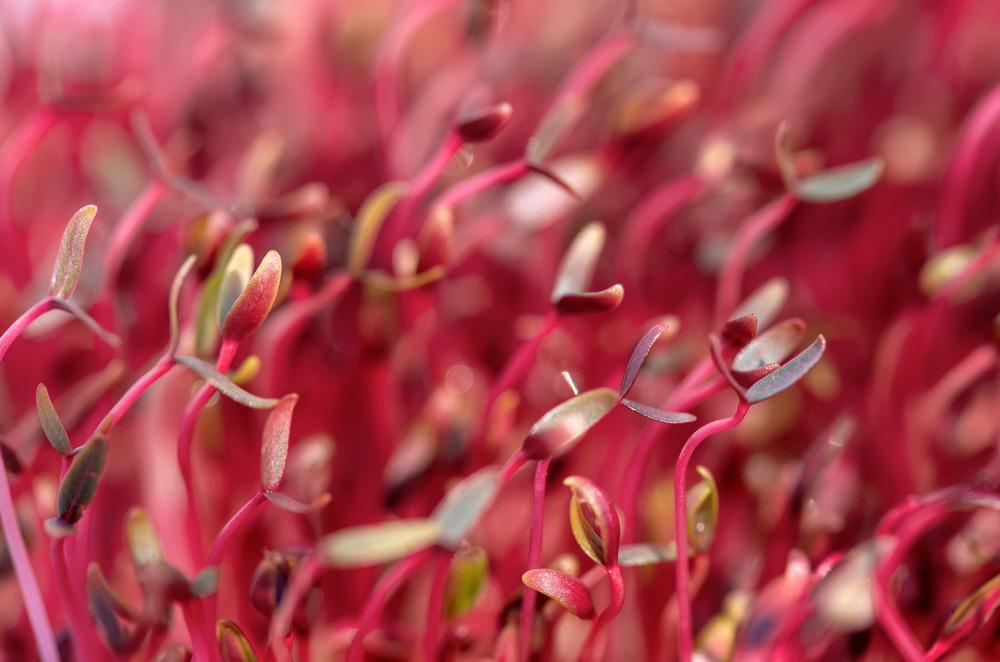
Red Amaranth microgreens are striking, delicate microgreens with vivid red, pink and burgundy colouring and a mild, earthy flavour. Their intense colour makes them particularly popular as a garnish for salads, restaurant dishes and mixed microgreen trays.
If you’re wondering how to grow Red Amaranth microgreens, they require a little more attention than easy varieties such as broccoli or radish. Amaranth seeds are extremely small, the seedlings are delicate, and the crop can be sensitive to excessive moisture and poor airflow. Once you understand these differences, however, Red Amaranth can be successfully grown at home.
This beginner-friendly guide explains how to grow Red Amaranth microgreens from seed, including how much seed to use, the best growing medium, germination temperature, blackout time, watering, lighting, harvesting and common problems to avoid.
Red Amaranth Microgreens at a Glance
What Are Red Amaranth Microgreens?
Red Amaranth microgreens are young Amaranthus seedlings harvested shortly after germination, usually once the cotyledons have fully developed and before the plants become mature leafy greens.
Depending on the cultivar, the seedlings can develop shades of deep red, crimson, burgundy, magenta and pink. Red Garnet is one of the best-known amaranth varieties grown specifically for microgreens.
Unlike taller microgreens such as peas and sunflowers, Amaranth remains relatively small and delicate. This is normal and should not be mistaken for poor growth.
What Do Red Amaranth Microgreens Taste Like?
Red Amaranth microgreens have a mild, earthy flavour with a tender texture. Their flavour is considerably milder than spicy microgreens such as mustard and radish.
Their main attraction is the combination of flavour, delicate texture and intense red colouring.
They are particularly useful:
- As a salad garnish
- On restaurant-style plated dishes
- In mixed microgreen salads
- On avocado toast
- With eggs
- On grain bowls
- With roasted vegetables
- As a colourful finishing garnish
Are Red Amaranth Microgreens Easy to Grow?
Red Amaranth is generally considered a moderately difficult microgreen rather than one of the easiest varieties for beginners.
The seeds are extremely small and the seedlings are delicate. Amaranth also requires careful moisture management because dense, wet growing conditions can encourage mould and damping-off.
This does not mean beginners cannot grow it. The main points are:
- Do not sow too densely
- Do not soak the seed
- Provide warmth during germination
- Keep the growing medium moist but not saturated
- Maintain good airflow
- Handle the seedlings gently
Once these requirements are understood, Red Amaranth can be a rewarding microgreen to grow.
How to Grow Red Amaranth Microgreens in 7 Simple Steps
- Prepare a clean shallow growing tray and moist growing medium.
- Sow approximately 15 g of Red Amaranth seed evenly over a 10 x 20 inch tray.
- Gently mist the seed and cover the tray during early germination.
- Maintain warm conditions and carefully control moisture.
- Remove the cover and provide bright light once the seedlings are established.
- Bottom water as the roots develop and maintain good airflow.
- Harvest the microgreens when the cotyledons are fully developed, usually around 10–14 days after sowing.
What You Need to Grow Red Amaranth Microgreens at Home
- Red Amaranth microgreen seeds
- A shallow growing tray with drainage holes
- A solid bottom tray to hold the growing tray
- A cover or second tray for germination
- Coco coir or a fine-quality potting/seed-raising mix
- A spray bottle
- Clean water
- A bright growing position or LED grow light
- Clean scissors or a sharp knife for harvesting
A three-tray setup can work particularly well. Use a solid tray underneath, a growing tray with drainage holes in the middle, and another tray or suitable cover over the top during germination.
Do Red Amaranth Microgreen Seeds Need to Be Soaked?
No. Red Amaranth seeds do not need to be soaked before sowing.
Amaranth seeds are extremely small. Soaking them makes the seed difficult to handle and distribute evenly over the growing medium.
Sow the seeds dry and then mist them gently after planting.
How Much Red Amaranth Seed Should You Use?
For a standard 10 x 20 inch microgreen tray, approximately 15 g of Red Amaranth seed is a useful starting rate.
For a 10 x 10 inch tray, use approximately 7–8 g.
Because Amaranth seeds are tiny, 15 g contains a very large number of seeds. Take your time when sowing and distribute them as evenly as possible.
Avoid clumps or piles of seed.
Overcrowding can:
- Reduce airflow
- Keep the growing surface excessively wet
- Increase the risk of damping-off
- Produce weak or uneven seedlings
A seed shaker can make it easier to distribute the fine seed evenly.
Best Growing Medium for Red Amaranth Microgreens
Red Amaranth can be grown in both soil-based and soilless systems.
Coco Coir
Coco coir is an excellent option for Amaranth microgreens. It holds moisture well while providing a relatively light growing medium for the fine roots.
Research into amaranth microgreen production has also found coconut fibre to perform well as a soilless substrate.
Add approximately 2–3 cm of moist coir to the tray and level the surface carefully before sowing.
Fine Potting or Seed-Raising Mix
A fine-quality potting or seed-raising mix can also work well and may be more forgiving for new growers.
Avoid coarse mixes containing large pieces of bark or wood. Amaranth seeds are extremely small and need consistent contact with the surface.
Hydroponic Growing
Amaranth can be grown hydroponically, but maintaining consistent moisture is particularly important.
Research into soilless Amaranth microgreen production has shown that the crop can be grown successfully on substrates such as coconut fibre with nutrient solution.
For beginners, coco coir or a fine growing mix is generally simpler than trying to grow directly on a very thin mat.
Do Red Amaranth Microgreens Need Fertiliser?
Not necessarily.
When growing Red Amaranth in a quality potting or seed-raising mix that already contains nutrients, plain water is usually sufficient for the short microgreen growing cycle.
When growing hydroponically on an inert medium with no nutrient value, a dilute nutrient solution can be used.
Avoid applying strong fertiliser solutions. Microgreens are young seedlings and excessive fertiliser is unnecessary.
Best Temperature for Growing Red Amaranth Microgreens
Temperature is more important for Amaranth than for many common microgreen varieties.
For germination, aim for a growing-medium temperature of approximately 24°C.
After germination, normal mild indoor temperatures are suitable. An ambient range around 18–24°C is a useful target.
This corrects an important point from the older growing guide: Red Amaranth does not need to remain above 22°C throughout the entire growing cycle.
Warmth is particularly useful during germination, but excessively warm conditions combined with high moisture can increase disease pressure.
Step 1: Prepare Your Growing Tray
Start with clean trays and equipment.
If using coco coir or potting mix, add approximately 2–3 cm of growing medium to the tray.
Level the surface carefully. This is particularly important for Amaranth because the seeds are so small.
Moisten the growing medium before sowing. It should feel evenly damp but should not be saturated or have standing water.
Place the growing tray inside a solid bottom tray.
Step 2: Sow the Red Amaranth Seeds
Measure approximately 15 g of seed for a 10 x 20 inch tray.
Sprinkle the seed evenly across the surface.
A seed shaker is useful, but you can also sow carefully by hand.
Do not bury the seed deeply. Amaranth seed should remain close to the surface with good contact against the moist growing medium.
After sowing, gently mist the seeds with clean water.
Do not soak Amaranth seed before planting.
Step 3: Cover the Tray for Germination
Place a clean cover or second tray over the growing tray.
Amaranth is delicate, so heavy weighting is not necessary.
Maintain a warm growing-medium temperature around 24°C if possible.
The seed should begin germinating within approximately 2–3 days.
Check the tray daily. If the growing surface begins drying, mist it lightly.
Do not automatically add water simply because another day has passed. Amaranth is sensitive to excessively wet growing conditions.
Step 4: Manage the Blackout Period
Amaranth can benefit from a short covered or blackout period while the seedlings establish and gain some stem length.
Depending on your growing method, this may involve approximately 3–5 days of covered germination and blackout combined.
As the seedlings begin lifting the cover, you can invert the top tray to provide additional room while maintaining darkness for a little longer.
Avoid keeping the crop unnecessarily wet and enclosed for an extended period. Reduced airflow combined with excessive moisture can encourage fungal problems.
Once the seedlings are established and have gained sufficient height, remove the cover.
Step 5: Move the Amaranth Microgreens into Light
Move the tray into bright light once the covered growing period is complete.
A bright indoor position or LED grow light works well.
Red Amaranth is naturally a small microgreen, so do not expect it to develop the tall stems of sunflower, pea or radish microgreens.
Good lighting helps the crop develop its characteristic intense red, burgundy and pink colouring.
Avoid suddenly placing delicate seedlings into harsh, hot direct sunlight through a window.
Step 6: Bottom Water and Maintain Good Airflow
Once the roots have established through the growing medium, bottom watering is generally preferable to repeatedly spraying the foliage.
Add a small amount of water to the solid bottom tray and allow the growing medium to absorb it.
Check the tray regularly rather than following a rigid watering schedule.
Watering frequency depends on:
- Temperature
- Humidity
- Airflow
- Growing medium
- Tray size
- Crop density
The growing medium should remain moist without becoming waterlogged.
Amaranth’s delicate stems make good airflow particularly important. Avoid keeping the crop continuously wet.
Step 7: When to Harvest Red Amaranth Microgreens
Red Amaranth microgreens are generally ready to harvest approximately 10–14 days after sowing.
Some crops may be ready a little earlier depending on the cultivar and growing conditions.
Rather than relying entirely on the calendar, look at the crop.
Harvest when:
- The cotyledons have fully opened
- The seedlings have developed strong red or burgundy colouring
- The crop looks healthy and upright
- The stems are long enough to cut cleanly above the growing medium
- The first true leaves are just beginning to appear, if you prefer a later harvest
Amaranth stays relatively short, so do not wait for it to reach the height of larger microgreen varieties.
How to Harvest Red Amaranth Microgreens
Use clean, sharp scissors or a sharp knife to cut the stems just above the growing medium.
Because the plants are small, cut carefully and avoid disturbing the growing medium.
Harvest only what you need or cut the entire tray.
If washing is required before eating, handle the seedlings gently and dry them thoroughly before storage.
How to Store Red Amaranth Microgreens
Red Amaranth is more delicate than many thicker-stemmed microgreens.
For best storage:
- Harvest with clean scissors
- Handle the microgreens gently
- Keep them as dry as practical before refrigeration
- Store in a clean airtight container
- Use paper towel to absorb excess moisture if necessary
- Refrigerate promptly
- Use while fresh and crisp
Avoid crushing the delicate leaves by tightly packing them into a container.
How to Use Red Amaranth Microgreens
Red Amaranth is particularly useful when you want to add colour without the strong heat of mustard or radish microgreens.
Try it:
- Scattered over salads
- On avocado toast
- As a garnish for eggs
- Over grain bowls
- With roasted vegetables
- On soups immediately before serving
- As a colourful restaurant-style garnish
- Mixed with green microgreens for colour contrast
The intense red colouring works particularly well alongside green varieties such as broccoli, kale and mizuna.
Why Grow Red Amaranth Microgreens?
Red Amaranth microgreens are grown as much for their appearance as for their flavour. Their vivid red, burgundy and pink colouring makes them particularly useful for adding contrast to salads, mixed microgreen trays and plated dishes.
They have a mild, earthy flavour and a delicate texture, making them suitable for growers who want a colourful microgreen without the strong peppery flavour of varieties such as mustard or radish.
Red Amaranth has also been included in peer-reviewed research comparing the sensory and nutritional characteristics of different microgreens. In one study, red amaranth was evaluated alongside five other microgreen species for flavour, appearance and chemical composition, with the researchers reporting good overall consumer acceptance and identifying carotenoids and other phytochemicals in the crop.
- Striking red, burgundy and pink colouring
- Mild, earthy flavour
- Useful as a garnish or in mixed microgreen trays
- Compact crop suitable for small indoor growing spaces
- Provides a different colour and texture from common green microgreens
- Can be grown indoors throughout the year when temperature and light are controlled
Can You Grow Red Amaranth Microgreens Without Soil?
Yes. Red Amaranth can be grown hydroponically using coco coir and other suitable soilless growing media.
Coco coir is particularly useful because it combines moisture retention with good root support.
Research into Amaranth microgreen production has successfully grown the crop using coconut fibre and hydroponic nutrient solutions.
For home growers, however, there is no need to make the setup complicated. Coco coir or a fine potting mix with careful watering can produce good results.
Growing Red Amaranth Microgreens in Warm Weather
Unlike cool-season brassica microgreens, Amaranth appreciates warmth during germination.
This makes it an interesting microgreen for growers in warmer Australian climates.
However, warm and wet are not the same thing.
In humid conditions, particularly during subtropical summers, excessive moisture combined with high temperatures can increase disease pressure.
During warm weather:
- Maintain airflow around the trays
- Avoid excessive watering
- Do not leave standing water in the bottom tray for long periods
- Avoid overcrowding
- Keep trays out of harsh afternoon sun
- Check the growing medium regularly
Common Problems When Growing Red Amaranth Microgreens
Damping-Off
Damping-off can cause young seedlings to collapse at the base of the stem.
The risk increases when densely planted seedlings are grown in saturated media with inadequate airflow.
Prevention is more useful than trying to rescue a badly affected crop.
- Use clean trays
- Use clean growing medium
- Avoid overwatering
- Maintain airflow
- Avoid excessive seed density
- Bottom water after the roots establish
Mould on Red Amaranth Microgreens
Amaranth can develop mould problems when the growing surface remains excessively wet.
If mould appears:
- Check whether the crop is being overwatered
- Improve airflow
- Reduce moisture on the foliage
- Check the seed density
Do not eat visibly mouldy or spoiled microgreens.
Red Amaranth Is Not Growing Tall
This is not necessarily a problem.
Amaranth is naturally a short, delicate microgreen. It will not normally reach the height of peas, sunflowers or many brassica microgreens.
If the seedlings otherwise look healthy, focus on colour and cotyledon development rather than trying to force additional height.
Poor Germination
If germination is slow or uneven, check:
- Growing-medium temperature
- Moisture levels
- Seed-to-medium contact
- Seed quality
- Whether the surface has dried out
A temperature around 24°C during germination can improve conditions for Amaranth seed.
Seedlings Are Falling Over
First check the base of the stems.
If stems are discoloured, narrowed or collapsing at soil level, damping-off may be involved.
If the plants are healthy but leaning, inadequate or uneven light may be responsible.
Amaranth Is Losing Its Red Colour
Colour intensity varies with cultivar, light, temperature and plant development.
Make sure the seedlings receive adequate light after the blackout period.
Growing Medium Is Too Wet
Reduce watering and allow the medium to use some of the existing moisture before adding more.
Do not keep adding water to a bottom reservoir when water remains unabsorbed.
Do You Need Hydrogen Peroxide to Grow Red Amaranth Microgreens?
No. Hydrogen peroxide is not required for routine Red Amaranth microgreen growing.
Older microgreen growing methods sometimes recommend repeatedly spraying hydrogen peroxide solutions because Amaranth can be susceptible to fungal problems.
For home growers producing an edible crop, a better routine is to focus first on:
- Clean equipment
- Clean water
- Appropriate seed density
- Good drainage
- Correct watering
- Good airflow
Repeatedly treating the crop with hydrogen peroxide should not be used as a substitute for correcting an excessively wet or poorly ventilated growing environment.
Frequently Asked Questions
How long do Red Amaranth microgreens take to grow?
Red Amaranth microgreens are generally ready to harvest in approximately 10–14 days, although timing varies with cultivar, temperature, light and desired harvest stage.
How long do Red Amaranth seeds take to germinate?
Under suitable warm conditions, Amaranth microgreen seeds commonly begin germinating within approximately 2–3 days.
Do Red Amaranth seeds need soaking?
No. The seeds are extremely small and should generally be sown dry without soaking.
How much Red Amaranth seed should I use for a 10 x 20 tray?
Approximately 15 g per 10 x 20 inch microgreen tray is a useful starting rate.
What temperature is best for germinating Red Amaranth microgreens?
Aim for a growing-medium temperature around 24°C during germination.
How long should Red Amaranth microgreens stay in blackout?
A covered germination and blackout period of approximately 3–5 days is a useful starting point, but watch the development of the crop rather than following the calendar rigidly.
Can Red Amaranth microgreens be grown indoors?
Yes. Red Amaranth is well suited to indoor growing where temperature, light, moisture and airflow can be controlled.
Can you grow Red Amaranth microgreens without soil?
Yes. Red Amaranth can be grown using coco coir and other suitable hydroponic or soilless growing media.
Do Red Amaranth microgreens need fertiliser?
Usually not when grown in a quality growing mix containing nutrients. A dilute nutrient solution can be useful when growing hydroponically in an inert medium.
Why are Red Amaranth microgreens difficult to grow?
Their extremely small seed and delicate seedlings make them less forgiving of overwatering, poor airflow and uneven growing conditions than easy microgreens such as broccoli or radish.
Why are my Red Amaranth microgreens so short?
Amaranth is naturally a small, low-growing microgreen. A healthy crop does not need to become tall before harvesting.
Should Red Amaranth microgreens be bottom watered?
Yes. Once the roots are established, bottom watering is a useful method because it keeps moisture around the root zone without repeatedly wetting the delicate foliage.
When should I harvest Red Amaranth microgreens?
Harvest when the cotyledons are fully developed, the crop has good red or burgundy colour and the stems are long enough to cut cleanly above the growing medium. This is commonly around 10–14 days after sowing.
Do Red Amaranth microgreens regrow after cutting?
Red Amaranth microgreens are normally treated as a single-cut crop. Start a new tray for your next harvest rather than relying on regrowth.
Learning how to grow Red Amaranth microgreens requires a little more attention than growing easy varieties such as broccoli or radish, but the process is straightforward once you understand the crop.
Sow the tiny seeds evenly, provide warm conditions for germination, avoid excessive moisture, maintain good airflow and move the seedlings into bright light once the covered growing period is complete.
With careful watering and the right conditions, you can usually harvest colourful Red Amaranth microgreens in around 10–14 days. Their vivid red and burgundy colouring makes them particularly useful for salads, garnishes and mixed microgreen trays.