
Round Leaf Pigface Seeds
Grow a spreading Australian native succulent with fleshy leaves and bright pink-purple flowers, suited to coastal gardens, rockeries and suitable native groundcover plantings. Round Leaf Pigface (Disphyma crassifolium) forms low mats of trailing stems that root at the nodes.
The Australian form, generally recognised as Disphyma crassifolium subsp. clavellatum, occurs in coastal habitats and inland saline areas. Its tolerance of dry conditions and salinity makes it useful for appropriately matched landscape and revegetation sites.
Round Leaf Pigface Seed Details
| Botanical name | Disphyma crassifolium; Australian form generally subsp. clavellatum |
|---|---|
| Common names | Round Leaf Pigface, Round-leaved Pigface, Rounded Noon-flower |
| Family | Aizoaceae |
| Plant type | Australian native succulent groundcover; commonly perennial, although annual or short-lived forms occur |
| Growth habit | Prostrate, spreading and mat-forming, with stems rooting at the nodes |
| Approximate size | Approximately 2–30 cm high, with a spread commonly around 1–2 m; varies with form and conditions |
| Foliage | Small, fleshy green leaves with a rounded cross-section; foliage may develop reddish or yellowish tones |
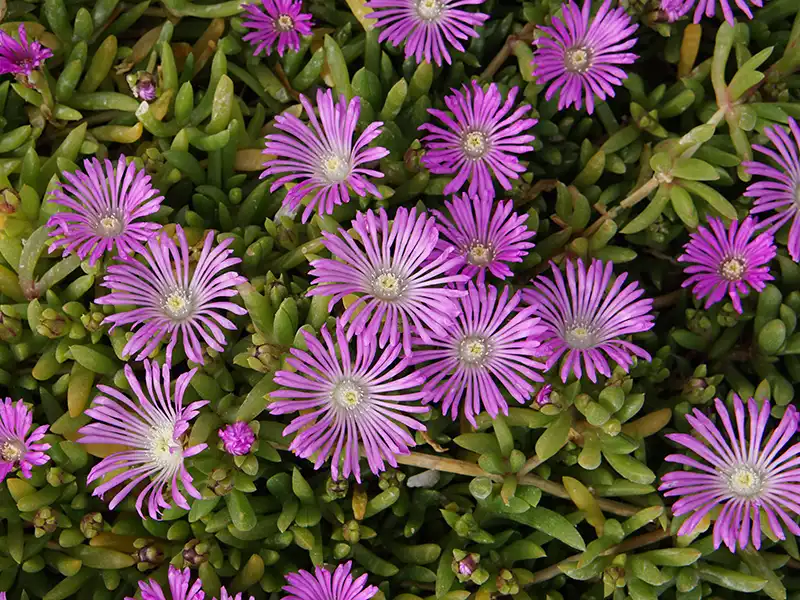
| Flowers and fruit | Pink to purple daisy-like flowers followed by seed capsules that become dry as they mature |
| Flowering period | Often spring to summer; flowering may occur at other times depending on climate |
| Position | Full sun to part shade |
| Soil | Adaptable to sand, loam and clay; well-drained conditions are useful for garden cultivation |
| Seeds per gram | To be confirmed for the supplied seed lot and preparation |
| Uses | Coastal gardens, rockeries, containers, embankments, edible native gardens and suitable saline-site revegetation |
Why Grow Round Leaf Pigface?
- Low-growing native succulent with colourful flowers.
- Spreading stems provide ground-level foliage cover.
- Tolerates drought and salinity once established.
- Useful in rockeries, containers and coastal landscapes.
- Flowers attract visiting insects.
- Edible succulent leaves offer a salty addition to meals.
- Suitable for locally appropriate soil-cover and revegetation plantings.
How to Grow Round Leaf Pigface from Seed
Start the small seeds in protected containers where moisture and watering can be controlled. The following is general nursery guidance; follow any additional instructions supplied for your seed lot.
- Prepare the growing medium. Use clean trays or small pots filled with a fine, free-draining seed-raising mix.
- Sow shallowly. Scatter seed thinly onto the damp surface and press gently into contact with the mix. If covering, use only a very light layer of fine washed sand.
- Water gently. Use a fine mist or gentle watering method to prevent seed from washing away.
- Maintain surface moisture. Keep the seedbed moist during emergence while allowing excess water to drain.
- Provide suitable conditions. Keep containers in a bright, sheltered position protected from intense heat, drying winds and severe frost.
- Allow time for emergence. Germination depends on seed quality and nursery conditions. Allow for uneven emergence rather than relying on a fixed number of days.
- Transplant established seedlings. Move seedlings into individual pots once they can be handled safely. Harden gradually before planting outdoors.
Round Leaf Pigface for Landscaping
Round Leaf Pigface creates a low layer of succulent foliage in mixed native beds. Its trailing stems can soften rock edges and cascade from containers or hanging baskets.
Leave room for spreading growth and trim stems where necessary to keep paths clear. Combine it with plants that suit the same light, soil and watering conditions.
Round Leaf Pigface for Revegetation and Soil Cover
Stems that root at the nodes help the plant develop spreading cover on suitable sites. It can be incorporated into locally appropriate coastal or inland saline vegetation plantings.
For restoration work, confirm the supplied subspecies and provenance. Match planting positions to the site’s drainage, salinity and vegetation community, and protect young plants while they establish.
Flowers and Foliage
The leaves are elongated and fleshy, with rounded angles in cross-section. Their shape gives this species a different texture from the larger, more sharply triangular leaves of many Carpobrotus pigfaces.
Pink-purple flowers open during the day and close at night. After flowering, the plant develops capsules containing small seeds.
Round Leaf Pigface in Edible Gardens
The succulent leaves are edible and valued for their salty flavour and crisp texture. Harvest small amounts from established plants for salads or cooked dishes, leaving sufficient foliage for continued growth.
Wash harvested leaves before use. This description focuses on the edible foliage rather than treating the mature seed capsules as the fleshy fruits of Carpobrotus pigface.
Where to Grow Round Leaf Pigface
- Sunny native garden beds.
- Coastal landscapes and rockeries.
- Containers and hanging baskets.
- Suitable embankments and informal garden edges.
- Edible native plant gardens.
- Locally appropriate saline-site revegetation projects.
When to Sow Round Leaf Pigface Seeds in Australia
TreeProject recommends late spring to summer in its Victorian nursery guidance. The following table provides general planning guidance across climates. Maintain surface moisture and avoid extreme propagation temperatures.
| Climate Zone | Suitable Sowing Period | Growing Notes |
|---|---|---|
| Cool | Late spring to early summer under protected conditions | Protect emerging seedlings from severe weather and maintain surface moisture. |
| Temperate | Late spring to summer with heat protection | Shelter containers from drying winds and excessive heat. |
| Subtropical | Mild to warm periods under managed conditions | Maintain drainage and avoid excessive tray temperatures. |
| Tropical | Milder periods under controlled nursery conditions, where suitable | Confirm provenance suitability and protect seed from heavy rain. |
| Arid / Semi-arid | Mild, warm periods with reliable irrigation | Prevent surface drying during emergence and provide establishment watering. |
Tips for Growing Round Leaf Pigface Successfully
- Use clean containers and a suitable seed-raising medium.
- Sow thinly and avoid burying small seeds deeply.
- Water gently during emergence.
- Protect propagation trays from intense heat.
- Harden seedlings gradually before outdoor planting.
- Control competing weeds during establishment.
- Allow room for stems to spread.
- Harvest edible foliage sparingly from established plants.
Frequently Asked Questions
What is Round Leaf Pigface?
Round Leaf Pigface is a low-growing succulent botanically known as Disphyma crassifolium. The Australian form is generally identified as subsp. clavellatum.
Is it the same as Native Pigface?
It belongs to a different genus from Carpobrotus rossii. Both are succulent groundcovers in the family Aizoaceae.
Are the leaves edible?
Yes. The fleshy leaves can be eaten fresh or cooked and have a salty flavour.
Is Round Leaf Pigface drought tolerant?
Established plants tolerate dry conditions. Germinating seed and newly planted seedlings still require reliable moisture.
Can it grow in containers?
Yes. Its trailing habit suits pots and hanging baskets with suitable drainage and light.
Is it a perennial?
It commonly grows as a perennial in cultivation, although botanical descriptions also record annual or short-lived plants.
Can it be used for revegetation?
Yes, where the species, provenance and site conditions suit the local vegetation community.
Grow Round Leaf Pigface from Seed
Round Leaf Pigface offers succulent foliage, colourful flowers and spreading groundcover for suitable garden and landscape positions.
Start seed in protected containers, maintain moisture during emergence and allow seedlings to establish before planting into their permanent position.
Reviews
There are no reviews yet.