
Phalaris Lawn Seeds
Establish a hardy, persistent perennial grass cover for acreage, large lawns, rural properties and utility grassed areas with Phalaris Lawn Seeds.
Phalaris (Phalaris aquatica) is a deep-rooted, cool-season perennial grass valued for its persistence, drought tolerance and ability to recover strongly when favourable growing conditions return.
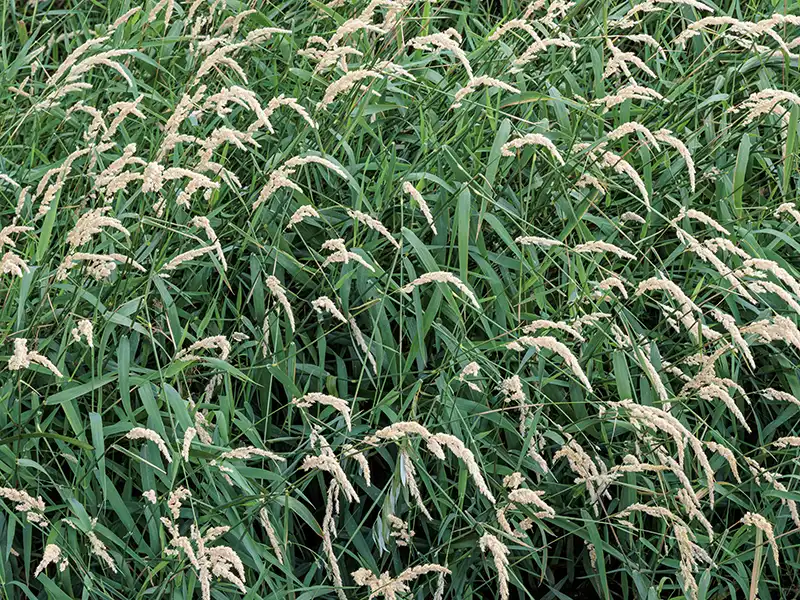
Unlike fine-textured turf grasses such as Couch or Queensland Blue Couch, Phalaris develops a coarser, tufted growth habit. It is best suited to larger areas where durability, groundcover and persistence are more important than creating a closely manicured ornamental lawn.
Phalaris grows most actively during autumn, winter and spring and performs particularly well in temperate regions with moderate rainfall and reasonably fertile soils.
Phalaris Lawn Seed Details
| Common name | Phalaris / Australian Phalaris |
|---|---|
| Botanical name | Phalaris aquatica |
| Plant type | Cool-season perennial grass |
| Growth habit | Deep-rooted, tufted perennial with short rhizomes |
| Best use | Acreage lawns, rural properties, utility grassed areas, large open spaces and perennial groundcover |
| Position | Full sun preferred |
| Main growth period | Late autumn, winter and spring |
| Soil preference | Moderate to high fertility soils; performs particularly well in heavier soils |
| Watering | Maintain consistent moisture during germination and early establishment |
Why Choose Phalaris Lawn Seed?
- Long-lived perennial grass capable of forming persistent grass cover once established.
- Deep root system provides useful tolerance to periods of dry weather.
- Strong cool-season growth through autumn, winter and spring.
- Suitable for large lawns, acreage properties and practical utility areas.
- Performs well on deeper, reasonably fertile soils.
- Can tolerate periods of waterlogging better than many temperate grasses.
- Good persistence once a mature stand has developed.
- Useful where a hardy, practical grass cover is preferred over fine ornamental turf.
Where Is Phalaris Best Used?
Phalaris is best considered a hardy utility grass rather than a fine turf species. Its persistence and perennial growth make it particularly useful for larger properties and less intensively managed grassed areas.
| Acreage lawns | Suitable for large grassed areas where persistence and practical groundcover are more important than fine turf texture. |
|---|---|
| Rural properties | Useful around rural homes, farm buildings and larger open spaces where a tough perennial grass is required. |
| Utility grassed areas | Suitable for practical grass cover where appearance is secondary to durability and persistence. |
| Cool-season groundcover | Provides its strongest growth during the cooler months when many warm-season lawn grasses slow down. |
| Heavier soils | Particularly well suited to deeper, heavier and reasonably fertile soils where suitable moisture is available. |
Is Phalaris a Fine Lawn Grass?
No. Phalaris should not be confused with fine turf species such as Couch, Kentucky Bluegrass or Queensland Blue Couch.
It naturally develops a tufted, comparatively coarse growth habit and can produce tall flowering stems if allowed to mature. Regular mowing can maintain a shorter grassed area, but the finished appearance will be more natural and functional than a closely manicured turf lawn.
How to Sow Phalaris Lawn Seed
Phalaris seedlings can be relatively slow to establish and may struggle when competing with existing weeds or vigorous grasses. Good seedbed preparation and weed control are therefore particularly important.
- Remove weeds and unwanted vegetation.
Control existing weeds and competing grasses before sowing. Young Phalaris seedlings establish best where competition is kept to a minimum. - Prepare a firm, fine seedbed.
Loosen compacted soil where necessary, remove large clods and rake the surface reasonably level. - Broadcast the seed evenly.
Divide the seed into two portions and sow in two directions across the area to improve distribution. - Keep sowing shallow.
Lightly rake the seed into the surface rather than burying it deeply. Good seed-to-soil contact is important for successful establishment. - Firm the surface.
Gently roll or press the seedbed after sowing to improve contact between the seed and moist soil. - Water gently.
Use a fine spray to moisten the soil thoroughly without washing seed away. - Maintain consistent moisture.
Keep the upper soil layer moist while seedlings emerge and develop their initial root system. - Begin mowing only after establishment.
Allow plants to develop sufficient roots and leaf growth before beginning regular mowing.
Phalaris Establishment & Growth
Phalaris should not be expected to produce an instant lawn. Young plants initially establish more slowly than fast-germinating grasses such as Ryegrass.
Once established, however, Phalaris develops a deep and extensive root system and can become a very persistent perennial grass. Its strongest seasonal growth generally occurs from autumn through spring.
- Expect slower initial establishment than many conventional lawn grasses.
- Reduce weed competition during the seedling stage.
- Maintain moisture while seedlings develop.
- Avoid heavy traffic during establishment.
- Growth becomes stronger as plants develop their permanent root system.
- Established plants can persist for many years under suitable conditions.
When to Sow Phalaris in Australia
Phalaris is a temperate, cool-season perennial grass. It generally establishes best when soil moisture is reliable and temperatures are suitable for cool-season grass growth.
| Climate | General Sowing Guide |
|---|---|
| Subtropical | Best considered for cooler districts and suitable soils. Autumn establishment is generally preferable where summer heat is significant. |
| Warm temperate | Autumn is generally the preferred sowing period where reliable moisture is available. |
| Temperate | Autumn is typically ideal, with early spring also possible where soil moisture and conditions are suitable. |
| Cool / tablelands | Autumn or early spring can be suitable depending on frost, rainfall and available irrigation. |
For best results, consider local rainfall, soil moisture, summer heat and frost conditions when selecting a sowing period.
Soil & Site Requirements
- Performs particularly well on deeper, heavier-textured soils.
- Prefers moderate to high soil fertility.
- Can tolerate periods of wet or poorly drained soil once established.
- Established plants have useful drought tolerance because of their deep root system.
- Highly acidic soils can reduce performance.
- Good weed control and seedbed preparation are especially important during establishment.
Lawn Care & Maintenance
- Maintain consistent moisture during germination and early establishment.
- Control weeds while Phalaris seedlings are becoming established.
- Avoid heavy traffic until plants have developed a strong root system.
- Mow regularly if a shorter lawn-like appearance is required.
- Avoid repeatedly scalping plants down to soil level.
- Expect stronger growth during autumn, winter and spring than during hot summer conditions.
- Maintain reasonable soil fertility to encourage dense, healthy growth.
Important Information for Properties with Livestock
Phalaris is widely used as a grazing pasture grass; however, livestock owners should be aware that Phalaris can be associated with livestock toxicity under certain conditions, particularly in sheep.
If the area will be grazed by livestock, appropriate pasture and livestock management should be followed. Seek local agronomic or veterinary advice where Phalaris will form part of a grazing system.
Frequently Asked Questions
What is Phalaris Lawn Seed?
Phalaris Lawn Seed is seed of Phalaris aquatica, a deep-rooted perennial temperate grass. It is primarily used as a pasture and utility grass but can also be used for larger, more natural grassed areas where durability and persistence are more important than fine turf texture.
Is Phalaris suitable for a home lawn?
It can be used where a hardy, coarse-textured grass cover is acceptable. It is generally better suited to acreage, rural properties and utility areas than highly manicured residential lawns.
Does Phalaris produce a fine lawn?
No. Phalaris has a broader, tufted growth habit compared with fine turf grasses such as Couch or Queensland Blue Couch.
Is Phalaris perennial?
Yes. Phalaris is a long-lived perennial grass and can remain persistent for many years when grown in suitable conditions.
When does Phalaris grow most strongly?
Phalaris is a cool-season grass, with its strongest growth generally occurring during late autumn, winter and spring.
Is Phalaris drought tolerant?
Established Phalaris has useful drought tolerance because of its deep and extensive root system. Young seedlings still require reliable moisture during establishment.
Can Phalaris tolerate wet soil?
Established Phalaris can tolerate periods of waterlogging and performs well on many heavier soils, provided other soil conditions are suitable.
Can Phalaris grow in acidic soil?
Phalaris is generally less tolerant of strongly acidic soils than some other perennial grasses. Soil testing and correction of major fertility or acidity issues may improve establishment and persistence.
Can Phalaris be mown?
Yes. Regular mowing can maintain a shorter and more uniform grassed area. However, because Phalaris is naturally a tufted pasture grass, it will not develop the same fine finish as specialist turf varieties.
Is Phalaris suitable for Queensland?
Phalaris is primarily adapted to temperate and cooler districts. In Queensland it is generally more appropriate for cooler inland or elevated locations than hot tropical or strongly subtropical coastal conditions.
Is Phalaris suitable for New South Wales?
Yes. Phalaris is widely adapted to suitable temperate areas of New South Wales, particularly the Tablelands and Slopes where soil, rainfall and fertility conditions are appropriate.
Can livestock graze Phalaris?
Phalaris is widely grown as a pasture grass, but it can cause livestock toxicity under certain circumstances. Livestock owners should follow appropriate grazing management and seek local agronomic or veterinary advice.
Reviews
There are no reviews yet.