
Kohlrabi Purple Microgreen Seeds
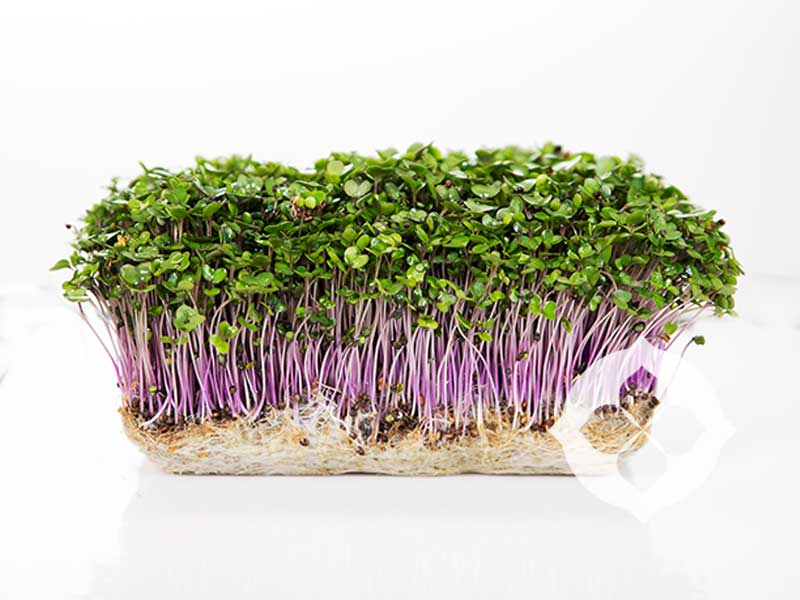
Grow colourful purple kohlrabi microgreens at home in approximately 10–15 days. Purple kohlrabi microgreen seeds produce attractive young seedlings with vivid purple to mauve stems, dark green seed leaves and a mild, fresh brassica flavour. They are easy to grow in shallow trays using soil, coir, hemp growing mats or other suitable microgreen growing media.
Purple Kohlrabi is an excellent microgreen variety for home growers, chefs and commercial microgreen production. Its contrasting purple stems and green leaves make it particularly attractive in salads, sandwiches, wraps, bowls and garnishes, while its mild flavour makes it easy to combine with stronger microgreens such as radish and mustard.
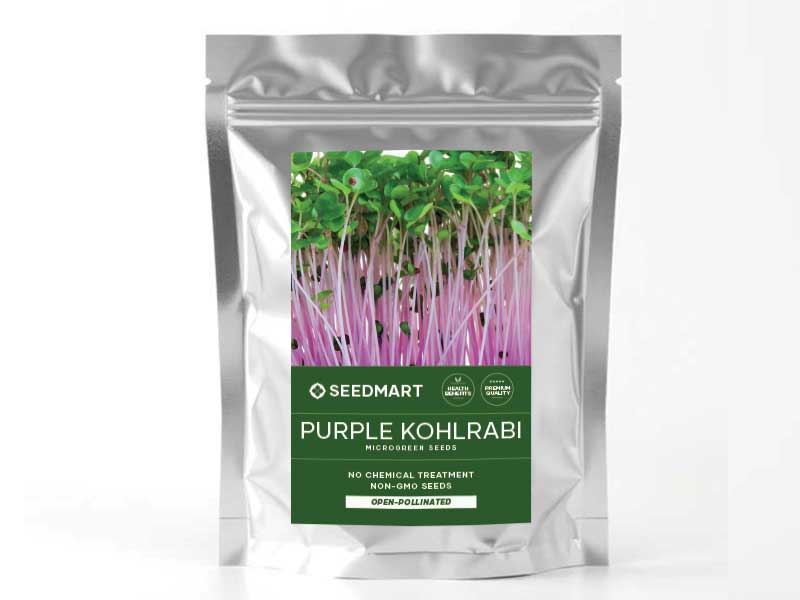
Seedmart Purple Kohlrabi Microgreen Seeds are supplied for growing purposes and are available in packet and bulk quantities for home and commercial growers.
Purple Kohlrabi Microgreen Seed Details
| Botanical name | Brassica oleracea var. gongylodes |
|---|---|
| Type | Purple Kohlrabi Microgreen |
| Plant family | Brassicaceae |
| Pre-soak | Not required |
| Approximate sowing rate | Approximately 10–20 g per 10 × 20 inch tray as a starting range; adjust for seed size, tray type and preferred density |
| Growing medium | Soil, coir, hemp growing mats or another suitable microgreen medium |
| Germination | Approximately 2–4 days under suitable conditions |
| Typical harvest | Approximately 10–15 days |
| Colour | Purple to mauve stems with dark green cotyledons, often showing a purple tint |
| Flavour | Mild, fresh cabbage and kohlrabi flavour |
| Availability | Packet and bulk quantities |
Why Grow Purple Kohlrabi Microgreens?
- Fast-growing microgreen variety with a typical crop cycle of approximately 10–15 days.
- Distinctive purple to mauve stems provide excellent visual contrast.
- Dark green cotyledons develop above the colourful stems for an attractive finished crop.
- Mild brassica flavour suitable for salads, sandwiches, wraps and garnishes.
- Suitable for indoor production throughout the year with adequate light and ventilation.
- Can be grown on soil, coir or suitable microgreen growing mats.
- No seed pre-soaking required.
- Suitable for home growers, chefs and commercial microgreen production.
- Works well on its own or as a colourful component of mixed microgreen crops.
- Available in smaller packets and economical bulk quantities.
How to Grow Purple Kohlrabi Microgreens
Purple Kohlrabi microgreens are relatively easy to grow and follow a similar production method to broccoli, cabbage and other small-seeded brassica microgreens. The seeds do not normally require pre-soaking and can be sown directly onto a moist growing medium.
For a standard 10 × 20 inch microgreen tray, approximately 10–20 grams of seed provides a useful starting range. Exact sowing density can be adjusted according to seed size, growing system, harvest stage and preferred crop density.
- Prepare the growing tray.
Add approximately 3–4 cm of moist growing medium to a shallow tray and gently level the surface. Suitable media include quality soil, coir or a purpose-made hemp growing mat. - Sow the Purple Kohlrabi seeds.
Spread the seed evenly across the growing surface. Aim for good, consistent coverage without allowing the seeds to pile heavily on top of one another. - Mist thoroughly.
Use a spray mister to moisten the seeds and growing surface evenly and help establish good contact between the seeds and growing medium. - Cover or stack the tray.
Cover the seeded tray with another tray or suitable cover during initial germination. Light, even pressure can help encourage consistent seed-to-medium contact and strong initial growth. - Maintain moisture during germination.
Keep the growing medium evenly moist without saturating it. Purple Kohlrabi commonly begins germinating within approximately 2–4 days under suitable conditions. - Introduce the seedlings to light.
Once the seedlings are established and pushing upward, remove the cover and expose them to suitable natural or artificial growing light. Good light helps develop compact growth and strong stem and leaf colour. - Water carefully.
Continue watering as required to maintain even moisture. Bottom watering after establishment can help keep the foliage drier and reduce unnecessary surface moisture in dense trays. - Harvest the microgreens.
Purple Kohlrabi microgreens are commonly ready for harvest approximately 10–15 days after sowing. Cut the stems cleanly just above the growing medium when the crop has reached your preferred size and colour.
What Do Purple Kohlrabi Microgreens Look Like?
Purple Kohlrabi is particularly popular as a microgreen because of its attractive colour contrast. The seedlings develop slender purple to pinkish-mauve stems topped by rounded dark green cotyledons, which can also show subtle purple colouring.
The combination gives Purple Kohlrabi a more decorative appearance than many completely green brassica microgreens and makes it especially useful for restaurant garnishes, salad mixes and colourful microgreen blends.
Colour intensity can vary according to seed genetics, growing temperature, light intensity, crop age and other growing conditions.
What Do Purple Kohlrabi Microgreens Taste Like?
Purple Kohlrabi microgreens have a mild, fresh brassica flavour reminiscent of cabbage, broccoli stems and mature kohlrabi. The flavour is generally less pungent than mustard or radish microgreens, making Purple Kohlrabi a versatile option for a wide range of dishes.
Their tender stems and crisp young leaves work particularly well in salads, sandwiches, wraps, grain bowls and cold dishes. They can also be used as an attractive fresh garnish where both colour and flavour are important.
Because the flavour is relatively mild, Purple Kohlrabi is also useful as a colourful base or supporting ingredient in mixed microgreen blends.
How to Use Purple Kohlrabi Microgreens
Purple Kohlrabi microgreens combine attractive colour with a mild flavour, making them particularly versatile in the kitchen.
- Salads: Add to leafy salads for fresh brassica flavour and contrasting purple stems.
- Sandwiches: Layer into sandwiches and rolls for colour, texture and fresh flavour.
- Wraps: Use in wraps, tacos and filled flatbreads.
- Bowls: Scatter over grain bowls, vegetable bowls and other cold dishes.
- Garnishes: Use the colourful seedlings to finish restaurant-style dishes and platters.
- Microgreen mixes: Combine with green broccoli, radish, mustard or other microgreens to introduce colour variation.
Purple Kohlrabi microgreens are best added fresh or towards the end of preparation so their colour, texture and delicate flavour are retained.
Purple Kohlrabi Microgreens and Brassica Vegetables
Kohlrabi belongs to the Brassicaceae family and is closely related to broccoli, cabbage, kale and cauliflower. Purple Kohlrabi microgreens are the young seedlings of the same type of plant that would eventually develop into mature kohlrabi if allowed to continue growing.
Like other edible brassicas, young kohlrabi plants naturally contain a range of plant compounds including glucosinolates. The amount and composition of naturally occurring compounds can vary according to variety, growing conditions, crop age, harvest stage and preparation.
Microgreens are harvested primarily for their tender young stems and seed leaves, well before the swollen stem characteristic of mature kohlrabi develops.
Purple Kohlrabi vs Broccoli Microgreens
Purple Kohlrabi and broccoli are both brassica microgreens and have broadly similar growing requirements, but they differ noticeably in appearance and flavour.
| Feature | Purple Kohlrabi Microgreens | Broccoli Microgreens |
|---|---|---|
| Stem colour | Purple to mauve | Pale green to whitish-green |
| Leaf colour | Dark green, sometimes with a purple tint | Green |
| Flavour | Mild cabbage and kohlrabi flavour | Mild broccoli and brassica flavour |
| Pre-soak | Not required | Not required |
| Typical harvest | Approximately 10–15 days | Approximately 8–14 days |
Purple Kohlrabi is particularly useful when growers want the ease and mild flavour of a brassica microgreen with additional stem colour and visual interest.
Purple Kohlrabi Microgreens vs Mature Kohlrabi
Purple Kohlrabi microgreens and mature kohlrabi come from the same type of plant but are harvested at very different stages.
| Feature | Kohlrabi Microgreens | Mature Kohlrabi |
|---|---|---|
| Harvest stage | Young seedling stage | Developed vegetable plant |
| Harvested portion | Young stems and seed leaves | Primarily the enlarged swollen stem, with leaves also edible |
| Growing space | Shallow, densely sown tray | Garden bed or larger container with individual plant spacing |
| Typical crop time | Approximately 10–15 days | Several weeks to maturity, depending on variety and growing conditions |
Frequently Asked Questions
How long do Purple Kohlrabi microgreens take to grow?
Purple Kohlrabi microgreens are commonly ready to harvest approximately 10–15 days after sowing. Growth rate varies according to temperature, light, moisture, sowing density and the stage at which you prefer to harvest.
Do Purple Kohlrabi microgreen seeds need to be soaked?
No. Purple Kohlrabi seeds are small brassica seeds and do not normally require pre-soaking before sowing.
How many Purple Kohlrabi seeds should I use in a 10 × 20 tray?
Approximately 10–20 grams per standard 10 × 20 inch tray provides a useful starting range. Commercial recommendations vary according to growing system and harvest stage, so growers should adjust sowing density to suit their trays and preferred crop.
How long do Purple Kohlrabi seeds take to germinate?
Germination commonly begins within approximately 2–4 days under suitable warm, moist growing conditions.
Can Purple Kohlrabi microgreens be grown without soil?
Yes. Purple Kohlrabi can be grown using suitable soilless microgreen media such as coir or purpose-made growing mats. The medium should retain adequate moisture while still allowing drainage and airflow.
Do Purple Kohlrabi microgreens need light?
Light is not normally required during the initial covered germination stage. After the seedlings emerge and establish, expose them to suitable natural or artificial growing light so the cotyledons expand and develop good colour.
Why are Purple Kohlrabi microgreens purple?
Purple Kohlrabi varieties naturally develop anthocyanin pigmentation in their stems and other plant tissues. The exact intensity of the purple colouring can vary with genetics, light, temperature and crop age.
What colour are Purple Kohlrabi microgreens?
They typically produce purple to mauve stems with dark green cotyledons. Some leaves can also develop subtle purple colouring, creating an attractive contrast between the stems and foliage.
What do Purple Kohlrabi microgreens taste like?
Purple Kohlrabi microgreens have a mild, fresh brassica flavour reminiscent of cabbage, broccoli stems and mature kohlrabi. They are generally milder than strongly flavoured radish or mustard microgreens.
Are Purple Kohlrabi microgreens spicy?
They are generally mild rather than strongly spicy. Their flavour has a fresh cabbage-like character with only a gentle brassica bite.
When should I uncover Purple Kohlrabi microgreens?
Remove the cover once germination is established and the seedlings are pushing upward, commonly after approximately 2–4 days depending on temperature and growing conditions.
When should Purple Kohlrabi microgreens be harvested?
Harvest is commonly around 10–15 days after sowing. Cut the young stems cleanly just above the growing medium when the cotyledons are fully developed and the plants have reached your preferred size.
Can Purple Kohlrabi microgreens be grown indoors?
Yes. Purple Kohlrabi is well suited to indoor microgreen production and can be grown throughout the year when adequate growing light, moisture, airflow and suitable temperatures are provided.
Can I grow Purple Kohlrabi microgreens on a windowsill?
Yes, provided the seedlings receive sufficient light. A bright windowsill can work for small home crops, although dedicated growing lights generally provide more consistent light for larger or commercial production.
Can Purple Kohlrabi be mixed with other microgreens?
Yes. Its purple stems make it particularly useful in microgreen mixes. It combines well visually with green broccoli, kale and other brassicas and can also balance stronger-flavoured radish or mustard microgreens.
Are Kohlrabi microgreens the same plant as mature kohlrabi?
Yes. Kohlrabi microgreens are simply harvested at the young seedling stage. If suitable plants were grown to maturity with adequate spacing, they would eventually develop the enlarged stem associated with mature kohlrabi.
Where can I buy Purple Kohlrabi Microgreen Seeds in Australia?
Seedmart supplies Purple Kohlrabi Microgreen Seeds in packet and bulk quantities for home growers, chefs, microgreen growers and commercial businesses throughout Australia.
Need More Help Growing Purple Kohlrabi Microgreens?
Growing your own Purple Kohlrabi microgreens? Follow our step-by-step guide to growing Purple Kohlrabi microgreens for advice on sowing, germination, covered growing, watering, light and harvesting.
Ross Cotton –
Looks good strikes well will be continue using nice addition to a house mix