
Coast Banksia Seeds
Grow one of Australia’s most recognisable coastal native trees with Coast Banksia (Banksia integrifolia), a hardy evergreen species with attractive pale-yellow flower spikes and distinctive silver-backed foliage.
Coast Banksia is a versatile Australian native tree naturally associated with coastal environments of eastern Australia. It develops a spreading canopy of leathery green leaves with contrasting silvery-white undersides and produces cylindrical cream to pale-yellow flower spikes that provide an attractive feature through the cooler months.
Well suited to coastal gardens, native gardens, wildlife plantings, windbreaks, larger properties, revegetation and landscape projects, Coast Banksia is particularly valued for its tolerance of wind, salt exposure, sandy soils and a broad range of growing conditions.
Once established, it forms a substantial long-lived tree and should be positioned where it has sufficient space to develop.
Coast Banksia Seed Details
| Botanical name | Banksia integrifolia |
|---|---|
| Common names | Coast Banksia, Coastal Banksia |
| Family | Proteaceae |
| Plant type | Australian native evergreen tree |
| Approximate height | Commonly approximately 5–25 m depending on site and exposure; may become larger under favourable conditions |
| Flower colour | Cream to pale yellow |
| Indicative flowering period | Mainly autumn through early spring, with timing varying according to climate and location |
| Position | Full sun to light shade |
| Soil | Adaptable to a range of soils; particularly well suited to free-draining sandy and coastal soils |
| Sowing depth | Sow shallowly and cover lightly with fine seed-raising mix or sand |
| Typical germination | Approximately 2–6 weeks under suitable conditions |
| Seed treatment | No special pre-treatment is generally required for cleaned seed |
| Uses | Coastal gardens, native gardens, wildlife gardens, windbreaks, screening, revegetation, erosion-control plantings and larger landscape projects |
Why Grow Coast Banksia?
- Hardy Australian native evergreen tree suited to a broad range of landscapes.
- Produces distinctive cream to pale-yellow Banksia flower spikes.
- Attractive leathery green foliage with contrasting silvery-white undersides.
- Excellent tolerance of wind and coastal exposure once established.
- Adaptable to sandy soils and a range of other soil types.
- Useful for attracting native wildlife to larger gardens and landscapes.
- Suitable for revegetation, shelter, screening and coastal landscaping.
- Relatively straightforward to propagate from fresh, viable seed.
How to Grow Coast Banksia from Seed
Coast Banksia can be readily propagated from seed. Unlike many Australian native species with hard seed coats, Banksia integrifolia does not normally require hot-water treatment, scarification or smoke treatment before sowing.
- Choose suitable containers.
Use clean pots, tubes or propagation trays with good drainage. Deeper containers can be useful because Banksia seedlings begin developing substantial root systems while still young. - Prepare a free-draining seed-raising mix.
Use a clean, open propagation medium that drains freely while retaining enough moisture for germination. A sandy native seed-raising mix is suitable. - Sow the seed shallowly.
Place the seed on the prepared surface and cover lightly with fine seed-raising mix, washed sand or vermiculite. Avoid burying the seed deeply. - Water gently.
Use a fine spray to settle the seed into the growing medium without displacing it. - Keep moist but not waterlogged.
Maintain consistent moisture during germination, but ensure excess water drains freely. Saturated growing media can increase the risk of seedling disease. - Provide moderate temperatures.
Coast Banksia seed responds well to mild germination temperatures. Extremely hot conditions are best avoided during early propagation. - Allow seedlings to emerge.
Under favourable conditions, germination can occur within approximately 2–6 weeks. Germination time will vary according to temperature, seed viability and propagation conditions. - Pot seedlings on while young.
Seedlings raised together should be transferred into individual containers before their developing root systems become heavily intertwined. - Harden plants before planting out.
Gradually expose young plants to brighter light, wind and outdoor conditions before transplanting them into their permanent position.
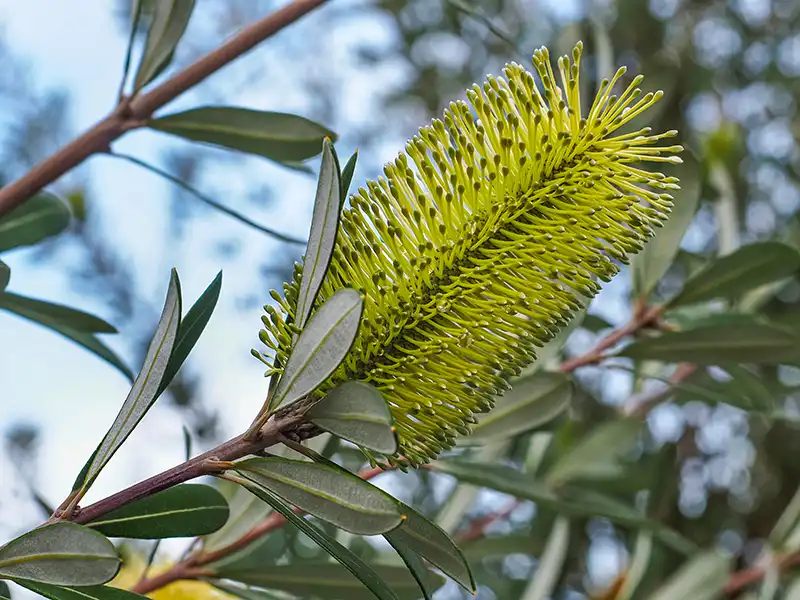
Cream and Pale-Yellow Banksia Flowers
Coast Banksia develops the distinctive cylindrical flower spikes associated with the Banksia genus.
The flowers are generally cream to pale yellow and are produced in dense cylindrical clusters. Each flower spike is made up of numerous individual flowers, producing the characteristic brush-like Banksia appearance.
Flowering commonly occurs through the cooler part of the year, particularly from autumn through winter and into spring, although exact timing varies according to location and growing conditions.
As the flowers mature, woody follicles develop on the old flower structures, creating the distinctive Banksia seed-bearing cones.
Distinctive Green and Silver Foliage
The foliage is one of the attractive features of Banksia integrifolia.
Leaves are leathery and generally dark to medium green on the upper surface, while the underside is noticeably paler and often appears silvery-white.
This contrast becomes particularly noticeable when foliage moves in coastal winds, giving established trees an attractive two-toned appearance.
Young leaves may have more noticeable teeth along their margins, while mature foliage is commonly smoother-edged.
Coast Banksia for Coastal Gardens
As its common name suggests, Coast Banksia is particularly well adapted to coastal environments.
Its natural habitat includes exposed coastal areas where plants may encounter sandy soils, wind and salt-laden air.
- Coastal gardens: useful where plants must tolerate wind and salt exposure.
- Sandy soils: naturally adapted to many free-draining coastal soils.
- Windbreaks: established trees can provide useful shelter on larger properties.
- Screening: evergreen foliage provides year-round structure.
- Coastal revegetation: useful in appropriate native restoration and landscape projects.
Young plants still require protection and reliable moisture while establishing. Their tolerance of exposed conditions improves as their root systems develop.
How Large Does Coast Banksia Grow?
Coast Banksia should be considered a medium to large native tree rather than a compact garden shrub.
Mature trees commonly reach approximately 5–25 m, with final size strongly influenced by climate, exposure, soil, moisture and local growing conditions. Particularly favourable sites can support even larger specimens.
In exposed coastal positions, trees may remain shorter and develop a more spreading or windswept form.
Allow adequate room between the planting position and buildings, paths, drains, overhead services and other trees.
For small suburban gardens, the mature dimensions should be considered carefully before planting.
What Soil Is Best for Coast Banksia?
Coast Banksia is adaptable to a surprisingly broad range of soils.
It performs particularly well in free-draining sandy and coastal soils, but can also grow in loams and other soil types where drainage and site conditions are suitable.
When growing Coast Banksia:
- Avoid permanently waterlogged soil.
- Improve drainage in heavy or compacted sites before planting.
- Do not assume highly fertile soil is required.
- Use native-plant fertilisers if supplementary feeding is necessary.
- Avoid fertilisers containing high levels of phosphorus.
Banksias have specialised root systems that are particularly efficient at obtaining nutrients from naturally nutrient-poor Australian soils.
Does Coast Banksia Need Full Sun?
Coast Banksia performs best in an open position receiving plenty of sunlight.
Full sun is preferred for strong growth and flowering, although plants can tolerate some light or partial shade.
Trees planted in an open sunny position generally develop stronger canopies and produce the best floral display.
Good airflow is also beneficial, particularly in humid climates.
Coast Banksia for Wildlife Gardens
Banksias are valuable structural plants in Australian wildlife gardens.
Their large flower spikes provide a substantial floral resource, while the branches and evergreen canopy contribute shelter and habitat within larger native plantings.
Coast Banksia can be incorporated into gardens designed to encourage native birds, insects and other wildlife.
For the greatest habitat value, combine it with a diversity of locally suitable Australian native shrubs, grasses and flowering groundcovers to provide different food and shelter resources throughout the year.
When Does Coast Banksia Flower?
Coast Banksia can flower over an extended period, with flowering commonly concentrated between approximately autumn and early spring.
Nindethana lists indicative flowering from approximately April through September.
Timing varies according to geographic location, climate, rainfall and the individual plant.
Trees grown from seed require time to develop before reaching flowering maturity, so Coast Banksia should be regarded as a long-term landscape tree rather than a fast-flowering annual or short-lived perennial.
Where to Grow Coast Banksia
Coast Banksia is best suited to sites with enough space to accommodate a substantial mature native tree.
- Australian native gardens.
- Coastal gardens.
- Wildlife and bird-friendly gardens.
- Large residential blocks.
- Rural properties.
- Windbreak and shelter plantings.
- Screening and boundary plantings.
- Parks and larger landscape projects.
- Coastal revegetation.
- Erosion-control and environmental plantings where the species is locally appropriate.
When using native seed for environmental restoration, locally appropriate provenance may be preferable where available.
Tips for Growing Coast Banksia Successfully
- Sow cleaned seed without hot-water treatment or scarification.
- Use a clean, free-draining propagation medium.
- Cover seeds only lightly after sowing.
- Keep the growing medium moist but never permanently saturated.
- Avoid extreme heat during germination.
- Transfer seedlings into individual containers while relatively young.
- Gradually harden seedlings before planting them into exposed positions.
- Choose a sunny site with enough space for a substantial mature tree.
- Water young trees while their root systems establish.
- Avoid high-phosphorus fertilisers.
- Allow extra space when planting close to buildings, paths and other infrastructure.
Frequently Asked Questions
What is Coast Banksia?
Coast Banksia is an Australian native evergreen tree botanically known as Banksia integrifolia. It produces leathery green and silver foliage together with cylindrical cream to pale-yellow flower spikes.
Is Coast Banksia native to Australia?
Yes. Banksia integrifolia is native to eastern Australia and is particularly associated with coastal environments in Queensland, New South Wales and Victoria.
How tall does Coast Banksia grow?
Trees commonly grow approximately 5–25 m tall depending on exposure, soil, rainfall and climate. Trees may become larger under particularly favourable conditions.
Is Coast Banksia evergreen?
Yes. Coast Banksia is an evergreen tree and retains foliage throughout the year.
What colour are Coast Banksia flowers?
The cylindrical flower spikes are generally cream to pale yellow.
When does Coast Banksia flower?
Flowering is commonly concentrated from autumn through winter and into spring. Nindethana lists an indicative flowering period from approximately April to September.
Do Coast Banksia seeds need smoke treatment?
No. Cleaned Banksia integrifolia seed does not generally require smoke treatment before sowing.
Do Coast Banksia seeds need hot-water treatment?
No. Hot-water treatment and scarification are not normally required. Sow viable cleaned seed directly into a suitable free-draining propagation mix.
How deep should Coast Banksia seed be planted?
Sow shallowly. Place the seed on the prepared propagation mix and cover lightly with fine mix, sand or vermiculite.
How long does Coast Banksia seed take to germinate?
Germination can occur in approximately 2–6 weeks under suitable conditions. Temperature, moisture and seed viability influence germination time.
What temperature is best for Coast Banksia germination?
Moderate conditions are preferred. Research on Banksia integrifolia indicates that relatively cool to mild temperatures are favourable, with approximately 18–23°C providing suitable conditions for germination.
Can Coast Banksia tolerate coastal conditions?
Yes. Coast Banksia is particularly well suited to coastal environments and has good tolerance of wind, sandy soils and salt exposure once established.
Can Coast Banksia grow in sandy soil?
Yes. Free-draining sandy soils are particularly suitable and are common within the species’ natural coastal habitat.
Can Coast Banksia grow in other soils?
Yes. The species is adaptable to a range of soil types provided the site is suitable and does not remain permanently waterlogged.
Does Coast Banksia need full sun?
Full sun is preferred for strong growth and flowering, although established plants can tolerate some light or partial shade.
Is Coast Banksia drought tolerant?
Established trees have useful tolerance of dry conditions, but young plants require reliable moisture while their root systems develop.
Is Coast Banksia suitable for small gardens?
Usually only where adequate space is available. Coast Banksia can become a substantial tree, so its mature height, canopy and root system should be considered before planting near buildings or other infrastructure.
Can Coast Banksia be used as a windbreak?
Yes. Its evergreen growth and tolerance of exposed coastal conditions can make it useful for shelter and windbreak plantings on larger properties.
Should I fertilise Coast Banksia?
Heavy fertilising is generally unnecessary. If fertiliser is required, use a product formulated for Australian native plants and avoid high levels of phosphorus.
Can Coast Banksia be grown for revegetation?
Yes. It is widely suited to coastal and native revegetation projects where Banksia integrifolia is appropriate to the local environment. For ecological restoration, locally appropriate provenance should be considered where available.
Grow Coast Banksia from Australian Native Seed
With its pale-yellow flower spikes, distinctive green and silver foliage, coastal resilience and substantial evergreen form, Banksia integrifolia is an excellent Australian native tree for larger gardens, coastal landscapes, wildlife plantings and revegetation projects.
For best results, sow the seed shallowly into a clean, free-draining propagation mix, maintain consistent moisture without waterlogging and transplant young seedlings carefully before their developing root systems become crowded.
Choose a permanent planting site with plenty of sunlight and sufficient room for the tree to develop into an impressive long-lived Coast Banksia.
Reviews
There are no reviews yet.