
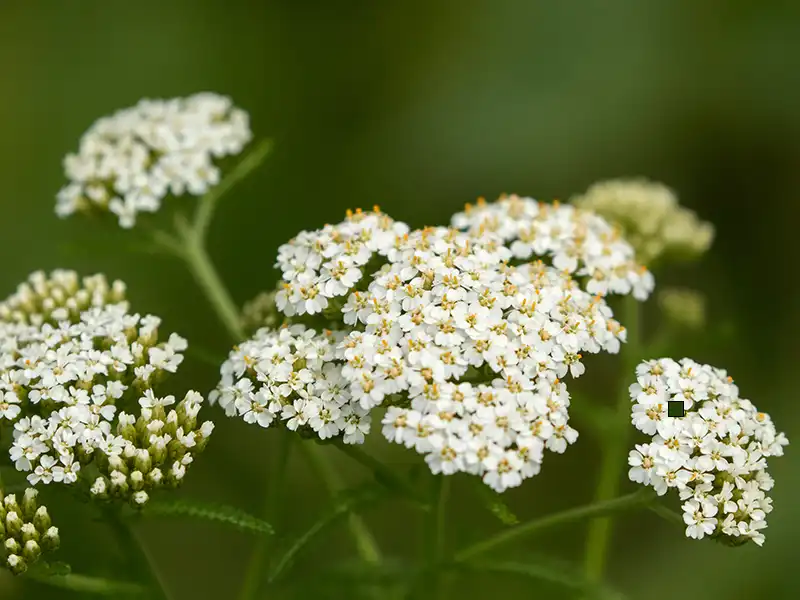
Yarrow (Achillea millefolium) is a hardy perennial herb grown for its aromatic, finely divided foliage and broad clusters of small white flowers. It is well suited to sunny Australian herb gardens, cottage borders, beneficial-insect plantings and water-wise gardens where its spreading growth can be appropriately managed.
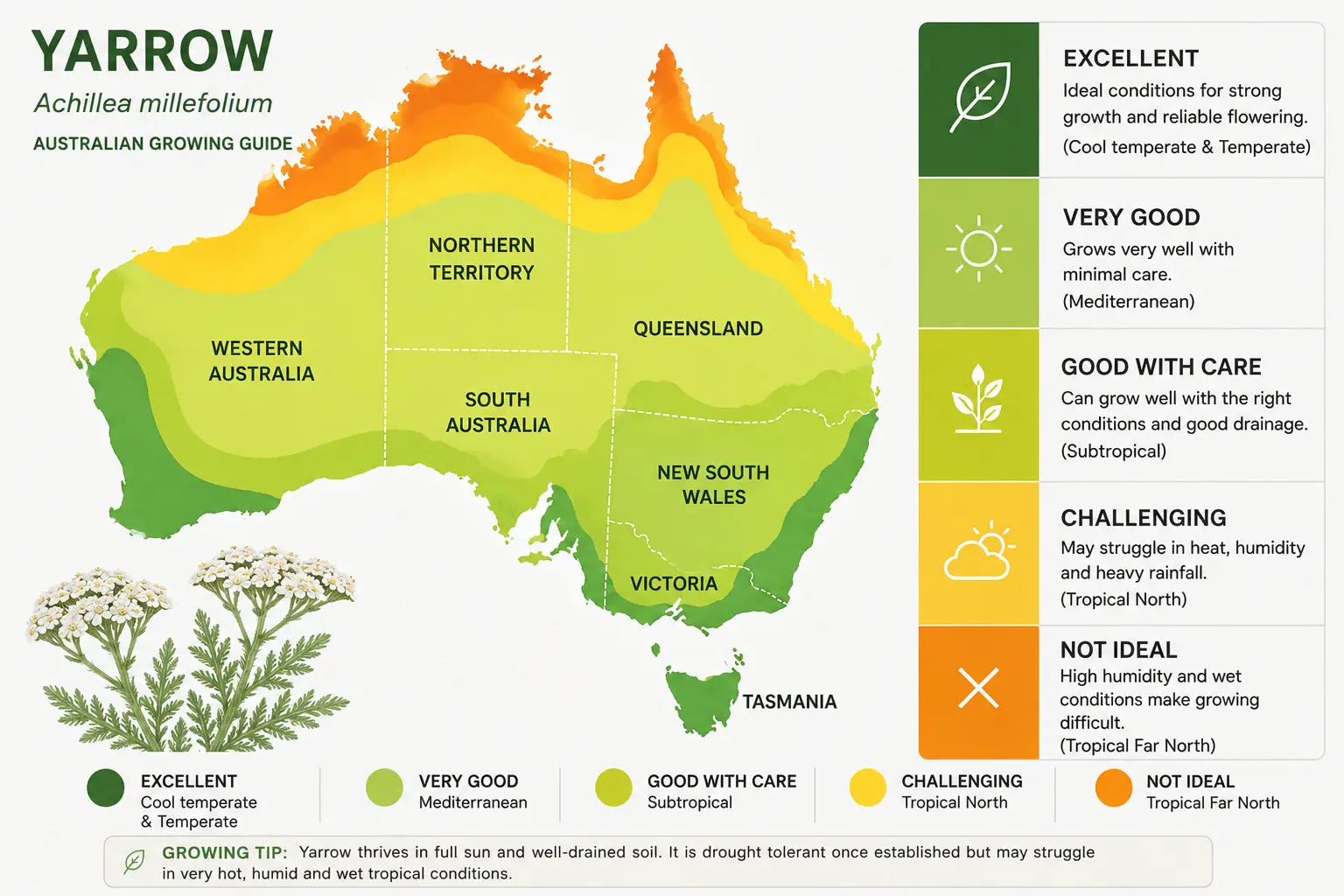
Yarrow grows across a wide range of Australian climates, particularly in cool, temperate and suitable subtropical districts. Once established, it tolerates heat, frost and periods of dry weather, but it performs best in full sun and freely draining soil. The tiny seeds should be surface sown because light assists germination.
Common yarrow is an introduced plant that has naturalised in parts of Australia. It spreads through underground rhizomes and may also self-seed. Grow it in a managed garden area, remove unwanted shoots and flower heads, and avoid planting it beside bushland, waterways, conservation areas or agricultural land where escape could create a weed problem.
| Feature | Yarrow |
|---|---|
| Botanical name | Achillea millefolium |
| Plant family | Asteraceae |
| Plant type | Herbaceous perennial |
| Typical height | Approximately 40–100 cm |
| Position | Full sun |
| Sowing depth | Surface sow |
| Germination time | Approximately 10–21 days |
| Flowering period | Generally late spring to autumn |
| Plant spacing | Approximately 30–45 cm |
| Life cycle | Perennial |
What Is Yarrow?
Yarrow is a flowering perennial herb in the daisy family. It develops a low basal growth of soft, deeply divided leaves before producing upright stems topped with flattened clusters of many small flowers.
The species Achillea millefolium generally produces white flower heads, although naturally occurring plants may display cream, pale pink or faint mauve colouring. Named ornamental yarrow cultivars are also available in yellow, red, apricot, pink and other colours, but these are selected varieties rather than the typical white-flowering species.
Yarrow foliage is often described as feathery or fern-like. The leaves are aromatic when crushed and remain relatively low to the ground while the flowering stems rise above them.
The plant expands through underground stems called rhizomes. These rhizomes allow an established yarrow plant to form an increasingly broad patch. Mature flowers may also produce seed, creating a second method of spread.
Is Yarrow Native to Australia?
Common yarrow, Achillea millefolium, is not native to Australia. It originated outside Australia and has become naturalised in several states and territories.
It is found in disturbed ground, roadsides, pastures, lawns, grasslands and some cooler natural environments. Gardeners should therefore manage its rhizomes and prevent unwanted seed production, particularly where a property adjoins environmentally sensitive land.
The name yarrow is applied to several plants and ornamental cultivars. When growing common white yarrow from seed, check that the botanical name is Achillea millefolium.
Does Yarrow Grow in Australia?
Yarrow can grow successfully across much of Australia. It is most naturally suited to cool and temperate climates, but it can also be grown in subtropical areas when planted during the cooler part of the year and provided with excellent drainage.
Established plants tolerate frost and dry periods. Yarrow may struggle in persistently hot, wet and humid tropical conditions, particularly where the soil remains saturated during the wet season.
In dry inland areas, yarrow can perform well when young plants receive regular moisture during establishment. Once the roots and rhizomes are developed, the plant becomes considerably more drought tolerant.
Successful cultivation depends less on rich soil than on good drainage, adequate sunlight and responsible management of the plant’s spreading habit.
When to Plant Yarrow in Australia
Yarrow seed can generally be sown during mild spring or autumn weather. The best time depends on local temperature, rainfall, summer heat and winter frost.
Spring sowing gives seedlings time to establish before summer. Autumn sowing can also be effective in temperate and mild climates because the plants develop roots during cooler weather before producing stronger spring growth.
| Australian climate | Suggested sowing period | Growing notes | Likely flowering |
|---|---|---|---|
| Cool temperate Canberra, Hobart, the tablelands and cool inland districts |
September to November or February to April | Sow after severe frost has eased in spring, or early enough in autumn for seedlings to establish before very cold weather. | Summer to early autumn, sometimes most strongly from the second growing season |
| Temperate Melbourne, Adelaide, Sydney and similar districts |
March to May and August to November | Autumn and spring usually provide favourable temperatures for germination and transplant establishment. | Late spring through summer and into autumn |
| Subtropical Brisbane, southeast Queensland and northern NSW |
March to August | Sow during the cooler, less humid part of the year. Avoid waterlogged positions and provide strong airflow. | Spring to early summer, depending on sowing time |
| Tropical Darwin, Cairns and humid northern districts |
April to July | Grow during the cooler dry season in a sunny position with exceptional drainage. Long-term persistence may be unreliable in very humid locations. | During the dry season or as temperatures begin to warm |
| Arid and semi-arid Warm inland districts |
March to May and August to October | Establish plants during mild weather and provide regular water until the root system is developed. | Spring and summer where sufficient moisture is available |
These periods are general Australian guidelines. Local elevation, frost dates, rainfall, irrigation, soil temperature and extreme heat should also be considered.
How to Grow Yarrow from Seed
Yarrow is relatively easy to raise from seed when the seeds are sown on the surface and kept consistently moist. The seeds are extremely small and should not be planted at the depth used for larger herb or vegetable seeds.
Light assists germination. Covering yarrow seed too deeply is one of the most common reasons for poor or uneven emergence.
| Growing factor | General guide |
|---|---|
| Sowing method | Surface sow in trays, cells, pots or a finely prepared seedbed |
| Sowing depth | Do not bury; press gently onto the surface |
| Light requirement | Light assists germination |
| Germination temperature | Approximately 18–24°C |
| Germination time | Commonly approximately 10–21 days |
| Plant spacing | Approximately 30–45 cm |
| Position | Full sun |
| Soil | Moderately fertile to lean, freely draining soil |
| Watering | Consistent moisture during germination and establishment |
| Container size | One plant or a managed clump in a medium to large pot |
Step-by-Step Sowing Instructions
1. Choose the Correct Sowing Time
Sow during mild spring or autumn weather. In subtropical and tropical districts, favour the cooler and less humid months.
2. Prepare the Seed-Raising Mix
Fill a tray, small pots or cell containers with a fine, freely draining seed-raising mix. Level the surface and moisten it before sowing.
3. Sow the Seed Thinly
Scatter the tiny yarrow seeds sparingly across the surface. Mixing the seed with a small amount of dry fine sand can make even distribution easier.
4. Press the Seeds Into Place
Gently press the seeds against the moist surface using a flat board, the back of a spoon or clean fingertips. Do not bury them.
5. Maintain Light and Moisture
Place the tray in bright filtered light. Keep the surface evenly moist with a fine mist or bottom watering, but do not saturate the mix.
6. Provide Suitable Warmth
Maintain a temperature of approximately 18–24°C where practical. Germination commonly occurs within 10–21 days.
7. Move Seedlings Into Stronger Light
After emergence, provide bright light and good airflow. Weak light can produce thin, stretched seedlings.
8. Thin Overcrowded Seedlings
Remove or transplant excess seedlings once they can be handled. Crowded seedlings compete for light and are more vulnerable to damping-off.
9. Pot Seedlings Individually
Transfer seedlings into cells or small pots after they develop true leaves and are large enough to handle safely.
10. Harden Before Transplanting
Gradually expose indoor-raised seedlings to outdoor sun, wind and temperature changes over approximately one week.
11. Plant Into the Garden
Space plants approximately 30–45 cm apart in a sunny, freely draining position.
12. Water During Establishment
Water regularly until the young plants are actively growing and developing strong roots.
Yes. Yarrow seeds should be surface sown because exposure to light assists germination. Press them firmly against the moist growing medium, but do not cover them with a normal layer of soil or potting mix.
What Do Yarrow Seeds and Seedlings Look Like?
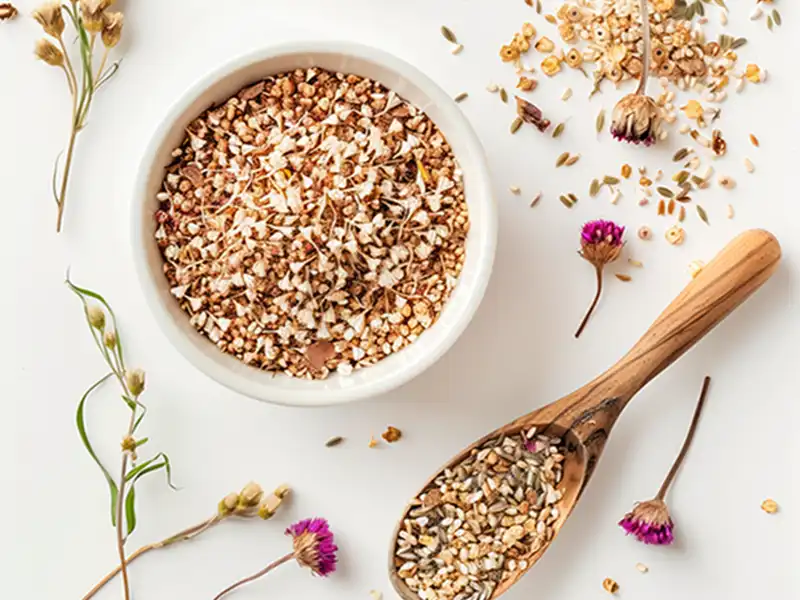
Yarrow seeds are very small, narrow and lightweight. Their small size makes them easy to sow too thickly, particularly when they are scattered directly from the packet.
Newly emerged yarrow seedlings are also extremely small. The first seed leaves are simple and do not immediately resemble the mature fern-like foliage.
As the seedlings develop, their true leaves become progressively more divided. The characteristic feathery appearance becomes easier to recognise as several sets of true leaves form.
When raising yarrow outdoors, label the sowing area carefully. Small weed seedlings can otherwise be difficult to distinguish from the crop during the earliest growth stages.
Yarrow Sun, Soil and Water Requirements
Does Yarrow Need Full Sun?
Yarrow performs best in full sun. Aim for at least six hours of direct sunlight each day, with open all-day sun producing the strongest stems and most reliable flowering.
Plants grown in excessive shade may survive, but they often become taller, softer and less floriferous. Weak stems may lean or collapse, especially after rain.
Light afternoon shade can be tolerated in extremely hot districts, but the plant should still receive substantial direct sunlight.
Best Soil for Yarrow
Yarrow grows in sandy, loamy, gravelly and moderately poor soils, provided excess water can drain away. It does not require heavily enriched garden soil.
Moderately lean conditions often produce shorter, sturdier plants. Rich soil and excessive nitrogen can encourage lush foliage and tall, weak flower stems.
Heavy clay should be improved before planting, particularly where it remains wet after rain. Raised beds, mounded planting areas or large containers may be preferable where garden drainage cannot be corrected.
Yarrow tolerates a broad soil pH range and is generally less demanding about pH than it is about drainage.
Watering Yarrow
Keep the seed-raising mix consistently moist while seeds germinate. Because the seeds remain on the surface, they can dry quickly and may need regular light misting.
Young transplants also require reliable moisture while their roots become established. Water deeply enough to moisten the root zone, then allow the upper soil to begin drying before watering again.
Established yarrow is drought tolerant, but this does not mean it grows indefinitely without water. Occasional deep watering can maintain flowering and foliage quality during prolonged hot, dry weather.
Avoid frequent shallow watering and persistent saturation. Waterlogged soil can damage roots and encourage plant decline.
Does Yarrow Need Fertiliser?
Yarrow generally requires little fertiliser in ordinary garden soil. A modest application of mature compost before planting is usually sufficient.
Avoid repeated applications of high-nitrogen fertiliser. Excessive feeding can produce tall, floppy plants with reduced structural strength.
Container plants may require occasional light feeding because nutrients are gradually removed through watering. Apply a balanced fertiliser conservatively and according to its label directions.
How Far Apart Should Yarrow Be Planted?
Space yarrow plants approximately 30–45 cm apart in a managed garden bed. This gives each plant room to establish while allowing the mature foliage and flower stems to form an effective display.
Wider spacing may be appropriate in humid climates because increased airflow can reduce leaf wetness and help limit fungal disease.
Remember that common yarrow does not remain within its original planting hole. It gradually expands through rhizomes and may eventually fill the space between neighbouring plants.
Where strict containment is required, grow one plant in a large container or install it in an area where surrounding shoots can be easily removed.
How Big Does Yarrow Grow?
Common yarrow usually grows approximately 40–100 cm tall when in flower. The lower foliage generally remains much shorter than the upright flowering stems.
Height varies with sunlight, soil fertility, moisture and genetics. Plants in rich or shaded positions may become taller and less stable than plants growing in open sun and moderately lean soil.
A single plant may initially occupy approximately 30–60 cm, but the rhizomes can extend beyond this area over time. Regular division and edge maintenance are necessary where the plant must remain within a defined space.
Is Yarrow a Perennial?
Yarrow is a herbaceous perennial. It does not complete its entire life cycle in one season in the way an annual herb does.
The above-ground growth may become sparse or die back during cold winter weather, particularly in frost-prone districts. The crown and underground rhizomes remain alive and produce new growth when conditions become favourable.
In mild climates, some basal foliage may remain visible throughout winter.
Seed-raised plants may produce flowers during their first growing season when sown early and grown under favourable conditions. Other plants devote their first season primarily to root and leaf development and flower more strongly in the following year.
When Does Yarrow Flower?
In Australia, yarrow generally flowers from late spring through summer and may continue into autumn. PlantNET records flowering from approximately November to April in New South Wales, although local climate and elevation affect the exact timing.
Spring-sown plants may flower during their first summer if they establish quickly. Autumn-sown plants commonly form roots and basal foliage before producing a stronger display during the following spring and summer.
Regular deadheading may encourage additional flowering stems, particularly where moisture and temperature conditions remain suitable.
How Long Does Yarrow Take to Grow?
Yarrow seed commonly germinates within approximately 10–21 days. Seedlings then require several additional weeks before they are large enough to transplant safely.
Under favourable conditions, plants develop a useful clump during their first growing season. Some may flower within several months of sowing, while others flower most strongly during their second season.
The plant continues expanding and maturing over successive years. A well-established yarrow clump may eventually need division to maintain vigour and prevent excessive spread.
How to Grow Yarrow in Pots
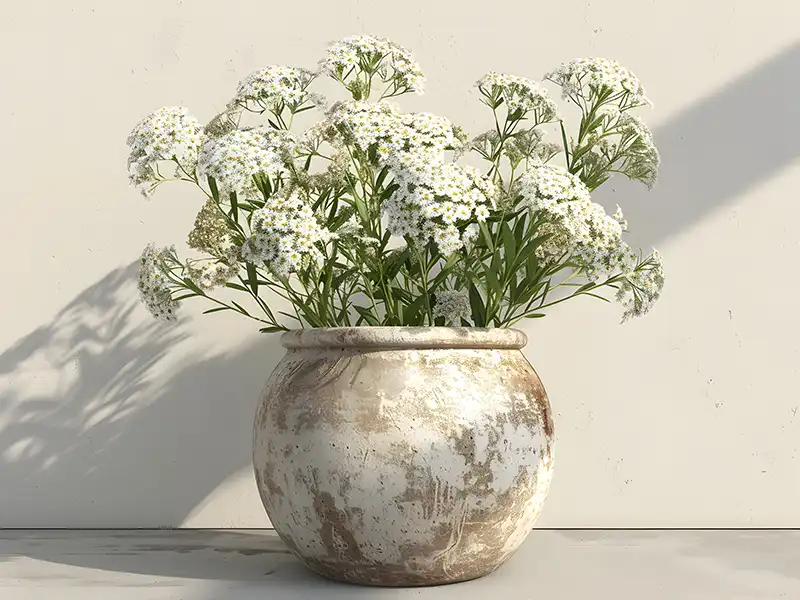
Yarrow can be grown successfully in a pot and container cultivation provides a practical way to manage its spreading rhizomes.
Choose a medium to large container with generous drainage holes. A pot approximately 30 cm or more across provides greater stability and reduces how quickly the mix dries during hot weather.
Use a quality potting mix that drains freely. Avoid placing the pot in a saucer that remains filled with water.
Position the container in full sun. A heavy pot can help prevent tall flower stems from making the container unstable in exposed locations.
- Grow one yarrow plant or one managed clump per container.
- Use a freely draining potting mix.
- Position the pot in full sun.
- Water when the upper potting mix begins to dry.
- Avoid constantly wet or waterlogged conditions.
- Deadhead flowers before unwanted seed develops.
- Divide the plant when the pot becomes crowded.
- Check drainage holes for escaping rhizomes.
Container-grown yarrow requires more frequent watering than mature plants in the ground. Check the pot during hot or windy weather, but do not assume wilting always means the plant needs more water. Confirm that the potting mix is actually dry before watering.
Does Yarrow Spread?
Yarrow spreads in two ways: through underground rhizomes and through seed.
The rhizomes extend horizontally beneath or close to the soil surface. New shoots emerge from these stems and gradually enlarge the original clump.
Flowers that are allowed to mature may also produce numerous small seeds. Some of these seeds can germinate in nearby disturbed soil, gravel, garden beds or lawns.
The spreading habit is useful where a resilient ground-covering perennial is deliberately wanted, but it can become difficult to manage in a small bed or near natural vegetation.
Do not dispose of rhizomes, mature seed heads or viable plant fragments in bushland, roadside vegetation or unmanaged areas. Check local weed advice before planting and contain yarrow carefully where it has the potential to spread beyond the garden.
Is Yarrow Invasive or a Weed?
Whether yarrow behaves as a garden perennial or a weed depends on the location and how it is managed.
Common yarrow is naturalised in parts of Australia and is recognised as capable of invading disturbed areas, pasture, grassland and some natural environments. It can form dense patches through rhizome growth and produce large quantities of seed.
This does not mean every yarrow plant will immediately become uncontrollable. However, gardeners should not assume that it is a harmless native wildflower or allow it to spread beyond cultivation.
To manage yarrow responsibly:
- Grow it within a defined and regularly maintained garden area.
- Deadhead before seeds mature.
- Remove shoots that appear beyond the intended clump.
- Divide plants before rhizomes spread too widely.
- Use containers where containment is a priority.
- Do not plant beside bushland, reserves, waterways or grazing land.
- Dispose of seed heads and rhizomes securely.
- Check state and local weed guidance before planting.
How to Prune Yarrow
Yarrow does not require complex pruning. Most maintenance involves removing spent flower stems and cutting back old foliage.
Use clean secateurs or garden scissors. Remove flower stems individually for a natural appearance, or cut the flowering growth back more broadly after the main display has finished.
Avoid cutting into the crown below healthy basal growth. Leave enough foliage for the plant to continue photosynthesising and rebuilding its reserves.
When to Cut Back Yarrow
Cut back spent flower stems during summer when the blooms fade. This improves the plant’s appearance, limits self-seeding and may encourage a second flush of flowers.
In cool climates, old foliage and stems can be left temporarily to provide winter structure and habitat, then cut back before fresh spring growth becomes active.
Where diseased foliage is present, remove it rather than leaving it around the crown. Dispose of affected material appropriately instead of using it as garden mulch.
Should Yarrow Be Deadheaded?
Deadheading is recommended when you want to prolong flowering, maintain a tidy display or prevent self-seeding.
Cut the flower stem back to a healthy side shoot or to the basal foliage. Do not remove only the uppermost portion if this leaves a long bare stem.
Leave a limited number of flower heads only when you deliberately want to collect seed.
How to Divide Yarrow Plants
Division is one of the easiest ways to propagate established yarrow and control the size of a spreading clump.
Yarrow can generally be divided in spring as new growth begins. In mild Australian climates, early autumn division may also be successful, provided the plants have time to establish before severe heat, drought or frost.
1. Water the Plant Beforehand
Water dry soil one day before division so it is easier to lift and the roots are hydrated.
2. Cut Back Tall Stems
Remove old flower stems and excessively tall foliage to make the clump easier to handle.
3. Lift the Clump
Insert a garden fork or spade around the plant and carefully raise the crown and rhizomes from the soil.
4. Inspect the Plant
Discard dead, woody, diseased or severely damaged central material.
5. Separate Healthy Sections
Pull or cut the clump into smaller divisions. Each piece should have healthy shoots or buds and a useful section of roots.
6. Replant Promptly
Plant the divisions at approximately the same depth at which they were previously growing.
7. Water Thoroughly
Settle the soil around the roots and maintain moderate moisture during re-establishment.
8. Remove Unwanted Material Securely
Do not discard viable rhizomes where they could establish beyond the garden.
Division every few years can rejuvenate congested plants, but yarrow grown in fertile soil or irrigated beds may require more frequent containment.
How to Propagate Yarrow
Yarrow can be propagated from seed or by dividing an established plant.
Growing from seed is suitable when producing a larger number of plants. Seedlings may show natural variation in height, flowering time and flower colour.
Division produces genetically identical sections of the parent plant and provides larger plants more quickly. It is the preferred method for preserving the exact characteristics of a named cultivar.
Small rooted rhizome sections may also establish readily. This is useful for intentional propagation but is also why discarded roots must be handled responsibly.
What to Plant with Yarrow
Yarrow combines visually with sun-loving plants that prefer freely draining soil and do not require constant irrigation.
Potential garden companions include:
- Calendula
- Echinacea
- Lavender
- Rudbeckia
- Salvia
- Thyme
- Oregano
- Feverfew
- Coreopsis
- Drought-tolerant ornamental grasses
Choose companion plants according to local suitability rather than appearance alone. Avoid combining yarrow with plants that require constantly moist soil, dense shade or heavy fertilising.
Allow enough room to inspect and manage yarrow’s rhizomes. Delicate or slow-growing plants may be overwhelmed if they are positioned immediately beside an unmanaged yarrow clump.
Yarrow Flowers and Beneficial Insects
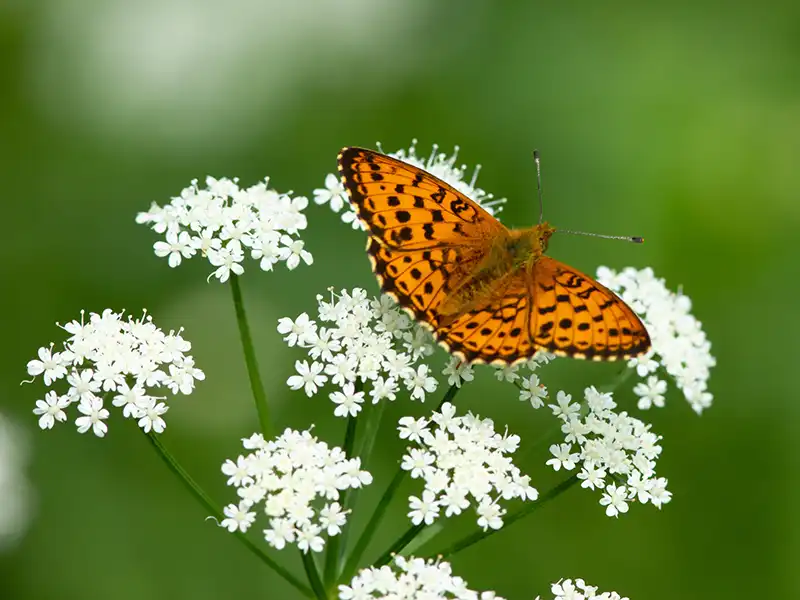
A yarrow flower cluster is composed of many small individual flower heads arranged into a broad, relatively flat surface.
This structure makes the flowers accessible to bees, hoverflies, butterflies and other insects. Yarrow can contribute to a diverse garden planting that provides nectar and pollen across the flowering season.
No individual plant guarantees biological pest control. Beneficial-insect gardening is most effective when a range of suitable flowering species is grown and pesticide use is minimised.
Remove flowers before seed matures when garden containment is more important than extending the flowering display.
How to Harvest Yarrow Flowers
Yarrow stems can be harvested for fresh or dried decorative arrangements.
For fresh flowers, cut the stems when most of the small flowers in the cluster are open but before the entire head begins fading or browning.
Harvest during dry weather after surface moisture has evaporated. Use clean secateurs and place the cut stems into water promptly.
For dried arrangements, select well-formed flower heads and remove damaged leaves. Hang small bunches upside down in a dry, shaded and well-ventilated location.
The flower heads should be completely dry before being stored or used in arrangements.
Yarrow has a history of traditional herbal use, but this guide does not provide medical or dietary advice. Do not consume or prepare yarrow medicinally without correct identification and advice from an appropriately qualified health professional.
How to Harvest Yarrow Seeds
Leave selected flower heads on healthy plants after flowering. The heads will gradually fade, turn brown and become dry as the seeds mature.
Harvest before wind, rain or natural shedding disperses the seed.
- Select dry, mature flower heads from healthy plants.
- Cut the stems during dry weather.
- Place the heads in a paper bag or on a clean tray.
- Allow them to dry further in a sheltered, ventilated location.
- Rub or crumble the heads gently to release the small seeds.
- Remove as much dry flower material as practical.
- Allow the seed to dry thoroughly before packing.
- Store it in a labelled container in a cool, dry and dark location.
Common yarrow is open-pollinated. Plants grown from saved seed may vary, especially when other yarrow forms or cultivars flower nearby.
Only leave as many seed heads as you intend to harvest. Remove the remainder before seed can disperse around the garden.
Common Yarrow Growing Problems
| Problem | Likely cause | What to do |
|---|---|---|
| Seeds do not germinate | Seed buried too deeply, surface allowed to dry, unsuitable temperature or old seed | Surface sow fresh seed, provide light and maintain even moisture at approximately 18–24°C. |
| Seedlings are crowded | The tiny seeds were sown too thickly | Thin seedlings early or transplant them carefully into separate cells. |
| Seedlings become tall and weak | Insufficient light, excessive warmth or overcrowding | Provide stronger light, good airflow and adequate spacing. |
| Plant produces few flowers | Too much shade, excessive nitrogen, immature plant or severe moisture stress | Increase sunlight, reduce high-nitrogen feeding and maintain appropriate watering. |
| Flower stems fall over | Rich soil, shade, excessive water or exposed windy conditions | Grow in stronger sun, avoid excessive fertiliser and provide discreet support where necessary. |
| Leaves develop a white coating | Powdery mildew encouraged by humidity, poor airflow or plant stress | Improve spacing and airflow, water the soil rather than foliage and remove heavily affected material. |
| Aphids gather on stems | Sap-sucking insects feeding on soft growth | Hose off small populations, encourage beneficial insects or use an appropriate treatment where necessary. |
| Plant declines in wet soil | Poor drainage or repeated waterlogging | Reduce watering, improve drainage or move the plant to a raised bed or container. |
| Leaves yellow | Waterlogging, natural ageing, root stress or nutrient imbalance | Check soil moisture and drainage before applying fertiliser. |
| Plant spreads beyond its space | Rhizome expansion or self-sown seedlings | Dig out unwanted rhizomes, deadhead before seed matures and consider container cultivation. |
| Plant develops a dead centre | An old or congested clump | Lift and divide the plant, discard the declining centre and replant vigorous outer sections. |
| Poor growth in a tropical climate | Persistent humidity, excessive rainfall, heat or waterlogged soil | Grow during the cooler dry season and provide full sun, airflow and exceptional drainage. |
Frequently Asked Questions
What is yarrow?
Yarrow is the perennial herb Achillea millefolium. It produces finely divided aromatic leaves and upright stems topped with broad clusters of small flowers.
Does yarrow grow in Australia?
Yes. Yarrow grows in many Australian climates, particularly cool and temperate regions. It is an introduced plant that has naturalised in parts of Australia, so its spread should be carefully controlled.
Is yarrow native to Australia?
No. Common yarrow, Achillea millefolium, is not native to Australia. It has become naturalised in several Australian regions.
Is yarrow an annual or perennial?
Yarrow is a perennial. It can live for multiple years and produces new growth from its crown and underground rhizomes.
How do you grow yarrow from seed?
Surface sow the tiny seeds onto moist seed-raising mix, press them gently into place and expose them to light. Maintain even moisture and a temperature of approximately 18–24°C.
Does yarrow seed need light to germinate?
Yes. Light assists yarrow germination. Surface sow the seeds and do not bury them beneath a normal layer of soil or potting mix.
How long does yarrow take to germinate?
Yarrow commonly germinates within approximately 10–21 days under suitable light, moisture and temperature conditions.
Is yarrow easy to grow from seed?
Yarrow is generally straightforward to grow from seed when it is surface sown and kept moist. The most common problems are covering the seeds too deeply, allowing the surface to dry or sowing too densely.
When should yarrow seeds be planted in Australia?
Spring and autumn are the main sowing periods. In subtropical and tropical areas, sow during the cooler and less humid part of the year.
Does yarrow need full sun?
Yarrow performs best in full sun. It tolerates some light shade, but shaded plants may produce fewer flowers and weaker stems.
How far apart should yarrow be planted?
Space plants approximately 30–45 cm apart. Allow extra room where airflow is important or where the plant will be permitted to form a broader clump.
How tall does yarrow grow?
Common yarrow generally grows approximately 40–100 cm tall when flowering. Height varies with sunlight, moisture, soil fertility and genetics.
How long does yarrow take to grow?
Seeds commonly germinate in 10–21 days. Plants establish during their first growing season and may flower that year, although some produce their strongest display from the second season.
Can yarrow grow in a pot?
Yes. Grow yarrow in a medium to large container with unrestricted drainage and full sun. Container cultivation can help manage its spreading rhizomes.
Does yarrow spread?
Yes. Yarrow spreads through underground rhizomes and can also self-seed when mature flower heads are left on the plant.
Is yarrow invasive?
Yarrow can become invasive in suitable conditions. It is naturalised in parts of Australia and may spread into lawns, disturbed ground, pasture and natural areas. Keep it contained and prevent garden escape.
Is yarrow a weed?
Yarrow may be treated as a weed when it establishes where it is not wanted or invades agricultural or natural environments. Its status and significance vary by location, so check relevant state and local guidance.
Does yarrow self-seed?
Yes. Mature flower heads can release numerous small seeds. Deadhead fading flowers before seeds develop when self-sowing is not wanted.
When does yarrow flower?
Yarrow generally flowers from late spring through summer and may continue into autumn. In New South Wales, flowering is commonly recorded from approximately November to April.
Should yarrow be deadheaded?
Deadheading helps maintain a tidy appearance, may prolong flowering and prevents unwanted seed production. Remove the stem back to healthy foliage or a side shoot.
When should yarrow be cut back?
Remove faded flower stems during summer. Old or untidy growth can be cut back in late winter or early spring before vigorous new growth begins.
How do you divide yarrow?
Lift an established clump, separate it into healthy rooted sections and replant the vigorous outer pieces. Spring is generally the best time, although early autumn may suit mild climates.
How often should yarrow be divided?
Divide yarrow when the clump becomes congested, develops a declining centre or spreads beyond its allocated space. This may be required every few years or more often in favourable conditions.
Can yarrow tolerate drought?
Established yarrow is drought tolerant. Seeds, seedlings and newly divided plants still require consistent moisture while establishing.
What soil does yarrow prefer?
Yarrow prefers freely draining soil and tolerates sandy, loamy, gravelly and relatively lean conditions. Avoid persistently wet or waterlogged soil.
Can yarrow grow in clay soil?
Yarrow may grow in clay if drainage is adequate. Heavy clay that remains wet should be improved, mounded or replaced with a raised bed or container planting.
Does yarrow need fertiliser?
Yarrow normally needs little fertiliser. Excessive nitrogen can produce tall, weak growth, so avoid heavily enriching the planting area.
Can yarrow flowers be harvested?
Yes. Cut flower stems when most of the small flowers are open. They can be used in fresh arrangements or dried in a shaded, ventilated location.
How do you harvest yarrow seed?
Allow selected flower heads to become brown and dry, cut them before the seed disperses and crumble the heads over a clean tray. Dry the seed thoroughly before storage.
Can you eat yarrow flowers?
Yarrow has a history of traditional use, but this product is supplied as garden seed and this guide does not make a consumption or medicinal recommendation. Correct identification and qualified professional advice are important before internal use.
Is yarrow safe for every garden?
No plant is suitable for every location. Yarrow should be avoided or strictly contained near bushland, conservation areas, waterways, agricultural land and other places where its rhizomes or seeds could escape cultivation.
Grow Yarrow from Seed
Grow Achillea millefolium for aromatic feathery foliage, white summer flowers and a hardy perennial display in a sunny, responsibly managed garden.