
Cover Crops & Green Manure Guide
Some of the most valuable plants in a garden are never harvested at all.
These plants are called cover crops, also known as green manure crops. Instead of being grown primarily for food, they are planted to protect and improve the soil between main crops.
Cover crops can add organic matter, support soil biology, improve soil structure, reduce erosion, suppress weeds and, in the case of legumes, contribute biologically fixed nitrogen.
For Australian gardeners looking to restore tired vegetable beds or keep soil covered between growing seasons, cover crops are one of the simplest tools available.
Improve and protect soil
Green manure crops
Vetch, clover, cowpea, lablab and Sunn Hemp
Tillage radish and chicory
Oats, rye, millet, sorghum and buckwheat
Match the crop to your season and soil goal
Shop Green Manure & Cover Crop Seeds
Browse Seedmart’s range of soil-building cover crops for vegetable gardens, orchards, farms, raised beds and larger growing areas.
Table of Contents
- What Are Cover Crops?
- Why Cover Crops Improve Soil
- Different Types of Cover Crops
- Nitrogen-Fixing Cover Crops
- Deep-Rooted Soil Breakers
- Biomass-Producing Cover Crops
- Pollinator-Friendly Cover Crops
- Best Cover Crops for Australian Gardens
- When to Plant Cover Crops
- How to Terminate Cover Crops
- How to Dig in Green Manure
- Cover Crops in Raised Beds & Wicking Beds
- Choosing Cover Crop Seeds
What Are Cover Crops?
Cover crops are plants grown mainly to improve soil rather than for harvest.
Gardeners and farmers commonly plant them between vegetable crops or during the off-season to keep soil covered, add organic matter and maintain living roots in the ground.
A cover crop is a crop grown primarily for what it does for the soil rather than for what you harvest from it.
Cover crops are often called green manure crops when they are cut down and returned to the soil.
In natural ecosystems, soil is rarely left completely bare. Plants grow, die and decompose, continually returning organic material to the soil.
Cover crops imitate part of this natural cycle in gardens and farms.
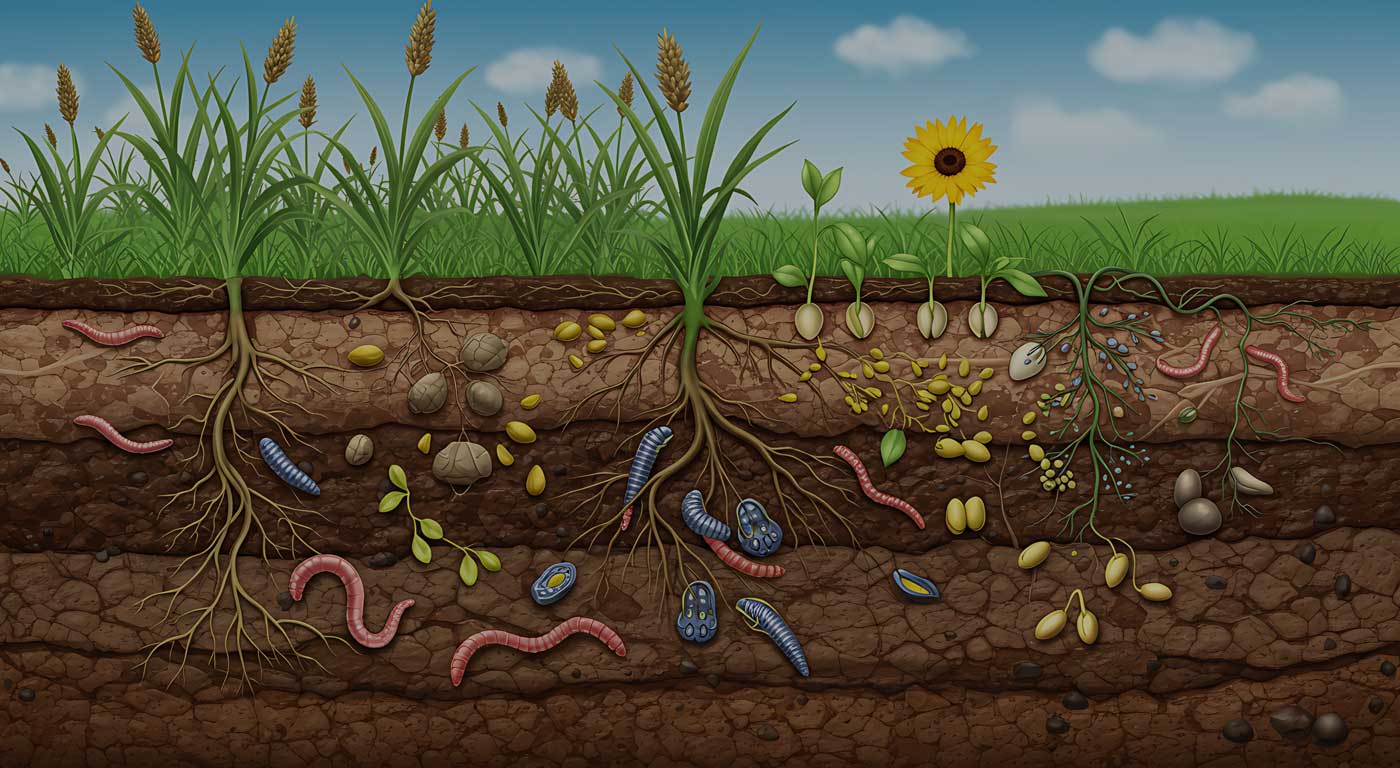
Roots create channels through the soil and help maintain a more open soil structure.
Leaves, stems and roots can be returned to the soil after the crop is terminated.
Legume cover crops can biologically fix atmospheric nitrogen when effectively nodulated.
Living roots and decomposing residues provide resources for soil organisms.
Vegetation helps protect exposed soil from rain and wind.
Living cover reduces direct exposure to sun, heavy rain and weathering.
Why Cover Crops Improve Soil
Soil is much more than a material that holds plant roots. Healthy soil contains minerals, organic matter, microorganisms, fungi, insects and plant roots interacting together.
When soil is left bare for long periods, its structure and biological activity can decline.
Bare Soil
- Organic matter breaks down without being replaced.
- Root activity stops.
- Heavy rain can compact the surface.
- Nutrients may be lost from the active root zone.
- Direct sun can dry exposed soil.
- Wind and water can contribute to erosion.
Living Cover
- Roots remain active in the soil.
- Plant residues add organic material.
- Soil is protected from direct weather exposure.
- Different root systems create soil channels.
- Living roots support soil organisms.
- Ground cover can compete with weeds.
Plant roots release sugars and other compounds into the surrounding soil. These root exudates provide an important food source for microorganisms living around the root zone.
When cover crops are later cut down, their leaves, stems and roots contribute additional organic matter as they decompose.
Roots create pores and channels
Organic matter can improve soil water-holding characteristics
Living roots support active microbial communities
Growing plants capture and cycle nutrients
Different Types of Cover Crops
Not every cover crop performs the same job.
The best choice depends on what you want to achieve, the time of year and the growing conditions at your site.
Useful where biological nitrogen fixation is a major goal.
Strong taproots explore deeper soil and create channels through compacted layers.
Fast-growing plants produce large amounts of organic material.
Flowering cover crops provide nectar and pollen for beneficial insects.
Combining legumes, grasses and broadleaf species can provide a wider range of root structures and soil benefits than relying on a single crop.
Nitrogen-Fixing Cover Crops

Legumes have the ability to form a biological relationship with specialised bacteria called rhizobia.
These bacteria live in nodules on suitable legume roots and convert atmospheric nitrogen into compounds that become incorporated into the plant.
When effectively nodulated legumes are grown and their biomass is returned to the soil, they can contribute nitrogen to the farming or gardening system.
Deep-rooted perennial legume with strong soil-building potential.
Warm-season legume suitable for hot growing conditions.
Vigorous warm-season legume useful in summer cover-crop systems.
Legume cover crops can be particularly useful before nutrient-demanding crops such as tomatoes, pumpkins and brassicas.
Deep-Rooted Soil Breakers
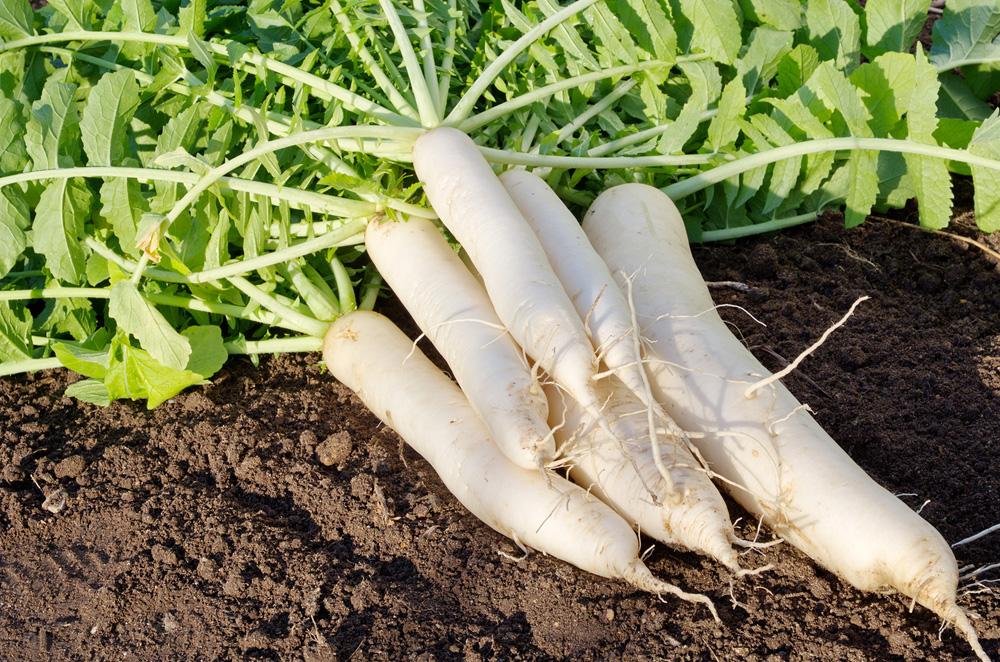
Some cover crops develop substantial taproots capable of penetrating deeper soil layers.
These roots can help create channels through compacted ground and improve pathways for water, air and future crop roots.
Tillage Radish
Tillage Radish is one of the best-known deep-rooted cover crops.
Its large taproot pushes through the soil while growing. After termination and decomposition, the root leaves a channel within the soil profile.
Other Deep-Rooted Options
- Chicory
- Lucerne
- Sorghum
- Other deep-rooted cover crop species
Deep-rooted species can be useful in compacted or heavy soils where increasing root penetration and creating biological channels are important objectives.
Biomass-Producing Cover Crops
Some cover crops are selected because they grow rapidly and produce large quantities of leaves and stems.
When this material is cut down and returned to the system, it contributes organic matter that can help improve soil structure.
Cool-season cereal producing fibrous roots and substantial leafy biomass.
Vigorous cereal useful for ground cover and organic-matter production.
Fast-growing warm-season grass suited to summer cover cropping.
Warm-season grass capable of producing large quantities of biomass.
Fast-growing broadleaf crop useful for short rotations and pollinator attraction.
Organic residues provide material for soil organisms and contribute to the organic-matter cycle as they decompose.
Pollinator-Friendly Cover Crops
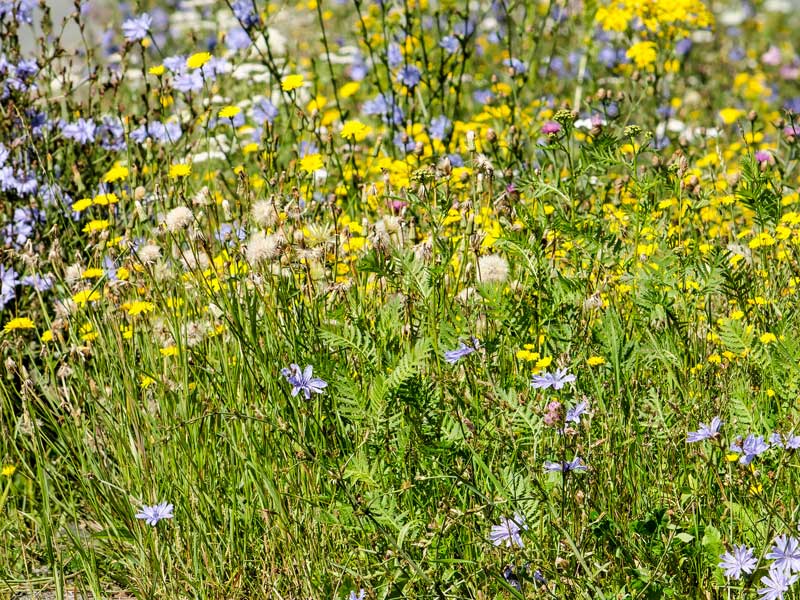
Some cover crops provide useful benefits above ground as well as below it.
Fast flowering and attractive to a range of visiting insects.
Produces abundant flowers that can attract bees and beneficial insects.
Provides rapid growth and flowers when allowed to reach blooming stage.
Flowering cover crops can provide nectar and pollen for bees, hoverflies and other insects while also adding visual interest to the garden.
Best Green Manure Crops for Australian Gardens
The best green manure crop depends on climate, soil type, season and the specific improvement you want to make.
For many Australian gardens, combining a nitrogen-fixing legume with a vigorous biomass crop is a practical starting point.
Crimson Clover
Best season: Autumn–Winter
Main benefit: Nitrogen fixation
Useful in vegetable beds and mixed cool-season cover crops.
Common Vetch
Best season: Autumn–Winter
Main benefit: Nitrogen fixation
Vigorous soil-building legume that combines well with cereals.
Tillage Radish
Best season: Autumn
Main benefit: Deep rooting
Large taproot can help create channels in compacted soil.
Sunn Hemp
Best season: Spring–Summer
Main benefit: Nitrogen fixation and biomass
Extremely vigorous in warm conditions.
Best season: Spring–Summer
Main benefit: Pollinators and biomass
Useful where a fast-growing short-season cover is required.
Best season: Summer
Main benefit: Nitrogen fixation
Heat-tolerant vigorous legume for warm-season systems.
When to Plant Cover Crops in Australia
Timing is important because different species perform best in different temperature ranges.
Transition into cool-season growing
Good options: Vetch, clover, oats and tillage radish.
Autumn is an excellent time to establish green manure crops that will protect soil through winter.
Cool-season cover crops
Good options: Clover, vetch and oats.
Choose species suited to your local frost conditions and remaining growing window.
Soils begin warming
Good options: Buckwheat, sorghum and millet.
Warm-season species become increasingly useful as soil and air temperatures rise.
Fast warm-season growth
Good options: Sunn Hemp, lablab and cowpea.
Warm-season legumes and grasses can produce substantial biomass during hot weather.
Local frost dates, rainfall, irrigation, altitude and regional climate should always be considered when choosing a planting window.
How to Terminate Cover Crops
Eventually a cover crop needs to be terminated so the area can be prepared for the next planting.
Chop & Drop
Cut plants near ground level and leave the material on the soil surface as mulch.
Incorporate
Chop the plants and lightly mix the green material into the upper soil layer.
Surface Mulch
Terminate the crop and allow the residue to form a protective cover over the soil surface.
Terminating before mature seed develops also generally leaves softer plant material that is easier to manage.
How to Dig in a Green Manure Crop
Green manure crops are commonly terminated while they are still green and relatively soft.
Cut the Crop
Slash, mow or chop the plants before they become heavily mature or set viable seed.
Chop the Residue
Smaller pieces generally break down more readily than long intact stems.
Incorporate Lightly
Mix the plant material into the upper soil layer where an incorporated green-manure system is being used.
Allow Decomposition
Give the organic material time to begin breaking down before establishing the next crop.
As the plant material decomposes, it contributes organic matter and recycled nutrients to the soil.
Cover Crops in Raised Beds and Wicking Beds
Cover crops are not limited to farms or large garden areas. They can also be grown in raised beds and larger wicking-bed systems.
These systems often contain carefully prepared growing mixes that benefit from regular inputs of organic matter and ongoing root activity.
Raised Garden Beds
Fast-growing cover crops can be sown between vegetable rotations to maintain soil cover and produce additional organic material.
Wicking Beds
Cover crops can maintain living roots within the growing medium between main crops and provide plant material that can later be returned to the system.
Fast-growing species such as buckwheat or vetch can be particularly useful where there is only a short gap between vegetable crops.
For more information about wicking bed systems, visit
Wicking Bed
.
Building Soil for Long-Term Productivity
Healthy soil develops gradually through repeated cycles of root growth, organic-matter return and biological activity.
Cover crops support this process by keeping plants growing during periods when the soil might otherwise be bare.
Living Roots
Cover crops maintain active roots within the soil between primary food crops.
Organic Residues
Leaves, stems and roots are eventually returned to the soil system.
Crop Diversity
Rotating legumes, grasses and broadleaf species introduces different root systems and residues.
Gradual Improvement
The benefits accumulate over repeated growing seasons rather than appearing from a single cover crop.
Choosing Cover Crop Seeds
You do not need to begin with a complicated multi-species system.
Many gardeners start with one or two crops chosen for their season and main soil problem, then introduce greater diversity as they become familiar with green manure growing.
Start by asking what your soil needs most — nitrogen, biomass, ground cover, deeper roots, weed suppression or a combination of these benefits.
Start Improving Your Soil with Cover Crops
Choose cool-season and warm-season green manure crops for Australian vegetable gardens, raised beds, orchards and larger growing areas.