
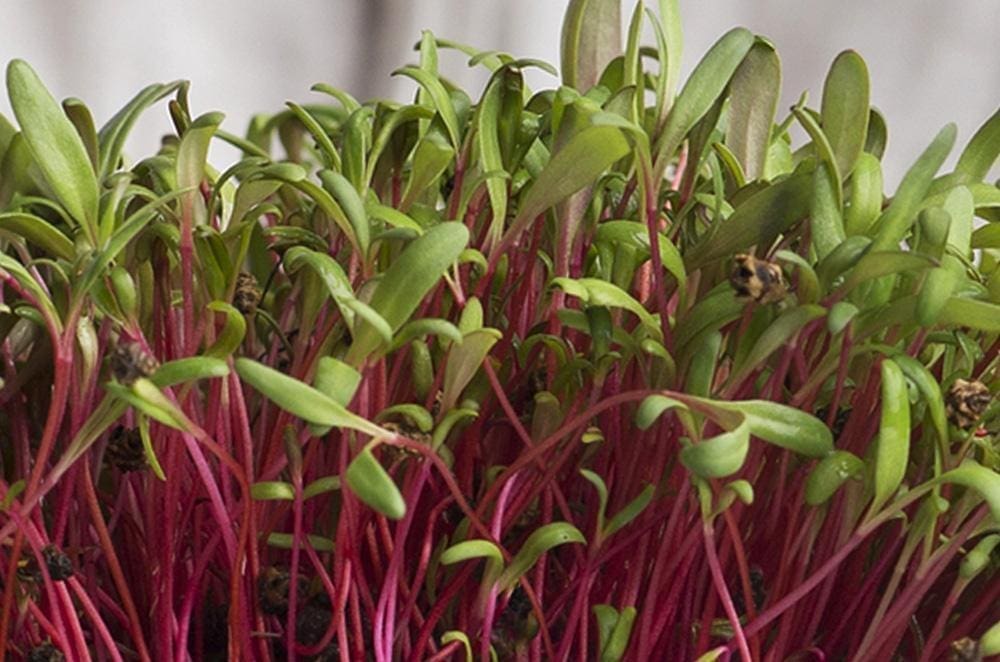
Beetroot and chard microgreens are colourful, mild-flavoured microgreens that can add vivid red, pink, yellow, orange and green stems to salads, sandwiches and plated dishes.
If you’re wondering how to grow beetroot and chard microgreens, they require a little more patience than fast-growing brassica microgreens such as broccoli, kale and radish. Their seeds are larger, irregularly shaped and slower to establish, and they generally perform best when lightly covered with growing medium during germination.
This beginner-friendly guide explains how to grow beetroot and chard microgreens at home, including how much seed to use, whether to soak the seeds, the best growing medium, blackout time, temperature, watering, lighting, harvesting and common growing problems.
Beetroot & Chard Microgreens at a Glance
What Are Beetroot & Chard Microgreens?
Beetroot and chard microgreens are young seedlings of Beta vulgaris, harvested when the seed leaves are fully developed and the first true leaves are beginning to appear.
Although beetroot and Swiss chard look quite different as mature plants, they are closely related and have very similar seed structure and growing requirements as microgreens.
Popular varieties include:
- Bull’s Blood Beet – known for deep red stems and dark foliage
- Detroit Dark Red Beet – red stems with green to reddish foliage
- Golden Beet – lighter stems with green foliage
- Bright Lights Chard – mixed stems in yellow, orange, pink, red and white
- Ruby Chard – red stems with green leaves
What Do Beetroot & Chard Microgreens Taste Like?
Beetroot and chard microgreens have a mild, earthy flavour with a tender to slightly crisp texture.
They are less peppery than microgreens such as radish, mustard and many brassicas, making them useful when you want colour without a strong spicy flavour.
Why Grow Beetroot & Chard Microgreens?
One of the biggest reasons to grow beetroot and chard microgreens is their colour. Depending on the variety, the young stems can develop shades of red, crimson, pink, orange, yellow and white, while the leaves range from green through to deep burgundy.
Red beet microgreens have also been studied for their distinctive pigmentation. Peer-reviewed research on red beet microgreens describes their intense pigmentation and betalain-rich profile.
- Striking coloured stems and foliage
- Mild, earthy flavour
- Useful in salads and mixed microgreen trays
- Excellent as a colourful garnish
- Suitable for indoor tray growing
- Provides a different appearance and flavour from brassica microgreens
Are Beetroot & Chard Microgreens Easy to Grow?
Beetroot and chard are generally more challenging than beginner microgreens such as broccoli, radish or kale.
The main reason is their seed structure. What looks like one beet or chard seed is actually an irregular, corky seed cluster. These clusters do not sit as neatly against the growing surface as smooth brassica seeds.
For this reason, good seed-to-medium contact is important.
If you remember only one growing tip, make it this:
Lightly cover beetroot and chard seeds with growing medium after sowing.
This helps keep the seed clusters evenly moist and in close contact with the growing medium during germination.
How to Grow Beetroot & Chard Microgreens in 7 Simple Steps
- Soak the seeds in cool water for approximately 4–8 hours.
- Prepare a tray with 3–4 cm of moist growing medium.
- Sow the seed evenly and lightly cover it with growing medium.
- Cover the tray for approximately 4–5 days during germination.
- Move the seedlings into bright light once they are established.
- Bottom water and provide good airflow as the crop develops.
- Harvest when the stems and cotyledons are well developed, usually around 12–21 days after sowing.
What You Need to Grow Beetroot & Chard Microgreens at Home
- Beetroot or chard microgreen seeds
- A shallow growing tray with drainage holes
- A solid bottom tray
- A second tray or cover for germination and blackout
- Fine-quality potting mix, seed-raising mix or suitable soilless growing medium
- A container for soaking the seeds
- Spray bottle or gentle watering bottle
- Clean water
- A bright windowsill or LED grow light
- Clean scissors or a sharp knife for harvesting
Do Beetroot & Chard Microgreen Seeds Need to Be Soaked?
Beetroot and chard microgreen seeds can benefit from a 4–8 hour soak in cool water before sowing.
Soaking helps hydrate the relatively large, corky seed clusters before they are placed into the growing medium.
To soak:
- Place the seed in a clean container.
- Cover with plenty of cool water.
- Leave for approximately 4–8 hours.
- Drain thoroughly before sowing.
Avoid soaking for excessively long periods. Once drained, sow the seed promptly.
How Much Beetroot or Chard Seed Should You Use?
Seed size varies between beetroot and chard cultivars, so there is no single seeding rate that is ideal for every variety.
For a standard 10 x 20 inch microgreen tray, approximately 25–35 g of seed is a practical starting range.
For a 10 x 10 inch tray, use approximately 12–18 g.
Bull’s Blood beet may perform well toward the lower end of this range, while larger chard seed clusters may require slightly more seed by weight.
The goal is an even layer of seed without heavy overlapping.
Avoid sowing too densely. Crowded beet and chard seedlings can retain moisture around the stems and reduce airflow.
Best Growing Medium for Beetroot & Chard Microgreens
Beetroot and chard usually perform best in a growing medium that provides good root support and consistent moisture.
Fine Potting or Seed-Raising Mix
A fine-quality potting or seed-raising mix is one of the most reliable options for home growers.
Use approximately 3–4 cm of growing medium. This is slightly deeper than you may use for small brassica microgreens because beetroot and chard produce stronger root systems and benefit from good anchorage.
Avoid very coarse mixes containing large pieces of bark or wood.
Coco Coir and Soilless Media
Beet microgreens can also be grown in suitable soilless media.
Academic research has successfully produced beet microgreens using cocopeat-based mixes and other soilless growing media.
A peer-reviewed study comparing growing media for red beet microgreens found that growing medium significantly affected crop performance, with peat-based medium and vermiculite producing strong yields.
For beginners, a fine soil-based or peat/coir-based growing medium is generally easier than very thin hydroponic mats.
Why Should You Cover Beetroot & Chard Seeds with Growing Medium?
This is one of the most important differences between growing beetroot or chard and growing small-seeded microgreens such as broccoli.
Beetroot and chard seed clusters are large, rough and irregularly shaped.
After spreading the seed across the tray, apply a thin layer of growing medium over the top.
You do not need to bury the seeds deeply. The purpose is to:
- Improve contact between the seed and growing medium
- Keep moisture more consistent around the seed
- Help support the emerging seedlings
- Reduce exposed seed clusters sitting on top of the tray
- Help loosen some seed hulls as the shoots emerge
Lightly mist the covering layer after sowing.
Best Temperature for Growing Beetroot & Chard Microgreens
Beetroot and chard microgreens generally grow well in mild indoor conditions around 18–24°C.
For germination, slightly warmer growing-medium temperatures can speed establishment. Commercial microgreen guidance commonly uses approximately 24°C during germination, followed by cooler ambient conditions after emergence.
Very warm and humid conditions can increase disease pressure, especially when trays are densely planted or overwatered.
In warm Australian climates, airflow becomes particularly important during summer.
Step 1: Soak the Beetroot or Chard Seeds
Measure the amount of seed required for your tray.
Place the seed in a clean container and cover it with cool water for approximately 4–8 hours.
After soaking, drain the seed thoroughly.
The seed clusters will remain firm and irregular in shape. This is normal.
Step 2: Prepare the Growing Tray
Fill a shallow tray with approximately 3–4 cm of fine growing medium.
Level the surface gently using your hand or a small flat object.
Moisten the growing medium before sowing. It should be evenly damp but not saturated.
Place the growing tray inside a solid bottom tray to catch drainage and allow bottom watering later.
Step 3: Sow and Cover the Seeds
Spread the drained beetroot or chard seeds evenly over the growing surface.
Try to avoid large clumps or areas where multiple seed clusters are piled heavily on top of one another.
Gently press the seed against the growing medium to improve contact.
Then apply a light layer of growing medium over the seeds.
The seed does not need to be deeply buried. A thin covering is sufficient.
Lightly mist the surface with clean water.
Step 4: Covered Germination and Blackout Period
Place a second tray or blackout cover over the growing tray.
Keep the tray covered for approximately 4–5 days.
Beetroot and chard normally begin germinating in approximately 3–5 days, although germination can be slower under cool conditions.
Check the tray daily.
The growing medium should stay moist, but avoid automatically watering twice every day if the soil is already wet.
Excessive moisture combined with poor airflow can encourage mould and damping-off.
Once most seedlings have emerged and are beginning to lift through the covering layer, the tray can be moved into light.
Step 5: Expose the Microgreens to Light
Remove the blackout cover and place the tray in bright light.
You can use:
- A bright windowsill
- A sheltered indoor growing position
- An LED grow light
Beetroot and chard microgreens are valued for their coloured stems, and good light helps the seedlings develop strong colour and compact growth.
If using natural light, rotate the tray regularly so the seedlings do not lean heavily toward one side.
Step 6: Water and Grow
Once the roots are established, bottom watering is generally preferable to repeatedly misting the foliage.
Add a small amount of water to the solid bottom tray and allow the growing medium to absorb it.
Keep the growing medium evenly moist but not waterlogged.
How frequently you need to water depends on:
- Temperature
- Humidity
- Airflow
- Tray size
- Growing medium
- Seedling density
For best results:
- Maintain good airflow around the tray
- Avoid leaving large amounts of standing water in the bottom tray
- Rotate trays if light is coming from one direction
- Avoid harsh direct afternoon sunlight
- Keep foliage as dry as practical between waterings
Step 7: When to Harvest Beetroot & Chard Microgreens
Beetroot and chard microgreens generally take longer to mature than broccoli, radish and mustard.
A useful harvest window is approximately 12–21 days after sowing, depending on the variety and growing conditions.
Rather than relying entirely on the calendar, harvest when:
- The cotyledons have fully opened
- The stems have developed good colour
- The crop is standing upright
- The seedlings are approximately 5–10 cm tall
- The first true leaves are beginning to develop, if you prefer a later harvest
Some beet cultivars are naturally slower than chard or other microgreen species, so do not be concerned if the crop takes more than two weeks.
How to Harvest Beetroot & Chard Microgreens
Use clean scissors or a sharp knife to cut the microgreens just above the growing medium.
Cutting low on the stem allows you to retain more of the colourful red, pink, orange or yellow stem while avoiding soil contamination.
Try not to pull seedlings from the roots, as this can bring growing medium into the harvested crop.
How Much Can You Harvest from One Tray?
Yield varies considerably between cultivars.
Seed density, germination percentage, temperature, growing medium, light and harvest stage all affect the final amount harvested.
For home growers, it is usually better to prioritise an even, healthy tray rather than increasing seed density simply to maximise yield.
Overcrowded beetroot and chard microgreens can take longer to dry between waterings and may be more susceptible to mould.
How to Store Beetroot & Chard Microgreens
After harvesting, keep the microgreens cool and dry.
For best storage:
- Harvest with clean scissors
- Remove any growing-medium particles
- Keep the microgreens as dry as practical
- Store in a clean airtight container
- Line the container with paper towel if necessary to absorb excess moisture
- Refrigerate promptly
- Use while the leaves and stems are still crisp
If you wash the microgreens before refrigeration, dry them thoroughly before storing.
How to Use Beetroot & Chard Microgreens
Beetroot and chard microgreens are particularly useful when you want to add colour without the strong heat of mustard or radish.
Try them:
- Mixed through salads
- On sandwiches and wraps
- On avocado toast
- With scrambled eggs or omelettes
- On grain bowls
- With roasted vegetables
- As a garnish for soups
- As a colourful finishing garnish on plated meals
- Mixed with green microgreens for colour contrast
Beetroot vs Chard Microgreens
Beetroot and chard microgreens are closely related and grown using a very similar method, but their appearance varies considerably by cultivar.
Tips for Growing Beetroot & Chard Microgreens Indoors
- Soak seeds for 4–8 hours before sowing
- Use a fine growing medium rather than a coarse mix
- Press seeds gently into the growing surface
- Lightly cover the seed with growing medium
- Do not overcrowd the tray
- Maintain even moisture during germination
- Switch to bottom watering after seedlings establish
- Provide good airflow
- Use bright light after blackout
- Allow more time than you would for brassica microgreens
Growing Beetroot & Chard Microgreens in Warm Weather
Beetroot and chard can be grown indoors throughout the year, but warm and humid conditions require closer moisture management.
When temperatures rise:
- Improve airflow around the trays
- Check the growing medium before watering
- Do not keep the tray continuously saturated
- Avoid leaving water sitting permanently in the bottom tray
- Keep trays away from harsh afternoon sun
- Consider growing in an air-conditioned or cooler indoor position during very hot weather
Warm, wet conditions combined with dense seedlings can encourage fungal problems.
Common Problems When Growing Beetroot & Chard Microgreens
Poor or Uneven Germination
Beetroot and chard naturally germinate less uniformly than many small-seeded brassicas.
If germination is poor, check:
- Whether the seeds were kept evenly moist
- Whether the growing-medium temperature was suitable
- Whether the seeds had good contact with the growing medium
- Whether the seeds were covered lightly after sowing
- Seed quality and age
Seed Hulls Stuck to the Microgreens
The rough seed clusters can remain attached to emerging seedlings.
Lightly covering the seed with growing medium helps provide resistance as the seedlings emerge and can help loosen some seed hulls naturally.
Do not pull firmly on hulls attached to delicate seedlings.
Mould
Mould is more likely when the crop is too wet, overcrowded or poorly ventilated.
To reduce the risk:
- Avoid excessive seed density
- Do not overwater
- Improve airflow
- Use clean trays
- Switch to bottom watering after establishment
Do not eat visibly mouldy or spoiled microgreens.
Damping-Off
Damping-off causes young seedlings to weaken or collapse near the base of the stem.
Excessively wet growing media and poor airflow increase the risk.
If seedlings repeatedly suffer from damping-off, review watering, airflow, seed density and tray hygiene rather than simply applying more water or treatments.
Microgreens Are Growing Slowly
Beetroot and chard are naturally slower than broccoli, radish and mustard microgreens.
Cool temperatures, weak light or overly wet growing medium can slow them further.
A crop taking two to three weeks is not necessarily a problem.
Seedlings Are Tall and Weak
Long, weak stems usually indicate insufficient light after germination.
Move the tray to a brighter position or use an LED grow light.
Leaves Look Pale
Seedlings may initially appear pale when the blackout cover is removed.
After exposure to adequate light, they should develop stronger green, red or burgundy colouring.
Growing Medium Is Staying Too Wet
Do not water simply because it is morning or evening.
Check the tray first.
If the growing medium is still wet or water remains in the bottom tray, allow some of the existing moisture to be used before adding more.
Frequently Asked Questions
How long do beetroot microgreens take to grow?
Beetroot microgreens generally take approximately 12–21 days from sowing to harvest, although some cultivars may take longer.
How long do chard microgreens take to grow?
Chard microgreens commonly take around 12–21 days, depending on variety, temperature, light and desired harvest stage.
Do beetroot microgreen seeds need soaking?
A 4–8 hour soak in cool water is commonly used and can help hydrate the large seed clusters before sowing.
Do chard microgreen seeds need soaking?
Yes, a short 4–8 hour soak is a useful preparation method for chard microgreen seed.
How much beetroot seed should I use for a 10 x 20 tray?
Approximately 25–35 g per 10 x 20 inch tray is a useful starting range. The ideal amount varies with cultivar and seed size.
Should beetroot microgreen seeds be covered with soil?
Yes. A thin covering of growing medium is useful because the large, irregular seed clusters benefit from good contact with a consistently moist growing surface.
Should chard microgreen seeds be covered?
Yes. Chard has a similar compound seed structure to beetroot and benefits from being lightly covered after sowing.
How long should beetroot and chard microgreens stay in blackout?
Approximately 4–5 days is a useful starting point. Move them into light once most seedlings have emerged and are established.
What is the best temperature for beetroot microgreens?
After germination, mild indoor temperatures around 18–24°C are suitable. Slightly warmer growing-medium temperatures around 24°C can assist germination.
Can beetroot microgreens be grown without soil?
Yes. Research has successfully produced beet microgreens in several soilless growing media. However, for beginners, a fine soil, peat or coir-based medium is generally easier than a thin hydroponic mat.
Can chard microgreens be grown without soil?
Chard can be grown in suitable soilless systems, but its larger seed clusters and stronger root system mean a supportive growing medium is usually the easiest option for home growers.
Are beetroot and chard microgreens the same?
No, but they are closely related. Beetroot and Swiss chard are both forms of Beta vulgaris, which is why their microgreen seeds and growing requirements are very similar.
Why are beetroot microgreens harder to grow?
The seed clusters are large and irregular, germination is slower than many brassicas, and the crop requires careful moisture management. Good seed-to-medium contact, a light soil covering and patience make a significant difference.
Do beetroot and chard microgreens regrow after cutting?
They are normally grown as a single-cut microgreen crop. For a continuous supply, sow a fresh tray after harvesting.
Learning how to grow beetroot and chard microgreens takes a little more patience than growing broccoli, kale or radish, but the basic method is straightforward.
Soak the seed briefly, use a fine growing medium, sow at a moderate density and lightly cover the seeds with growing medium. Keep the tray evenly moist during germination, move the seedlings into bright light once established and switch to bottom watering as the roots develop.
With the right conditions, beetroot and chard microgreens usually produce a colourful harvest within approximately 12–21 days, giving you red, pink, orange, yellow and green stems that are particularly useful in salads, mixed microgreen trays and garnishes.