

Australian Sunflower Cover Crop & Green Manure Guide
Sunflowers can be more than a summer flower. Grown as a warm-season cover crop, Helianthus annuus produces substantial above-ground biomass, develops a branching root system and provides temporary soil cover between cash crops.
For Australian market gardeners, home growers and landholders, sunflowers can add a broadleaf component to summer rotations. They can also be grown for pollinators, provided some plants are allowed to flower.
This guide explains the benefits and limitations of sunflower green manure, which types to choose, when and how to sow in Australia, and how to terminate the crop without creating unwanted volunteers.
Looking for sunflower seeds for planting? Seedmart supplies Black Sunflower Seeds suitable for seasonal cover cropping and green manure, as well as sunflower seed products for other growing applications.
What Is a Sunflower Cover Crop?
A sunflower cover crop is a planting of sunflowers grown primarily to protect and improve the growing environment rather than to harvest flowers or seed.
Sunflowers belong to the family Asteraceae and are generally grown as warm-season annuals. They develop upright stems, broad leaves, a strong primary root and numerous lateral roots.
When planted as a cover crop, sunflowers can provide seasonal ground cover, produce organic material and contribute to crop rotation diversity. Their above-ground growth can be cut and retained as mulch or incorporated into the soil as green manure.
Sunflowers are particularly useful where a grower wants a warm-season broadleaf crop to complement grasses and legumes within a planned rotation.
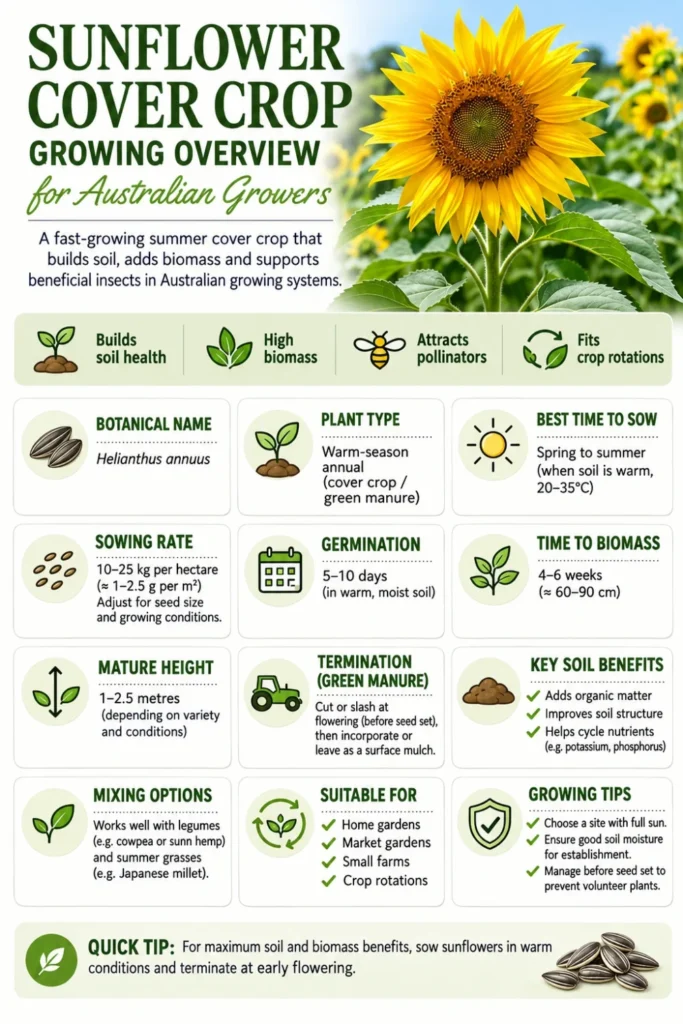
Benefits of Growing Sunflowers as a Cover Crop
Sunflowers offer several potential benefits in garden beds, market gardens and agricultural rotations. The results depend on establishment, growing conditions, plant density and how the crop is terminated.
1. Organic Matter Production
Sunflowers can produce substantial stems, leaves and root biomass during warm weather.
When this material decomposes, it contributes organic residues to the soil and supports biological activity.
2. Seasonal Soil Protection
Established sunflower foliage intercepts sunlight and rainfall, reducing the amount of bare soil exposed during the growing season.
Retained crop residues can provide additional surface protection after termination.
3. Root Development
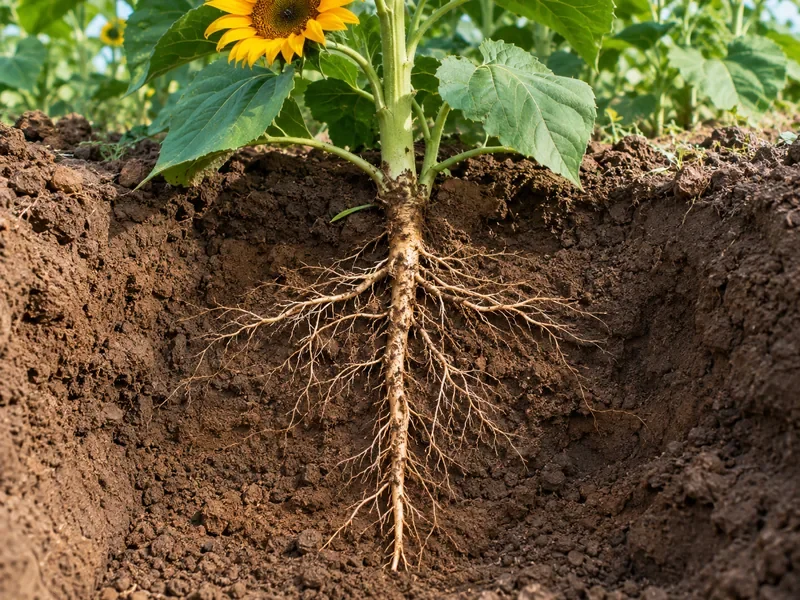
Sunflowers develop a primary taproot and lateral roots that explore the soil for moisture and nutrients.
Root growth and subsequent decomposition can contribute to soil structure, although results depend on soil conditions.
4. Weed Competition
Once established, sunflowers compete with weeds for light, moisture and nutrients.
Good establishment and appropriate plant density are important. Sunflowers do not eliminate existing weeds or guarantee weed-free soil.
5. Nutrient Cycling
Sunflowers absorb nutrients from the soil during growth and retain them in plant tissues.
As residues decompose, some nutrients can be returned to the soil system for subsequent crops.
6. Pollinator Resources
Sunflower heads contain numerous small florets that may provide pollen and nectar to visiting insects.
Allowing plants to flower can benefit bees and other pollinators, although flower accessibility and nectar production vary between sunflower types.
7. Crop Rotation Diversity
Sunflowers provide a different plant family from common grass, legume and brassica cover crops.
This can help diversify rotations, provided sunflower-related pest and disease risks are also considered.
8. Mixed Cover Crop Plantings
Sunflowers can add upright broadleaf growth to suitable warm-season mixtures.
They may complement grasses and legumes when the mixture is designed around compatible growing periods and termination requirements.
What Sunflowers Cannot Do
Sunflowers are useful cover crops, but some commonly repeated claims about their soil benefits are overstated.
- Compaction: Sunflower roots may explore cracks and suitable soil layers, but they cannot be relied upon to break severe hardpan or eliminate deep compaction.
- Soil fertility: Sunflowers recycle nutrients rather than create new supplies of nitrogen, phosphorus or potassium.
- Weed control: Weed suppression depends on establishment and canopy development. Young sunflower crops can still experience significant weed competition.
- Drought tolerance: Established plants may tolerate some dry conditions, but successful germination and useful biomass production still require adequate moisture.
- Soil remediation: Sunflowers can absorb certain elements under some conditions, but growing them does not make contaminated soil safe. Any remediation project requires site-specific testing and management.
For the best results, choose sunflower cover crops for their practical strengths: warm-season biomass, temporary soil cover, rotation diversity and potential pollinator resources.
Types of Sunflower Seeds for Cover Cropping
Not every sunflower seed product is intended for the same purpose. Seed type, variety, seed treatment, plant size and intended use all influence suitability.
Black Sunflower Seeds
Black sunflower seeds are commonly associated with dark-seeded forms of Helianthus annuus. Some black-seeded sunflowers are oilseed types, although seed colour alone does not establish the exact variety or intended production characteristics.
Best For
Warm-season cover cropping, green manure, seasonal biomass and broadleaf rotation diversity where the supplied seed is suitable for planting.
Growing Notes
Plant height, flowering time and biomass production depend on the variety and growing conditions. Confirm the characteristics of the supplied seed lot rather than assuming every black sunflower grows identically.
Explore Seedmart Black Sunflower Seeds.
Oilseed Sunflowers
Oilseed sunflowers are generally selected for oil production. Many have relatively small, dark seeds and are grown commercially in agricultural systems.
Suitable varieties may also produce useful cover crop biomass, but their agronomic performance and management requirements vary.
Confectionery Sunflowers
Confectionery sunflower types are generally selected for larger seeds intended for food markets.
They can produce substantial plants, but seed size and purchase cost may make them less practical for cover cropping than seed specifically supplied for agricultural planting.
Ornamental Sunflowers
Ornamental sunflowers are selected for flower colour, flower form, height or branching habit.
Some tall, branching varieties can produce considerable biomass, but dwarf varieties may be less suitable where the primary objective is soil cover and organic matter production.
Sunflower Microgreen Seeds
Sunflower seeds sold for microgreens are intended for dense tray production and harvesting at the seedling stage.
Microgreen production is a different growing system from establishing sunflowers as a field cover crop. Choose seed according to its intended use and relevant quality requirements.
Explore Sunflower Microgreen Seeds.
Sunflowers Compared with Other Summer Cover Crops
Sunflowers are one option among several warm-season cover crops grown in Australia. The best choice depends on whether the priority is biomass, nitrogen fixation, rapid ground cover, forage or a combination of benefits.
| Cover Crop | Main Strength | Nitrogen Fixation | Growing Notes |
|---|---|---|---|
| Sunflower Helianthus annuus |
Upright biomass, broadleaf diversity and pollinator resources | No | Warm-season annual; manage before unwanted seed set |
| Japanese Millet Echinochloa esculenta |
Fast-growing grass biomass and seasonal soil cover | No | Warm-season grass; useful in suitable summer rotations |
| Sunn Hemp Crotalaria juncea |
Warm-season legume biomass and biological nitrogen fixation | Yes, with effective nodulation | Requires warmth and suitable growing conditions |
| Cowpea Vigna unguiculata |
Legume ground cover and potential nitrogen fixation | Yes, with effective nodulation | Warm-season crop; growth habit varies by variety |
| Buckwheat Fagopyrum esculentum |
Rapid establishment and short-duration cover | No | Sensitive to frost and extreme heat; timing matters |
Sunflowers are particularly useful when a warm-season broadleaf component is wanted. If biological nitrogen fixation is the main goal, include an appropriately managed legume rather than relying on sunflowers alone.
When to Plant Sunflower Seeds in Australia
The best time to plant sunflower seeds depends on soil temperature, frost risk, moisture availability and local climate.
Sunflowers generally establish most reliably when soil has warmed and the risk of damaging frost has passed. For cover cropping, sow early enough to allow useful vegetative growth before the next planned crop.
Late Spring – Summer
Wait until frost danger has passed and the soil is warm enough for reliable germination.
Shorter growing seasons may limit biomass production before autumn temperatures decline.
Spring – Early Summer
Sow after the final frost when soil moisture and warmth are suitable.
Early establishment allows more time for biomass production before the next rotation.
Spring – Summer
Warm conditions support rapid growth when adequate moisture is available.
Plan sowing around rainfall, irrigation and the intended termination date.
Suitable Warm-Season Windows
Sunflowers can grow in warm conditions, but excessive rainfall, humidity and waterlogging may affect establishment and disease pressure.
Choose a locally suitable planting window with adequate drainage.
Spring – Summer with Moisture
Sow when temperatures are suitable and reliable rainfall or irrigation is available.
High temperatures and limited water can reduce establishment and biomass production.
How to Plant Sunflower Seeds for Cover Cropping
Sunflowers are usually direct-sown because their developing root system is better suited to establishment in its final growing position.
Choose the Right Growing WindowSelect a frost-free period with warm soil and enough time for the crop to establish before termination.
Prepare the SeedbedRemove existing weeds and prepare a firm, reasonably fine seedbed with good seed-to-soil contact. Avoid working soil when it is excessively wet.
Select Suitable SeedUse viable sunflower seed intended for planting. Check variety information, germination, treatment status and the recommended sowing rate where available.
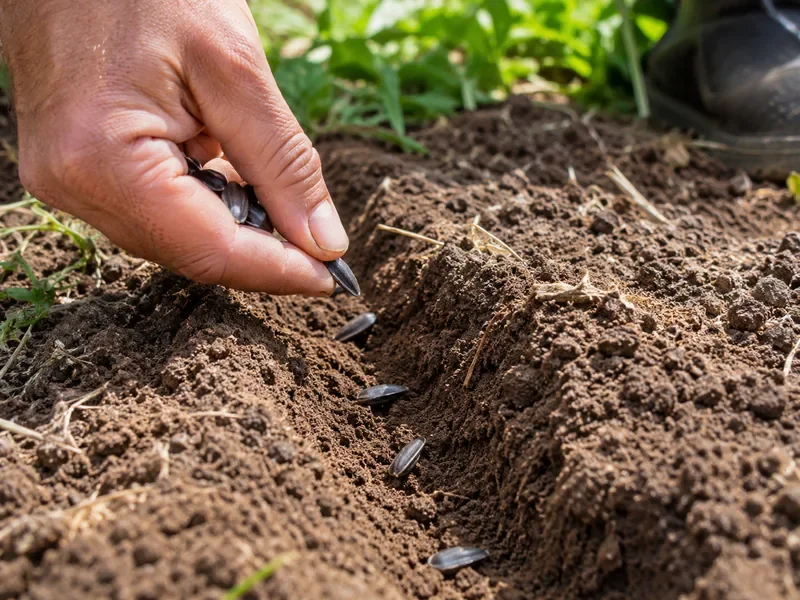
Sow at the Correct DepthPlant approximately 2–4 cm deep in suitable soil. Adjust for seed size, soil texture and moisture conditions. Avoid unnecessarily deep sowing.
Ensure Seed-to-Soil ContactAfter sowing, firm the soil gently where appropriate. Good contact helps the seed absorb moisture and germinate evenly.
Maintain Establishment MoistureProvide sufficient moisture for germination and early root development. Avoid prolonged saturation or waterlogging.
Monitor Early GrowthInspect the crop for weeds, insect damage, uneven emergence and moisture stress. Early competition can reduce sunflower growth.
Plan TerminationDecide whether the crop will be cut before flowering or allowed to flower for pollinators. Terminate before mature seed develops if volunteers are undesirable.
Sunflower Growing Requirements
For general sunflower growing information, see Seedmart’s guide to growing sunflowers from seed in Australia.
Sunflower Cover Crop Sowing Rates and Spacing
The correct sunflower sowing rate depends on seed size, germination percentage, target plant population, sowing equipment, soil conditions and whether sunflowers are grown alone or in a mixture.
Commercial sunflower planting is often planned around a target number of established plants per hectare rather than a single universal seed weight.
Garden Beds
For small garden plantings, sow seeds individually at suitable spacing and thin seedlings if necessary.
Spacing around 20–30 cm between plants can be used as an initial guide for some sunflower types, but the final spacing should reflect plant size and the desired density.
Field Cover Crops
For larger areas, calculate seed requirements using the desired plant population, seed size, germination and expected establishment.
Follow supplier recommendations for the specific seed lot and sowing system.
How to Calculate Seed Requirements
For precision sowing, seed requirements can be estimated using the following calculation:
Seed requirement (kg/ha) = Target seeds per hectare × thousand-seed weight (g) ÷ 1,000,000To allow for germination and field establishment losses, first adjust the number of seeds required to achieve the desired established plant population.
For example, a seed lot with a thousand-seed weight of 60 g requires approximately 6 kg to sow 100,000 seeds. This is a calculation example, not a recommended sunflower cover crop sowing rate.
Soil, Sunlight and Water Requirements
Soil
Sunflowers perform best in reasonably fertile, well-drained soil.
They can grow in a range of soil types, but severe compaction, poor drainage and waterlogging can restrict root development.
Sunlight
Choose a position receiving full sun for most of the day.
Insufficient sunlight can reduce plant growth, biomass production and flowering.
Water
Reliable moisture is particularly important during germination and establishment.
Water demand increases as plants develop, especially during hot weather and periods of rapid growth.
Fertility
Sunflowers require nutrients for healthy growth and biomass production.
They can recycle nutrients through residues, but they do not create additional soil fertility or fix atmospheric nitrogen.
Can Sunflowers Grow in Clay Soil?
Sunflowers can grow in some clay soils where drainage, aeration and moisture conditions are suitable.
However, severely compacted or waterlogged clay can restrict root development. Sunflower roots may help contribute to soil structure over time, but the crop should not be expected to repair major soil limitations on its own.
Are Sunflowers Drought Tolerant?
Established sunflowers may tolerate periods of limited moisture better than some shallow-rooted crops, depending on variety and growing conditions.
However, drought stress can reduce biomass, flowering and overall crop performance. For a productive cover crop, sufficient moisture remains important.
How to Use Sunflowers as Green Manure
Sunflowers can be grown specifically to produce plant material that is returned to the soil. This is commonly described as sunflower green manure.
When the crop is terminated, stems, leaves and roots gradually decompose. This adds organic residues and helps recycle nutrients already absorbed by the plants.
When Should You Cut Sunflowers for Green Manure?
The appropriate termination stage depends on whether the priority is tender biomass, maximum growth, pollinator resources or avoiding volunteer seedlings.
Before Flowering
Cutting before flowering generally provides younger, less mature plant material.
This can be easier to manage and helps avoid seed production, but it also prevents the crop from providing sunflower flowers to pollinators.
During Flowering
Allowing sunflowers to flower provides resources for visiting insects and allows additional plant development.
Terminate before viable seed forms if unwanted volunteer sunflowers are a concern.
Three Ways to Manage Sunflower Residues
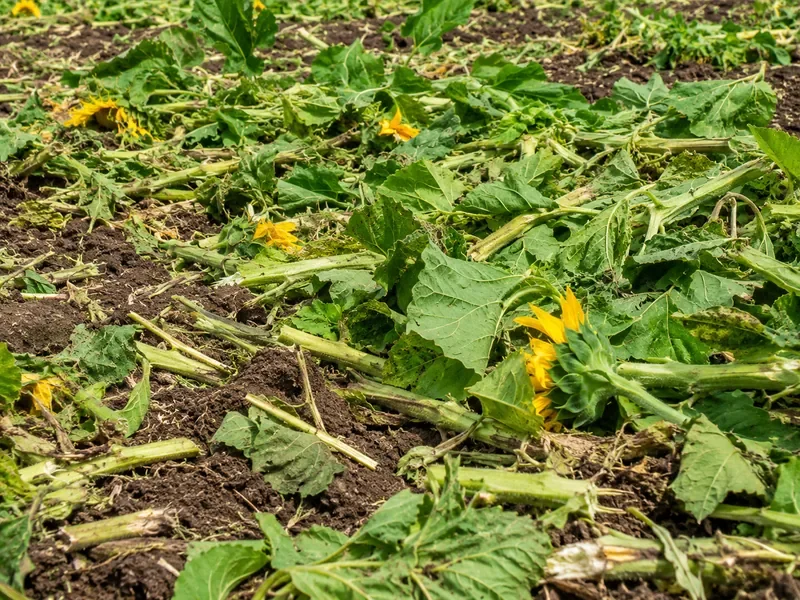
Cut and Leave as Surface MulchCut or chop sunflower stems and leave the residues on the soil surface. This can help protect the soil while the material gradually decomposes.
Chop and IncorporateChop plant material into manageable pieces and incorporate it into suitable soil where cultivation is part of the growing system.Allow sufficient decomposition time before planting the next crop.
Terminate and Leave Roots in PlaceCut plants near ground level and allow the roots to decompose in the soil.Large stems may need additional chopping or removal depending on the next crop and planting equipment.
How Long Should You Wait Before Planting the Next Crop?
The waiting period depends on residue quantity, stem maturity, soil temperature, moisture and the next crop’s sensitivity.
Where fresh material is incorporated, allowing approximately 2–4 weeks can be a useful starting point, but coarse sunflower stems may take considerably longer to decompose.
Seedlings should not be planted into large amounts of undecomposed material without considering potential physical interference, temporary nitrogen immobilisation and other residue effects.
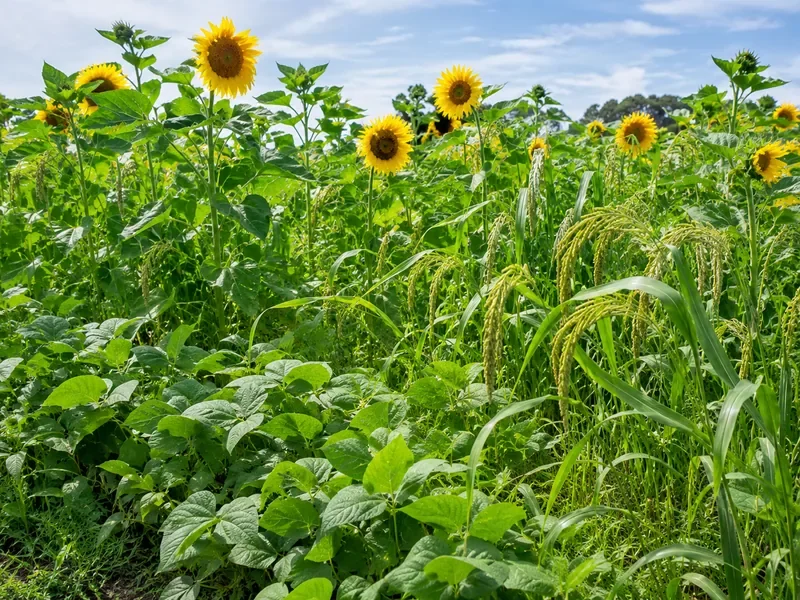
Can Sunflowers Be Grown in a Mixed Cover Crop?
Yes. Sunflowers can be included in suitable warm-season cover crop mixtures to add upright broadleaf growth and diversify the plant families present.
The best companion species depend on rainfall, soil, climate, crop objectives and the planned termination method.
Sunflower + Millet
Combines a broadleaf sunflower with a warm-season grass.
Millet can provide additional grassy biomass and seasonal soil cover, while sunflowers add a different growth habit and root architecture.
Sunflower + Cowpea
Combines sunflower biomass with a warm-season legume.
Effectively nodulated cowpeas can fix atmospheric nitrogen, while sunflowers contribute upright growth and crop diversity.
Sunflower + Sunn Hemp
Combines two upright warm-season species with different plant families.
Sunn hemp may contribute biological nitrogen fixation when effectively nodulated. Plant density needs careful management to avoid excessive competition.
Sunflower + Multi-Species Mix
Sunflowers may form one component of a broader summer cover crop blend containing suitable grasses and legumes.
Choose species with compatible growing periods and adjust the rate of each component rather than using its full standalone sowing rate.
Should Sunflowers Be Mixed with Every Cover Crop?
No. Some species have different seasonal requirements, moisture needs, growth rates or termination methods.
Sunflowers are warm-season plants and should not automatically be included in cool-season mixtures containing species such as oats, vetch or tillage radish without considering local growing conditions.
Browse Seedmart’s green manure and cover crop seed range for warm-season planting options.
Common Problems When Growing Sunflowers as a Cover Crop
Poor Germination
Possible causes: Cold soil, insufficient moisture, sowing too deeply, poor seed-to-soil contact or low seed viability.
What to do: Sow into warm soil at an appropriate depth and maintain suitable moisture during establishment.
Uneven Emergence
Possible causes: Variable sowing depth, uneven soil moisture, soil crusting or inconsistent seed placement.
What to do: Prepare a uniform seedbed and check sowing equipment or broadcasting methods.
Slow Early Growth
Possible causes: Cool weather, poor fertility, inadequate moisture, compaction or early weed competition.
What to do: Assess soil conditions and correct the underlying limitation where practical.
Yellowing Leaves
Possible causes: Nutrient deficiency, waterlogging, drought stress, disease or normal ageing.
What to do: Inspect soil moisture, drainage and plant health before applying fertiliser.
Chewed Seedlings
Possible causes: Insect pests, slugs, snails or other feeding damage.
What to do: Inspect seedlings regularly and use suitable integrated pest management practices.
Weak Biomass Production
Possible causes: Low plant population, inadequate fertility, drought, excessive competition or a short growing window.
What to do: Review establishment, soil conditions and available growing time.
Unwanted Volunteer Sunflowers
Likely cause: Mature seed was produced and shed before crop termination.
What to do: Terminate before viable seed develops when volunteers are undesirable.
Difficult Residue Management
Likely cause: Large, mature stems can become coarse and slow to break down.
What to do: Terminate earlier or chop residues into smaller pieces before incorporation or surface retention.
Frequently Asked Questions About Sunflower Cover Crops
Are Sunflowers Good for Cover Cropping?
Yes. Sunflowers can provide warm-season biomass, seasonal soil cover, rotation diversity and pollinator resources. Their suitability depends on the growing system and intended objectives.
Do Sunflowers Improve Soil?
Sunflowers can contribute organic residues, root growth and nutrient cycling. However, they do not automatically correct severe compaction or nutrient deficiencies.
Are Sunflowers Good Green Manure?
Yes. Sunflowers can be grown and terminated to return plant material to the soil. Residue management and decomposition time should be considered before planting the next crop.
Do Sunflowers Fix Nitrogen?
No. Sunflowers are not nitrogen-fixing legumes. They absorb nitrogen already present in the soil and may recycle some of it through decomposition.
When Should I Plant Sunflower Seeds in Australia?
Generally during spring and summer when soil is warm and frost risk has passed. The ideal sowing window depends on local climate, moisture and the intended growing period.
How Deep Should Sunflower Seeds Be Planted?
Approximately 2–4 cm is a general guide for direct sowing. Adjust for seed size, soil texture, moisture and supplier recommendations.
How Long Do Sunflower Seeds Take to Germinate?
Sunflower seeds commonly germinate in approximately 5–10 days under favourable warm, moist conditions. Cooler or unsuitable conditions may delay emergence.
Can Sunflowers Break Up Clay Soil?
Sunflower roots may contribute to soil structure where they can penetrate the soil. They should not be relied upon to remove severe compaction or hardpan.
Can Sunflowers Suppress Weeds?
Established sunflowers compete with weeds for light and other resources. However, weed control during establishment is still important, and suppression is not guaranteed.
Are Sunflowers Better Than Millet for Cover Crops?
Neither is universally better. Sunflowers provide broadleaf diversity and potential pollinator resources, while millet provides grass biomass and can be useful for rapid seasonal soil cover.
Can I Grow Sunflowers with Cowpeas?
Yes, where growing conditions are suitable. Cowpeas may contribute biological nitrogen fixation when effectively nodulated, while sunflowers add upright broadleaf growth.
Should Sunflowers Be Cut Before Flowering?
Cutting before flowering can simplify residue management and prevent seed production. Allowing some plants to flower provides resources for pollinators, but termination should occur before unwanted seed set.
Can I Leave Sunflower Roots in the Ground?
Yes. Roots can be left to decompose naturally after the crop is terminated. Decomposition depends on soil temperature, moisture and biological activity.
Do Sunflowers Attract Bees?
Many sunflower varieties attract bees and other flower-visiting insects. The value of the flowers varies with variety and pollen or nectar availability.
Grow Sunflowers as a Cover Crop in Australia
Sunflowers can be a useful addition to Australian summer growing systems where the objective is to produce biomass, protect exposed soil, diversify rotations and provide flowering resources for pollinators.
For the best results, select suitable seed, sow into warm soil with adequate moisture, manage weeds during establishment and plan termination around the next crop.
Where nitrogen fixation or rapid ground cover is a priority, consider combining sunflowers with suitable warm-season legumes or grasses as part of a planned cover crop mixture.
Black Sunflower Seeds
Grow sunflowers for warm-season green manure, cover cropping and seasonal biomass production.
Green Manure & Cover Crop Seeds
Explore grasses, legumes, brassicas and other species for soil improvement and seasonal planting.
Explore Sunflower & Cover Crop Seeds
Choose suitable seed for your garden, market garden or agricultural planting. Seedmart Australia supplies a range of green manure and cover crop seeds for Australian growing conditions.