
Red Mustard Microgreen Seeds
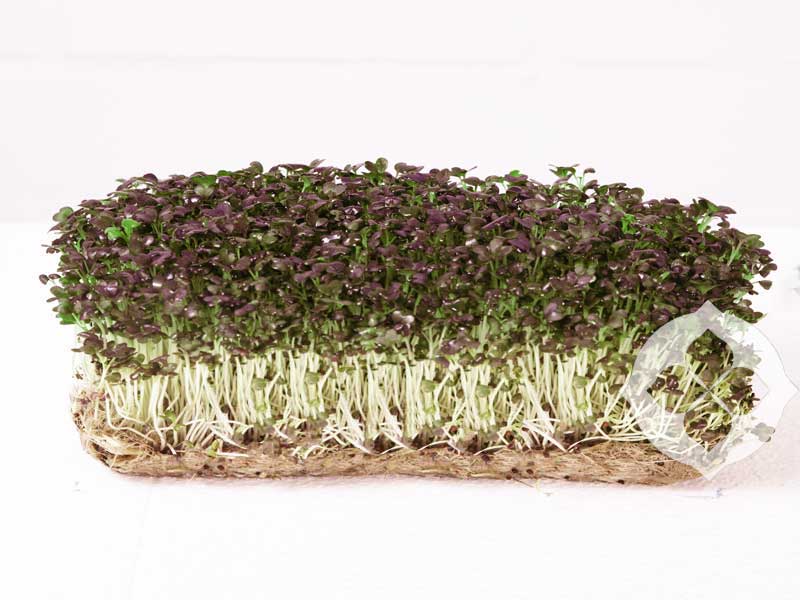
Grow colourful Red Mustard microgreens with a fresh, spicy mustard flavour in approximately 10–15 days. Red Mustard Microgreen Seeds produce attractive young seedlings with red, burgundy to purple-toned foliage and a distinctive peppery mustard flavour. They are easy to grow in shallow trays using soil, coir, hemp growing mats or other suitable microgreen growing media.
Red Mustard is an excellent choice for home growers, chefs and commercial microgreen production. The seedlings combine strong colour with a more pronounced flavour than milder brassica microgreens such as broccoli or kohlrabi, making them particularly useful for salads, sandwiches, wraps, bowls, garnishes and colourful microgreen mixes.
Seedmart Red Mustard Microgreen Seeds are supplied for growing purposes and are available in packet and bulk quantities for home and commercial growers.
Red Mustard Microgreen Seed Details
| Botanical name | Brassica juncea |
|---|---|
| Common name | Red Mustard |
| Plant family | Brassicaceae |
| Pre-soak | Not required |
| Approximate sowing rate | Approximately 10–15 g per 10 × 20 inch tray as a useful starting range |
| Growing medium | Soil, coir, hemp growing mats or another suitable microgreen medium |
| Germination | Approximately 2–4 days under suitable conditions |
| Typical harvest | Approximately 10–15 days |
| Colour | Green, red, burgundy to purple-toned foliage depending on cultivar and growing conditions |
| Flavour | Fresh, peppery mustard flavour with a spicy brassica bite |
| Availability | Packet and bulk quantities |
Why Grow Red Mustard Microgreens?
- Fast-growing microgreen variety with a typical crop cycle of approximately 10–15 days.
- Attractive red, burgundy and purple-toned foliage adds colour to microgreen trays and dishes.
- Distinctive peppery mustard flavour for growers wanting a stronger-tasting microgreen.
- Excellent for salads, sandwiches, wraps, bowls and garnishes.
- Suitable for growing indoors throughout the year with adequate light and ventilation.
- Can be grown on soil, coir or suitable microgreen growing mats.
- No seed pre-soaking required.
- Useful as a colourful and spicy component of mixed microgreen crops.
- Suitable for home growers, chefs and commercial microgreen production.
- Available in smaller packets and economical bulk quantities.
How to Grow Red Mustard Microgreens
Red Mustard microgreens are relatively easy to grow and follow a similar production method to other small-seeded brassica microgreens. The seeds do not normally require pre-soaking and can be sown directly onto a moist growing medium.
For a standard 10 × 20 inch microgreen tray, approximately 10–15 grams of seed provides a useful starting range. Adjust sowing density according to seed size, tray dimensions, growing system and preferred harvest stage.
- Prepare the growing tray.
Add approximately 3–4 cm of moist growing medium to a shallow tray and gently level the surface. Suitable media include quality soil, coir or a purpose-made hemp growing mat. - Sow the Red Mustard seeds.
Spread the seed as evenly as possible across the surface. Aim for consistent coverage without allowing seeds to accumulate in dense clumps. - Mist thoroughly.
Use a spray mister to moisten the seeds and growing surface evenly and help establish good seed-to-medium contact. - Cover or stack the tray.
Cover with another tray or suitable cover during the initial germination period. Light, even pressure can help encourage uniform germination and stronger initial establishment. - Maintain moisture during germination.
Keep the growing medium evenly moist without saturating it. Red Mustard commonly begins germinating within approximately 2–4 days under suitable conditions. - Introduce the seedlings to light.
Once the seedlings are established and pushing upward, remove the cover and place the tray under suitable natural or artificial growing light. Adequate light helps produce compact growth and stronger leaf colour. - Water carefully.
Continue watering as required to maintain even moisture. Bottom watering after establishment can help reduce unnecessary moisture on dense foliage. - Harvest the microgreens.
Red Mustard microgreens are commonly ready for harvest approximately 10–15 days after sowing. Cut the stems cleanly just above the growing medium once the cotyledons are fully developed or when the first true leaves begin to emerge, depending on your preferred crop stage.
What Do Red Mustard Microgreens Look Like?
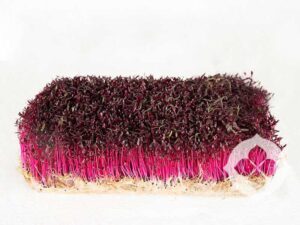
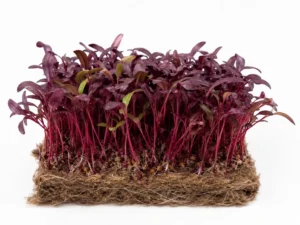
Red Mustard microgreens are valued for their strong visual contrast as well as their flavour. Depending on the particular red mustard cultivar and growing conditions, young plants may develop green leaves flushed with red, burgundy foliage or much darker purple-red colouring.
Some red mustard types produce relatively rounded young leaves, while others develop more deeply lobed or serrated true leaves as they mature. This makes Red Mustard particularly useful for growers wanting to add both colour and texture to microgreen mixes.
Leaf pigmentation can vary according to variety, temperature, light intensity, harvest stage and other growing conditions.
What Do Red Mustard Microgreens Taste Like?
Red Mustard microgreens have a fresh, peppery flavour with the distinctive heat associated with mustard greens. The flavour is generally stronger and more pungent than mild brassica microgreens such as broccoli or kohlrabi.
The intensity can vary between red mustard cultivars and according to harvest stage. Some produce a moderately spicy mustard flavour, while others develop a noticeably sharper bite.
This strong flavour makes Red Mustard especially useful where only a small quantity is needed to add character to salads, sandwiches, wraps, grain bowls and garnishes.
How to Use Red Mustard Microgreens
Red Mustard microgreens combine strong colour with a distinctive peppery flavour and are best used fresh.
- Salads: Mix through mild leafy salads to add colour and a spicy mustard bite.
- Sandwiches: Add to sandwiches and rolls where a peppery flavour is wanted.
- Wraps: Use fresh in wraps, tacos and filled flatbreads.
- Bowls: Scatter over grain bowls, rice bowls and vegetable dishes.
- Garnishes: Use the red-toned foliage to finish restaurant-style dishes and platters.
- Egg dishes: Pair with eggs, avocado and other mild ingredients where the mustard flavour provides contrast.
- Microgreen mixes: Combine with broccoli, kohlrabi, sunflower or other milder microgreens to add colour and flavour intensity.
Red Mustard microgreens are generally best added after cooking or used raw so their crisp texture, colour and characteristic flavour are retained.
Red Mustard Microgreens and Brassica Vegetables
Red Mustard belongs to the Brassicaceae family, which also includes broccoli, cabbage, kale, radish and kohlrabi.
Like other edible brassicas, mustard plants naturally contain glucosinolates and related plant compounds. The amount and composition present can vary considerably according to species, cultivar, growing conditions, crop age, harvest stage and preparation.
Red Mustard microgreens are harvested when the plants are still very young, generally around the cotyledon to first true leaf stage.
Red Mustard vs Broccoli Microgreens
Both Red Mustard and broccoli are fast-growing brassica microgreens, but they differ considerably in flavour and appearance.
| Feature | Red Mustard Microgreens | Broccoli Microgreens |
|---|---|---|
| Colour | Red, burgundy, purple and green tones | Predominantly green |
| Flavour | Peppery, mustard-like and moderately to strongly spicy | Mild, fresh brassica flavour |
| Pre-soak | Not required | Not required |
| Typical harvest | Approximately 10–15 days | Approximately 8–14 days |
| Best suited to | Colourful crops and stronger-flavoured microgreen mixes | Mild-flavoured microgreen crops and everyday use |
Red Mustard is particularly useful when growers want considerably more flavour and colour than a standard green brassica microgreen provides.
Red Mustard vs Radish Microgreens
Red Mustard and radish are both popular choices for growers looking for spicy microgreens, but their flavour and appearance are not identical.
| Feature | Red Mustard | Radish |
|---|---|---|
| Flavour character | Distinct mustard-like heat | Fresh, sharp radish-like heat |
| Appearance | Red, burgundy, purple and green foliage depending on variety | Varies widely by cultivar, with green, pink, purple or red stems possible |
| Typical use | Spicy accent, garnish and colourful microgreen mixes | Spicy accent, salads, sandwiches and microgreen mixes |
Both can be combined with milder microgreens to create blends with greater flavour, colour and texture variation.
Frequently Asked Questions
How long do Red Mustard microgreens take to grow?
Red Mustard microgreens are commonly ready to harvest approximately 10–15 days after sowing. Growth rate varies according to temperature, light, moisture, sowing density, cultivar and preferred harvest stage.
Do Red Mustard microgreen seeds need to be soaked?
No. Red Mustard seeds are small brassica seeds and do not normally require pre-soaking before sowing.
How many Red Mustard seeds should I use in a 10 × 20 tray?
Approximately 10–15 grams per standard 10 × 20 inch tray provides a useful starting range. Growers can adjust sowing density according to seed size, equipment and preferred crop density.
How long do Red Mustard seeds take to germinate?
Red Mustard commonly begins germinating within approximately 2–4 days under suitable warm, moist conditions.
Can Red Mustard microgreens be grown without soil?
Yes. Red Mustard can be grown using suitable soilless microgreen media including coir and purpose-made growing mats. Whatever medium is used should retain adequate moisture while still allowing good drainage and airflow.
Do Red Mustard microgreens need light?
The seeds do not require light during initial germination. Once seedlings have established, expose them to suitable natural or artificial growing light to develop stronger growth and foliage colour.
When should I uncover Red Mustard microgreens?
Remove the cover once germination is established and the seedlings begin pushing upward, commonly approximately 2–4 days after sowing depending on growing conditions.
When should Red Mustard microgreens be harvested?
Red Mustard is commonly harvested approximately 10–15 days after sowing, usually once the cotyledons are fully developed or around the emergence of the first true leaves.
What do Red Mustard microgreens taste like?
Red Mustard microgreens have a fresh, peppery mustard flavour. They are generally more pungent than broccoli or kohlrabi microgreens and can range from moderately spicy to quite hot depending on the cultivar and growing conditions.
Are Red Mustard microgreens spicy?
Yes. Mustard microgreens are grown partly for their characteristic peppery heat. The exact intensity varies between cultivars, with some red mustards being relatively mild and others producing a noticeably stronger mustard bite.
What colour are Red Mustard microgreens?
Colour varies between red mustard cultivars. Seedlings may produce green leaves with red flushing, burgundy foliage, dark red leaves or purple-red colouring. Light and growing conditions can also influence colour intensity.
Why are my Red Mustard microgreens not very red?
Colour is influenced by genetics as well as environmental conditions. Light intensity, temperature and harvest stage can all affect pigmentation, so crops grown under different conditions may show varying amounts of red or purple colour.
Can Red Mustard microgreens be grown indoors?
Yes. Red Mustard is well suited to indoor microgreen production and can be grown throughout the year when adequate light, moisture, airflow and suitable temperatures are provided.
Can Red Mustard microgreens be grown on a windowsill?
Yes. A bright windowsill can work for small home-grown trays, although dedicated growing lights generally provide more consistent light and growth for larger crops.
Can Red Mustard be mixed with other microgreens?
Yes. Red Mustard is particularly useful in blends because its colour and spicy flavour contrast well with milder varieties such as broccoli, kohlrabi and sunflower microgreens.
Is Red Mustard the same as Green Mustard?
No. Although both are mustard greens and may belong to the same species, red mustard types are selected for red, burgundy or purple pigmentation in their foliage. Green mustard varieties remain predominantly green.
Is Red Mustard the same as Mizuna?
No. Mustard and mizuna are related brassica vegetables, but they are not necessarily the same species or cultivar. Red Mustard commonly refers to red-leaved forms of Brassica juncea, while traditional mizuna is generally classified within Brassica rapa.
Where can I buy Red Mustard Microgreen Seeds in Australia?
Seedmart supplies Red Mustard Microgreen Seeds in packet and bulk quantities for home growers, chefs, microgreen growers and commercial businesses throughout Australia.
Need More Help Growing Red Giant Mustard Microgreens?
Growing your own Red Giant Mustard microgreens? Follow our step-by-step guide to growing Red Giant Mustard microgreens for advice on sowing, germination, blackout, watering, light and harvesting.
david mcpartlan –
Excellent products and great service thanks