
Celery Tall Utah Vegetable Seeds
Botanical Name: Apium graveolens var. dulce
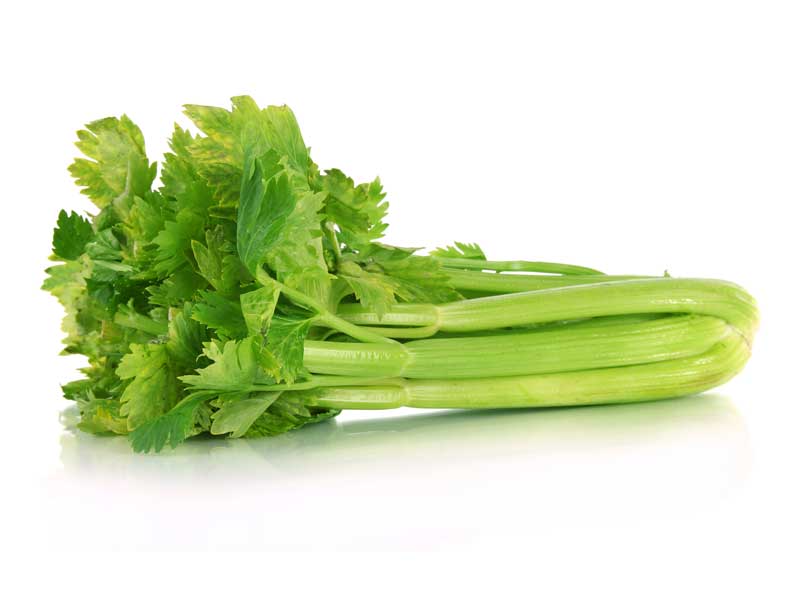
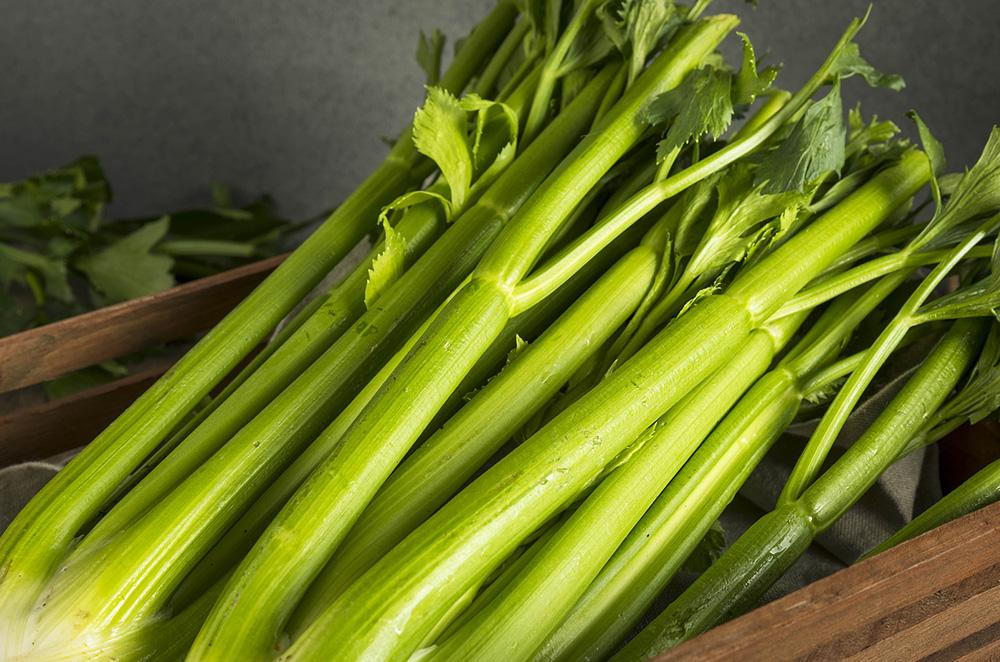
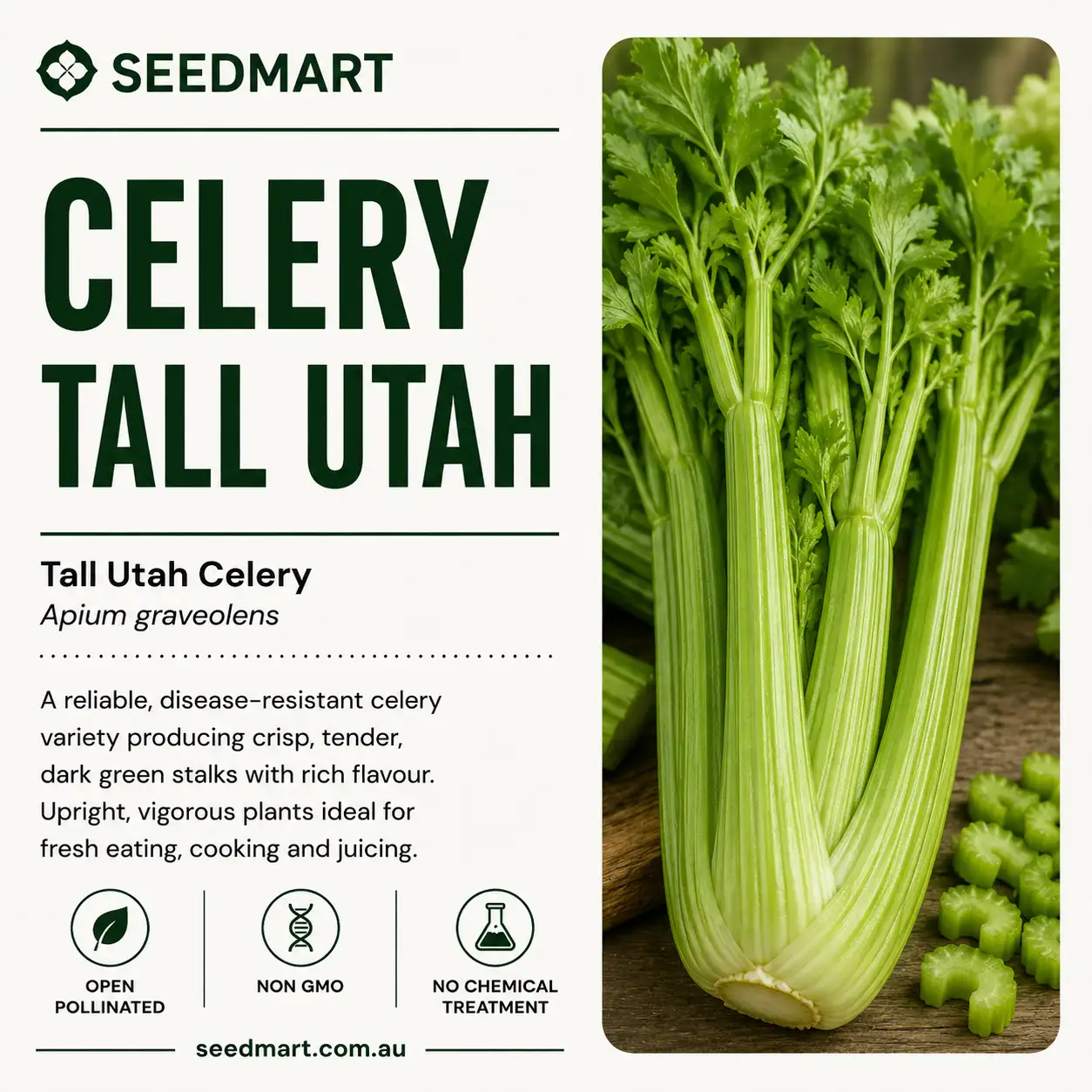
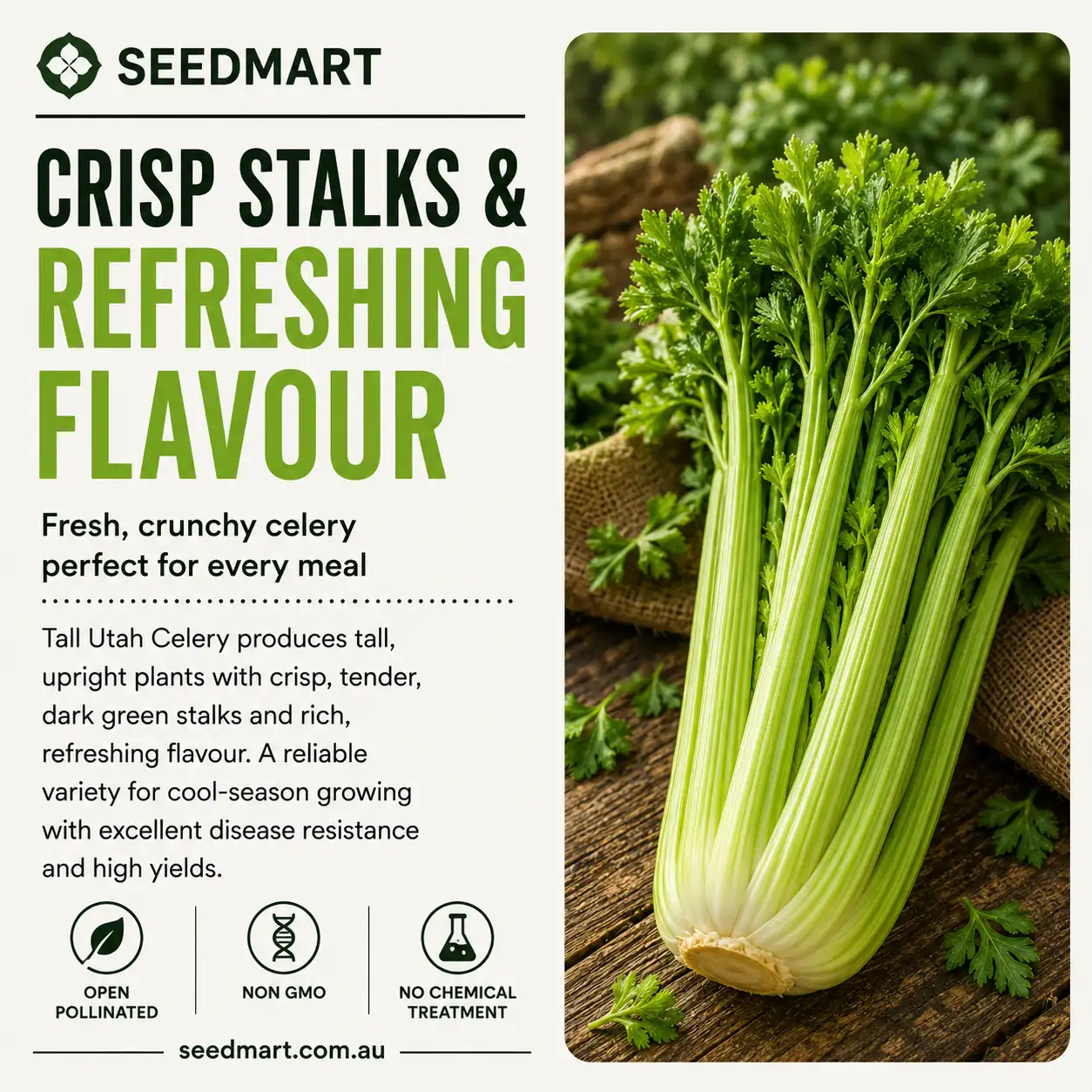
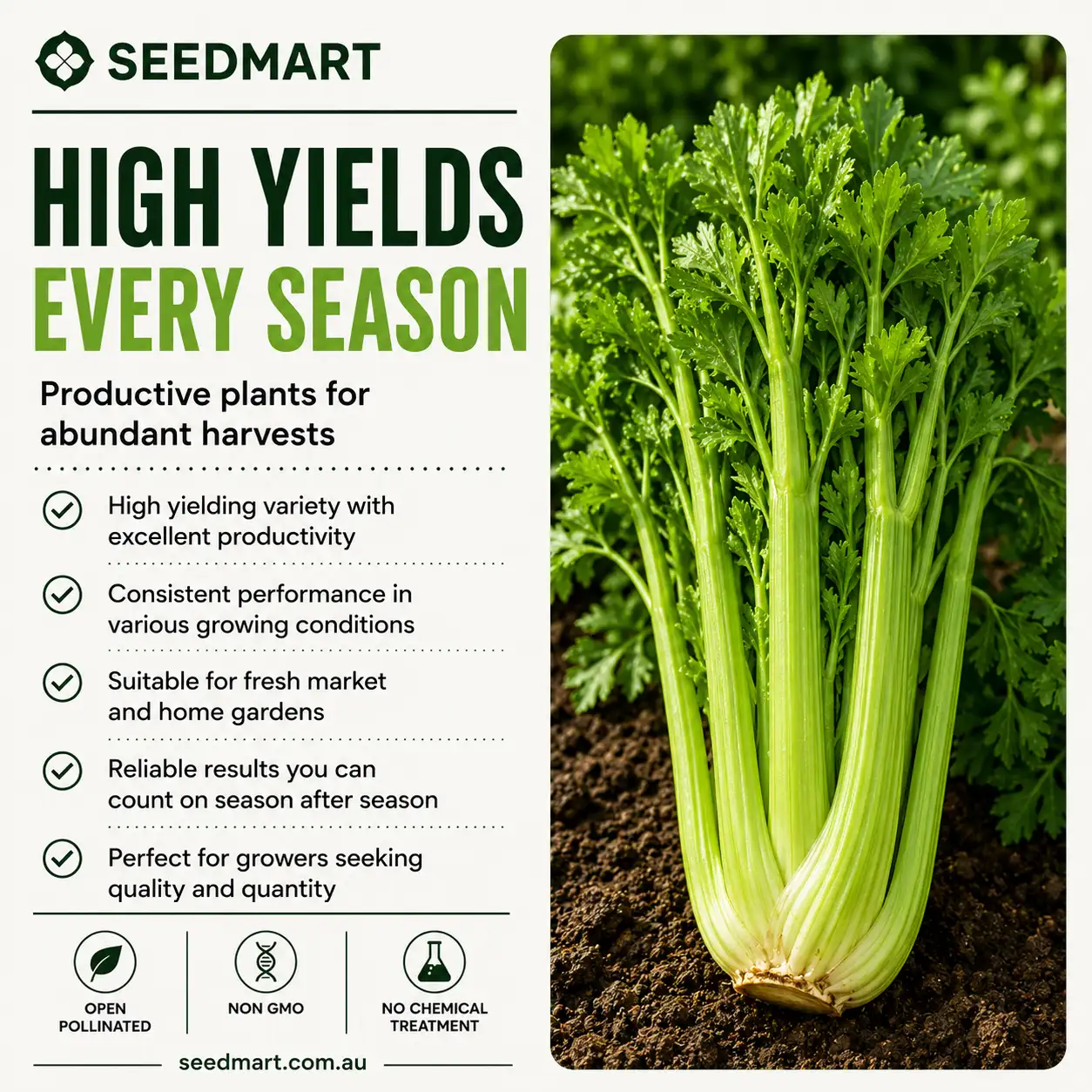
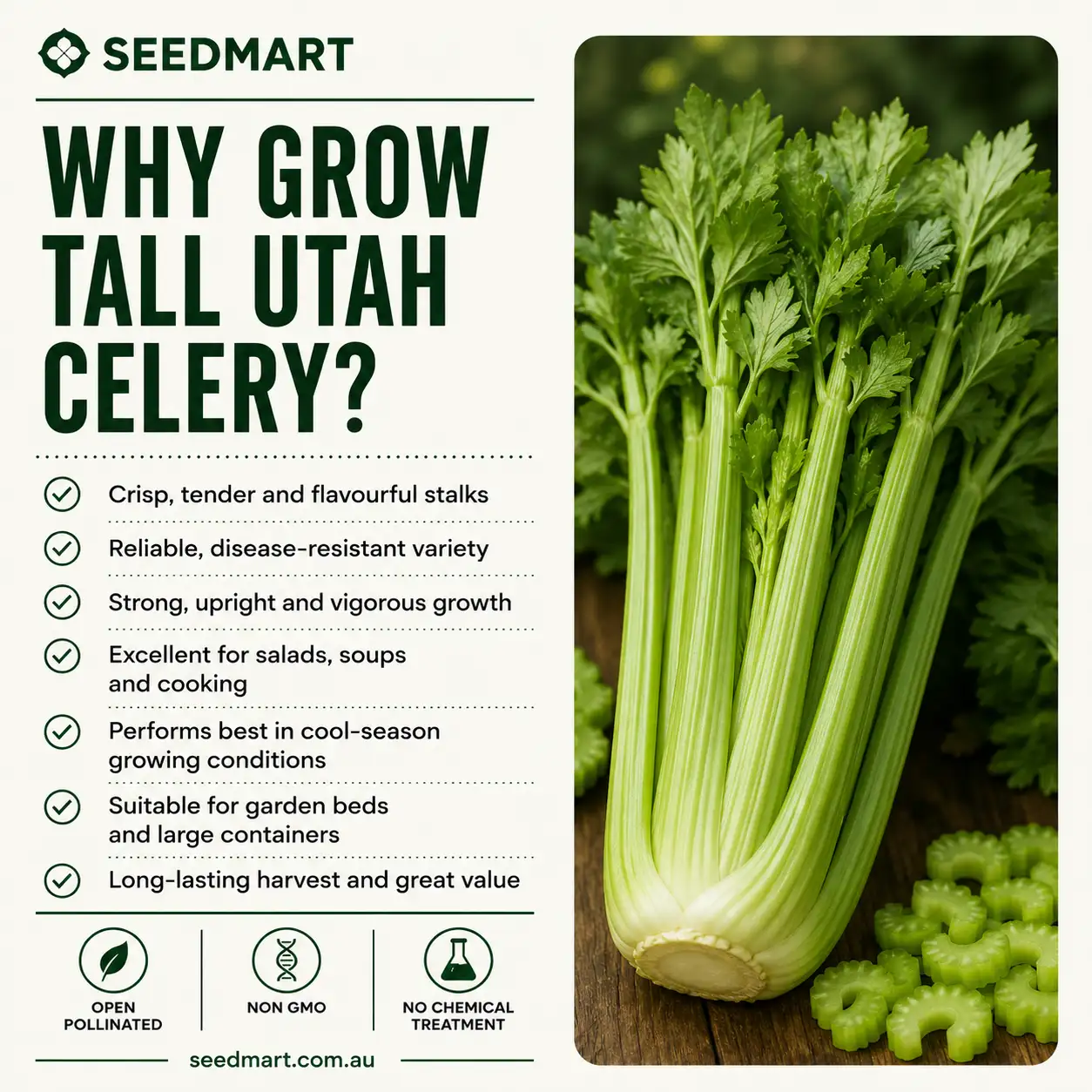
Tall Utah Celery is a classic green stalk celery producing vigorous upright plants with long, crisp, medium to dark green stems and compact leafy hearts. A dependable traditional celery variety, Tall Utah is valued for its strong growth, tender stalks and distinctive fresh celery flavour.
Well-grown plants can reach approximately 60 cm or more in height, producing substantial stalks suitable for fresh eating, salads, soups, stocks, stir-fries and cooked vegetable dishes. Individual outer stems may be harvested progressively, or the entire plant can be cut once the central head has reached the preferred size.
Celery requires more consistent moisture and fertility than many common vegetables, but Tall Utah rewards careful cultivation with crisp, productive stalks. It performs best during mild to cool weather and is particularly well suited to autumn, winter and spring production across many Australian climates.
Key Attributes
Tall Green StalksProduces long, upright medium to dark green stalks with good thickness and the characteristic crisp texture of traditional celery. |
Crisp & TenderWell-grown stalks are crisp and tender with a fresh celery flavour suitable for both raw and cooked dishes. |
Compact HeartsDevelops a dense central heart surrounded by substantial upright stalks for productive home and market garden harvests. |
Progressive HarvestOuter stalks can be harvested individually as required, allowing the centre of the plant to continue developing. |
Cool-Season FavouritePerforms best under mild to cool conditions with reliable moisture, making it particularly useful for autumn, winter and spring crops. |
Versatile Kitchen VegetableExcellent fresh in salads and snacks or cooked in soups, stocks, casseroles, stir-fries and savoury dishes. |
Product Description
Tall Utah is a traditional stalk celery variety selected for vigorous upright growth, crisp green stems and reliable performance under suitable cool-season conditions.
Botanically classified as Apium graveolens var. dulce, stalk celery belongs to the Apiaceae family alongside carrots, parsley, coriander, dill and fennel.
Plants develop a compact crown surrounded by numerous elongated leaf stalks or petioles. These thickened stalks form the familiar edible portion generally referred to as celery.
Tall Utah typically produces medium to dark green plants with substantial, rounded stalks and a compact central heart. Mature plants may reach around 60 cm or more under favourable conditions, although final size varies with soil fertility, spacing, moisture, temperature and harvest management.
Celery is naturally a long-season crop. Tall Utah commonly requires approximately 100–120 days to reach a substantial harvest stage, although individual stalks can be picked earlier once plants are sufficiently established.
Unlike vegetables that tolerate intermittent drought, celery performs best when growth remains uninterrupted. It has a relatively shallow root system and requires consistently moist soil to produce succulent stalks.
Dry conditions can reduce growth and result in tougher, more strongly flavoured stems.
For this reason, successful celery production depends heavily on fertile soil, regular irrigation and suitable seasonal temperatures.
Why Grow Tall Utah Celery?
- Classic green stalk celery variety.
- Produces tall, upright plants.
- Medium to dark green stalks.
- Crisp texture and traditional celery flavour.
- Compact central hearts.
- Well-grown stalks can exceed 30 cm in usable length.
- Mature plants may reach approximately 60 cm or more.
- Suitable for progressive stalk harvesting.
- Entire plants can also be harvested at maturity.
- Excellent for fresh eating.
- Suitable for salads and vegetable platters.
- Excellent for soups and stocks.
- Useful in stir-fries and cooked dishes.
- Well suited to autumn and winter vegetable gardens.
- Suitable for home and market garden production.
- Approximately 2,100–3,000 seeds per gram.
Plant Details
| Plant Type | Cool-season stalk vegetable |
| Variety | Tall Utah Celery |
| Botanical Name | Apium graveolens var. dulce |
| Family | Apiaceae |
| Growth Habit | Tall, upright, compact-hearted celery plant |
| Approximate Height | Approximately 60–75 cm under suitable conditions |
| Stalk Colour | Medium to dark green |
| Stalk Type | Long, thick, crisp stalks with rounded ribs |
| Flavour | Fresh, aromatic traditional celery flavour |
| Days to Harvest | Approximately 100–120 days under suitable conditions |
| Position | Full sun to light partial shade |
| Life Cycle | Biennial botanically, generally grown as an annual vegetable |
| Seeds per Gram | Approximately 2,100–3,000 |
Sowing Information
| Sowing Method | Best raised in seedling trays or punnets before transplanting |
| Sowing Depth | Approximately 2–5 mm; cover very lightly |
| Germination | Usually approximately 14–21 days; may be slower under cool or fluctuating conditions |
| Preferred Germination Temperature | Approximately 15–21°C |
| Plant Spacing | Approximately 20–30 cm |
| Row Spacing | Approximately 45–80 cm |
| Position | Full sun; light afternoon shade useful in warmer climates |
| Soil | Deep, fertile, moisture-retentive and well drained |
| Moisture | Requires consistent soil moisture throughout growth |
When to Sow Tall Utah Celery in Australia
| Climate Zone | Suggested Sowing Time | Growing Notes |
|---|---|---|
| Cool | Spring – early summer | Raise seedlings under protected conditions and transplant after severe frost risk has reduced. Celery benefits from a long cool growing season. |
| Temperate | Late winter – spring; late summer – autumn | Two useful planting windows may be possible. Avoid having the main stalk-development period coincide with prolonged extreme heat. |
| Subtropical | March – October | Best grown through the cooler months. Maintain reliable irrigation and provide afternoon protection where conditions become warm. |
| Tropical | February – September | Concentrate production into the cooler, drier season. Semi-shade may be useful in hot tropical conditions. |
| Arid | Autumn – early spring | Avoid extreme heat and provide dependable irrigation throughout the long growing period. |
These sowing periods are general guides. Local frost, temperature, elevation, rainfall and water availability should also be considered. Celery requires a relatively long growing season, so planting time should allow the crop to develop through predominantly mild conditions.
How to Grow Tall Utah Celery from Seed
Celery seed is extremely small and relatively slow to establish compared with many common vegetables.
For this reason, Tall Utah is generally easiest to grow by starting the seed in trays or punnets before transplanting into the garden.
Fill a seed tray with a fine, good-quality seed-raising mix.
Sow the seeds shallowly, approximately 2–5 mm deep, or press them lightly into the surface and cover with only a thin layer of growing medium.
Water carefully so the fine seeds are not displaced.
Maintain consistent moisture during germination. Celery seed should not be allowed to dry once germination has begun.
A soil temperature of approximately 15–21°C is generally suitable.
Germination commonly takes approximately 14–21 days, although individual seeds may emerge over an extended period.
Once seedlings are large enough to handle, prick them out into individual cells or small pots where necessary.
Grow seedlings on until they are robust enough for transplanting.
Harden plants gradually to outdoor conditions before planting into the vegetable garden.
Transplanting Celery Seedlings
Celery seedlings should be well established before they are transplanted into their permanent position.
Choose healthy plants with several true leaves and an active root system.
Water seedlings before transplanting.
Prepare planting holes approximately 20–30 cm apart.
Position seedlings at approximately the same depth at which they were growing in their trays or pots.
Firm the surrounding soil gently and water thoroughly.
During the first several weeks after transplanting, maintain reliable moisture while the root systems establish.
Avoid allowing young plants to dry severely.
A growth interruption during this stage can reduce later stalk development.
Growing Tall Utah Celery in Australian Conditions
Celery generally produces the best stalk quality under cool to mild conditions.
Tall Utah requires a relatively long growing season, so planting schedules should allow enough time for the plants to develop before severe heat arrives.
In cool climates, crops are generally established from spring once severe frost risk has reduced.
Temperate gardeners can often produce spring and autumn crops.
In subtropical regions such as South East Queensland, celery is particularly useful from autumn through winter and into spring.
Tropical gardeners should concentrate production into the coolest and driest months.
Prolonged heat can produce tougher stalks, stronger flavour and increased water demand.
Soil Preparation
Celery is a relatively demanding crop and performs best in fertile soil containing plenty of organic matter.
The ideal soil is:
- Deep
- Fertile
- Rich in organic matter
- Moisture retentive
- Well drained
- Approximately slightly acidic to neutral
Prepare the growing area before transplanting.
Incorporate well-decomposed compost or aged manure where appropriate.
Celery has shallow feeding roots and benefits from fertile soil throughout the growing period.
Avoid planting into soil that dries rapidly unless reliable irrigation is available.
Watering Tall Utah Celery
Reliable moisture is one of the most important requirements for successful celery.
Tall Utah should not be allowed to experience prolonged drought stress.
Celery has relatively shallow roots and requires consistent access to water to produce crisp, succulent stalks.
The most important watering stages include:
- Seed germination
- Seedling establishment
- After transplanting
- Rapid vegetative growth
- Stalk enlargement
- The weeks immediately before harvest
Water deeply enough to maintain moisture through the root zone.
Mulching can help conserve soil moisture, moderate soil temperature and suppress weeds.
Avoid maintaining permanently saturated conditions, as the root system still requires adequate aeration.
Why Consistent Moisture Matters
The edible celery stalk is composed largely of water.
Steady soil moisture therefore has a direct influence on stalk tenderness, size and crispness.
Plants repeatedly allowed to wilt may develop:
- Smaller stalks
- Tougher texture
- Stronger flavour
- Reduced overall yield
For premium stalk quality, aim for uninterrupted growth from transplanting through harvest.
Feeding Celery
Celery is a relatively heavy-feeding vegetable.
Begin with fertile soil containing adequate organic matter.
A suitable balanced vegetable fertiliser can be applied according to soil conditions and product directions.
Because celery remains in the garden for several months, additional feeding may be useful during periods of active growth.
Nitrogen supports strong leaf and stalk production.
However, fertiliser should be balanced with reliable irrigation, as heavy feeding without sufficient water will not produce high-quality celery.
Avoid applying concentrated fertiliser directly against the plant crown.
Mulching Celery
Mulching is particularly valuable around celery because the crop requires consistently moist soil.
Suitable mulch helps:
- Reduce evaporation
- Maintain more stable soil temperatures
- Suppress competing weeds
- Protect shallow roots
- Reduce rapid fluctuations in soil moisture
Apply mulch around established plants while keeping excessive material away from the central crown.
Organic mulches gradually break down and can contribute organic matter to the soil.
Does Tall Utah Celery Need Blanching?
Tall Utah is a green celery and does not need to be blanched in order to produce an edible crop.
Garden blanching refers to excluding light from developing celery stalks so they become paler and often milder in flavour.
If darker green stalks with stronger traditional celery flavour are preferred, simply grow the plants normally.
If paler stalks are desired, the outer stalks can be shielded from light during the later stages of growth.
Possible methods include:
- Wrapping the lower plant with cardboard
- Using a celery collar
- Drawing mulch around the outer stalks without covering the central leaves
Do not cover the growing centre completely.
Blanching is optional and is primarily a matter of preferred colour and flavour.
Blanching Celery Safely
If blanching is used, begin once plants are approaching harvest size.
Wrap the lower stalk section while allowing the leafy tops to remain exposed to sunlight.
Maintain good airflow around the plants.
Avoid creating persistently wet, enclosed conditions that could encourage stem or crown rot.
Check the plants regularly and harvest once the preferred stalk colour and size have developed.
Growing Celery in Pots
Tall Utah can be grown in containers, although its size and moisture requirements mean that relatively large pots are preferable.
Choose a deep container with adequate drainage.
Use a good-quality, moisture-retentive potting mix.
Plant one or several celery plants depending on container width, allowing enough space for each plant to develop.
Container-grown celery must be monitored carefully because potting mix can dry very quickly.
During warm or windy conditions, daily moisture checks may be necessary.
Regular supplementary feeding can also be beneficial because nutrients are gradually removed through irrigation.
Growing Celery in Raised Beds
Raised beds can provide excellent conditions for Tall Utah Celery when filled with fertile, moisture-retentive soil.
The main challenge with raised beds is that they can dry more rapidly than ground-level soil.
Incorporate organic matter and use mulch to reduce evaporation.
Provide a dependable irrigation system if possible.
Space plants approximately 20–30 cm apart.
Avoid allowing weeds to compete heavily with developing celery.
Harvesting Tall Utah Celery
Tall Utah generally reaches substantial maturity in approximately 100–120 days under suitable conditions.
Actual harvest time varies according to:
- Temperature
- Planting date
- Soil fertility
- Water availability
- Plant spacing
- Desired stalk size
Celery can be harvested in two main ways.
Individual stalk harvest: Remove mature outer stalks as required while leaving the central heart growing.
Whole plant harvest: Cut the entire plant at or just below soil level once the head reaches the desired size.
Harvest while stalks remain crisp and tender.
Use a clean, sharp knife for whole-plant harvesting.
Harvesting Individual Celery Stalks
Progressive harvesting is particularly useful for home gardens.
Begin with the largest outer stalks.
Cut or carefully remove them near the base without damaging the central crown.
The younger central stalks can continue developing.
This allows one plant to provide celery over an extended period.
Avoid repeatedly removing too much foliage at once, particularly while plants are still developing.
How to Tell When Celery Is Ready
Tall Utah can be harvested once the stalks have reached a useful size and feel firm and crisp.
Look for:
- Long upright stalks
- Good stalk thickness
- A compact central heart
- Healthy green foliage
- Crisp stems rather than soft or hollow growth
For home gardens, there is no need to wait until every stalk reaches maximum size.
Individual outer stems can be harvested as soon as they are useful in the kitchen.
Using Tall Utah Celery
Tall Utah has the characteristic fresh, aromatic flavour expected from green celery.
Fresh stalks can be used for:
- Salads
- Vegetable platters
- Fresh snacks
- Sandwiches and wraps
- Juicing
- Soups
- Stocks and broths
- Stews
- Casseroles
- Stir-fries
- Pasta sauces
- Stuffings
- Mirepoix and savoury vegetable bases
The leaves are also edible and have a stronger celery flavour.
Use tender leaves as a herb in soups, stocks, salads and savoury dishes.
Are Celery Leaves Edible?
Yes. Healthy celery leaves are edible.
The tender inner leaves have a fresh celery flavour and can be finely chopped for:
- Soups
- Stocks
- Salads
- Sauces
- Herb mixtures
- Savoury garnishes
Outer leaves can be more strongly flavoured and are particularly useful in stocks and cooked dishes.
Storing Fresh Celery
Freshly harvested celery should be cooled promptly.
Remove damaged or deteriorating leaves before storage.
Store under refrigeration where possible.
Celery stores best under cool conditions with relatively high humidity because the stalks lose crispness when they dehydrate.
Avoid leaving harvested celery exposed to warm, dry air.
For short-term home storage, keep stalks refrigerated in a suitable container or wrapping that limits moisture loss.
Why Is My Celery Thin or Tough?
Thin or tough stalks can result from several factors, including:
- Insufficient soil moisture
- Poor soil fertility
- Excessive heat
- Overcrowding
- Root restriction
- Interrupted growth
- Harvesting very old stalks
Celery quality is generally highest when plants grow continuously in fertile soil with reliable moisture.
Why Does Celery Become Hollow?
Hollow or weak stalks can develop when plant growth is disrupted or nutrition and moisture become unbalanced.
Maintain consistent irrigation and adequate soil fertility.
Avoid allowing the crop to alternate repeatedly between severe drying and heavy watering.
Where persistent problems occur across a crop, soil testing can help identify nutrient imbalances.
Common Celery Pests
Potential pests include:
- Aphids
- Leaf-feeding caterpillars
- Slugs and snails
- Leaf miners
- Other sap-feeding insects
Inspect young plants regularly.
Dense inner growth can conceal aphids, so check the developing heart as well as outer foliage.
Slugs and snails can damage young seedlings and tender stalks.
Maintain good garden hygiene and use locally appropriate management methods where required.
Celery Diseases
Celery can be affected by fungal and bacterial diseases where conditions are favourable.
Good crop management includes:
- Providing adequate spacing
- Maintaining airflow
- Avoiding unnecessary prolonged leaf wetness
- Using clean seedling equipment
- Removing severely diseased material
- Rotating crops where practical
Avoid watering directly into the crown late in the day where foliage will remain wet overnight.
Crop Rotation
Tall Utah belongs to the Apiaceae family.
Related crops include:
- Carrots
- Parsley
- Parsnips
- Coriander
- Dill
- Fennel
Where practical, rotate celery with unrelated crop families rather than repeatedly planting Apiaceae crops in the same soil.
Rotation can form part of a broader strategy for reducing some pest and disease problems.
Bolting in Celery
Celery is botanically biennial.
Under normal vegetable production, it is harvested during its first season before flowering.
However, exposure to prolonged cold while plants are young, followed by warmer conditions, can sometimes encourage premature flowering or bolting.
Bolting produces an elongated flowering stalk and reduces the quality of the edible celery stems.
Avoid planting very young seedlings into prolonged severe cold where possible.
Saving Tall Utah Celery Seed
Celery is generally biennial and normally produces seed after passing through an appropriate cool period.
Plants selected for seed production must therefore be retained beyond the normal vegetable harvest stage.
In the reproductive stage, plants develop tall branching flower stems carrying numerous small umbrella-like flower clusters known as umbels.
Following pollination, small seeds develop.
Allow the seed heads to mature and begin drying before harvesting.
Cut mature umbels and finish drying them in a well-ventilated location where necessary.
Rub or thresh the dry heads to release the seeds.
Separate as much dry plant material as practical.
Store thoroughly dried seed in a labelled container under cool, dry conditions.
Perfect For
- Home vegetable gardens
- Autumn and winter vegetable gardens
- Cool-season growing
- Raised garden beds
- Large containers
- Market gardens
- Fresh green celery stalks
- Progressive stalk harvesting
- Fresh salads
- Vegetable platters
- Soups and stocks
- Stews and casseroles
- Stir-fries
- Juicing
- Mirepoix and cooking bases
- Growers wanting a traditional tall green celery
Frequently Asked Questions
What is Tall Utah Celery?
Tall Utah is a traditional green stalk celery producing tall upright plants with crisp medium to dark green stems and compact hearts.
What is the botanical name of Tall Utah Celery?
The botanical name is Apium graveolens var. dulce.
How tall does Tall Utah Celery grow?
Well-grown plants commonly reach approximately 60 cm or more. Some Tall Utah strains may reach approximately 75 cm depending on growing conditions.
What colour is Tall Utah Celery?
Tall Utah produces medium to dark green stalks and foliage.
Is Tall Utah a stringless celery?
Tall Utah is commonly described as producing relatively tender, crisp stalks with low stringiness when grown well and harvested at the appropriate stage. Stalk texture can still vary with maturity and growing conditions.
How long does Tall Utah Celery take to grow?
Allow approximately 100–120 days for substantial maturity under favourable conditions. Celery is a long-season vegetable and actual harvest time varies with climate and cultivation.
How many celery seeds are in one gram?
Celery seed is extremely fine, with approximately 2,100–3,000 seeds per gram. Seed count varies naturally between lots.
When should Tall Utah Celery be planted in Australia?
Celery is primarily a cool-season crop. Planting time depends on climate, with spring production common in cool areas and autumn through spring particularly useful in warmer regions.
Can Tall Utah Celery be grown in Brisbane?
Yes. In Brisbane and South East Queensland, Tall Utah is particularly well suited to autumn, winter and spring production. Avoid relying on the hottest part of summer for premium stalk quality.
Can Tall Utah Celery grow in tropical Australia?
Yes, but it is generally best grown during the cooler, drier months. Semi-shade and reliable irrigation can help under warmer tropical conditions.
Does celery need full sun?
Celery generally performs well in full sun during mild weather. Light afternoon shade can be useful in hot climates.
How deep should celery seed be planted?
Celery seed is very small and should be sown shallowly, approximately 2–5 mm deep, or covered only very lightly with fine seed-raising mix.
How long does celery take to germinate?
Tall Utah commonly takes approximately 14–21 days to germinate, although germination may be uneven or slower under unsuitable conditions.
What temperature is best for celery germination?
Approximately 15–21°C is generally suitable for reliable germination.
Should celery seeds be soaked before sowing?
Some growers soak celery seed for several hours or overnight before sowing to encourage more uniform hydration. This is optional rather than essential. If seed is soaked, sow it promptly afterwards.
Should Tall Utah Celery be direct sown?
Direct sowing is possible, but raising seedlings in trays is generally easier because the seed is extremely fine and seedlings develop slowly during their early stages.
When should celery seedlings be transplanted?
Transplant once seedlings are sturdy, have several true leaves and have developed a useful root system. Harden them gradually before planting outdoors.
How far apart should Tall Utah Celery be planted?
Approximately 20–30 cm between plants is suitable for most garden production, with around 45–80 cm between rows.
Does celery need a lot of water?
Yes. Celery has shallow roots and performs best with consistently moist soil. Prolonged drought stress can produce smaller, tougher stalks.
Can celery tolerate dry soil?
Short periods of mild dryness may be tolerated, but repeated drying generally reduces stalk quality. Reliable moisture is one of the keys to producing crisp celery.
What soil is best for Tall Utah Celery?
Use deep, fertile, well-drained soil that retains moisture well and contains adequate organic matter.
Is celery a heavy feeder?
Yes. Celery has relatively high fertility requirements because it produces substantial leafy and stalk growth over a long growing period.
Does Tall Utah need blanching?
No. Tall Utah can be grown and harvested as a normal green celery without blanching. Blanching is optional if paler, milder stalks are preferred.
What does blanching celery mean?
Garden blanching involves excluding light from the lower stalks for a period before harvest. This reduces green pigmentation and can produce paler, milder stalks.
How can I blanch celery?
Wrap the lower stalk section with cardboard or another suitable collar while keeping the leafy tops exposed. Maintain airflow and avoid trapping excessive moisture around the crown.
Can celery be harvested one stalk at a time?
Yes. Remove mature outer stalks as required while leaving the younger central heart intact.
Can I harvest the whole celery plant?
Yes. Cut the entire plant at the base once the stalks and central heart reach the preferred size.
How do I know when Tall Utah Celery is ready?
Harvest when the stalks are tall, firm, crisp and sufficiently thick for your intended use. Home gardeners can begin removing useful outer stalks before the whole plant reaches maximum size.
Are celery leaves edible?
Yes. Celery leaves are edible and can be used in soups, stocks, sauces, salads and savoury dishes.
Can Tall Utah Celery be eaten raw?
Yes. Crisp fresh stalks are excellent raw in salads, snacks and vegetable platters.
Can Tall Utah Celery be cooked?
Yes. It is excellent in soups, stocks, stews, stir-fries, casseroles, sauces and many savoury dishes.
Can celery be grown in pots?
Yes, although Tall Utah requires a relatively large container because mature plants have substantial moisture and nutrient requirements.
Why is my celery tough?
Tough stalks can result from inadequate moisture, excessive heat, poor fertility, interrupted growth or leaving stalks on the plant too long.
Why is my celery thin?
Thin growth can result from overcrowding, insufficient fertility, inadequate moisture, weak seedlings or unsuitable seasonal conditions.
Why is my celery bolting?
Celery is biennial and can be induced to flower after prolonged exposure to cold followed by warmer conditions. Plant stress and maturity can also influence bolting.
Does celery tolerate frost?
Established celery tolerates cool conditions, but prolonged severe cold can damage plants and may encourage bolting in some circumstances.
What pests attack celery?
Potential pests include aphids, caterpillars, slugs, snails, leaf miners and other leaf-feeding or sap-feeding insects.
Should celery be mulched?
Yes. Mulching is particularly useful because it reduces soil moisture loss and helps maintain more even root-zone conditions.
Can I save seed from Tall Utah Celery?
Seed can be saved from suitable plants allowed to complete their biennial life cycle and flower. Maintaining varietal purity requires appropriate seed-saving and isolation practices.
Is celery an annual or biennial?
Celery is botanically biennial but is normally grown as an annual vegetable and harvested before flowering.
Is Tall Utah suitable for market gardens?
Yes. Tall Utah has long been grown for its tall green stalks, compact hearts and traditional celery characteristics and can be used for fresh-market production.
What is Tall Utah Celery best used for?
Tall Utah is suitable for fresh stalk production, salads, vegetable platters, soups, stocks, casseroles, stir-fries, juicing and traditional savoury cooking.
Reviews
There are no reviews yet.