
Black Wattle Seeds
Grow a fast-growing Australian native shrub or small tree with attractive green foliage and pale yellow flower spikes. Black Wattle (Acacia leiocalyx) is suited to native landscapes, habitat plantings and locally appropriate revegetation.
Also known as Early Flowering Black Wattle and Lamb’s Tail Wattle, this species occurs naturally in Queensland and New South Wales. Its upright to spreading growth provides structure in mixed native plantings, while flowering brings seasonal colour during winter and spring.
Black Wattle Seed Details
| Botanical name | Acacia leiocalyx |
|---|---|
| Common names | Black Wattle, Early Black Wattle, Early Flowering Black Wattle, Lamb’s Tail Wattle, Curracabah |
| Family | Fabaceae |
| Plant type | Australian native evergreen shrub or small tree |
| Growth habit | Fast-growing, upright to spreading and branching |
| Approximate height | Commonly up to approximately 6 m; can reach 10 m in some conditions |
| Foliage | Green, elongated phyllodes, often curved, with prominent lengthwise veins |
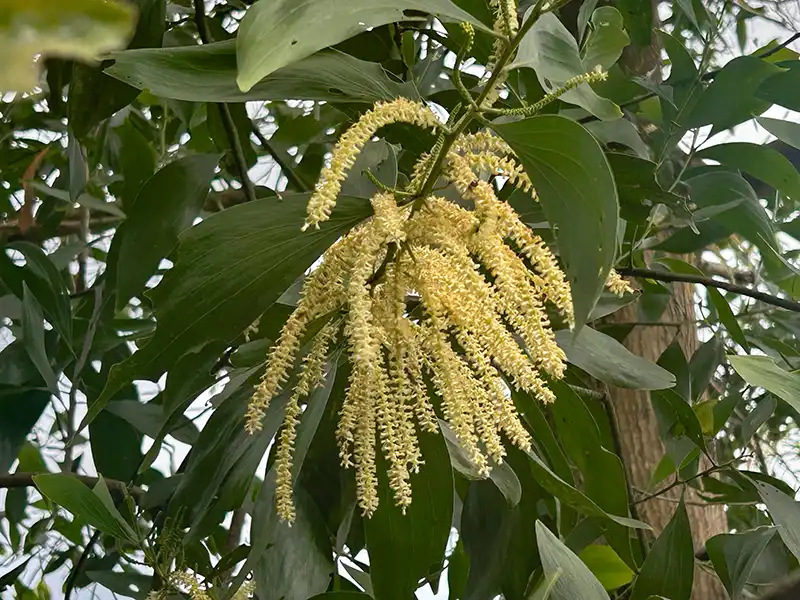
| Flowers | Pale yellow to yellow cylindrical flower spikes |
| Flowering period | Usually June–October; timing varies with location and conditions |
| Position | Sunny, open planting position |
| Soil | Well-drained soil; naturally occurs on a range of woodland and forest sites |
| Uses | Native landscapes, habitat plantings, mixed shrub and tree plantings, and suitable revegetation projects |
Why Grow Black Wattle?
- Fast-growing native shrub or small tree.
- Yellow flower spikes provide winter and spring interest.
- Flowers attract bees.
- Provides foliage and branching structure in mixed plantings.
- Suitable for revegetation where the species and provenance match the site.
How to Grow Black Wattle from Seed
Acacia seeds generally have a hard coat that restricts water uptake. Pretreatment helps overcome this barrier. Follow any instructions supplied specifically for your seed lot.
- Prepare the seed. Where hot-water treatment is recommended, pour freshly boiled water over seed in a heatproof container and allow it to cool and soak overnight. Do not keep the seed boiling.
- Check for swelling. Seeds that have swollen have absorbed water and are ready to sow. Carefully abrading a small area of the hard coat is an alternative treatment.
- Prepare the growing medium. Use clean, free-draining seed-raising mix in tubes or small pots.
- Sow shallowly. Cover treated seed lightly with fine mix.
- Maintain moisture. Water gently and keep the medium moist without prolonged saturation.
- Provide suitable growing conditions. Keep containers warm, well lit and protected from excessive heat or drying winds.
- Transplant established seedlings. Harden plants gradually before planting out, and avoid leaving them in containers until their roots become crowded.
Black Wattle for Landscaping
Use Black Wattle in spacious native plantings where its branching canopy can develop freely. Choose spacing with mature growth in mind and leave access for establishment watering and maintenance.
This is a relatively short-lived tree. Include longer-lived species in the planting design where a lasting canopy is required.
Black Wattle for Revegetation
Specify Acacia leiocalyx by botanical name when ordering for restoration work, as several different species share the common name Black Wattle.
Confirm the local vegetation community and provenance requirements. Prepare planting areas, manage competing weeds and monitor seedlings after planting.
Flowers and Foliage
Mature plants carry broad, leaf-like phyllodes. These contrast with the slender yellow flower spikes that give rise to the common name Lamb’s Tail Wattle.
Flowers are followed by narrow pods that may curve, twist or coil as they develop.
Where to Grow Black Wattle
- Spacious native landscapes.
- Mixed shrub and small-tree plantings.
- Habitat gardens with room for mature growth.
- Locally appropriate woodland plantings.
- Revegetation projects using suitable seed provenance.
When to Sow Black Wattle Seeds in Australia
These are general nursery planning guides rather than fixed species-specific sowing dates. Local suitability and reliable establishment conditions should guide decisions.
| Climate Zone | Suitable Sowing Period | Growing Notes |
|---|---|---|
| Cool | Spring to early summer, where suitable | Confirm local suitability and protect young seedlings from frost. |
| Temperate | Spring or early autumn with suitable warmth | Maintain moisture and avoid temperature extremes. |
| Subtropical | Spring or autumn under managed conditions | Protect trays from intense heat and drying winds. |
| Tropical | Suitable periods with controlled nursery conditions | Check planting suitability and shelter trays from heavy rain. |
| Arid / Semi-arid | Mild periods with dependable irrigation, where suitable | Assess site suitability and plan follow-up watering. |
Tips for Growing Black Wattle Successfully
- Use seed-lot instructions to guide pretreatment.
- Sow into clean containers with good drainage.
- Maintain moisture during germination.
- Harden seedlings gradually before planting out.
- Control weeds around newly planted seedlings.
- Plan spacing and future maintenance before planting.
Frequently Asked Questions
Which Black Wattle is this?
This product is Acacia leiocalyx, also known as Early Flowering Black Wattle.
Does it have feathery foliage?
Mature plants have broad, elongated phyllodes rather than permanently feathery foliage.
What do the flowers look like?
The flowers form pale yellow to yellow cylindrical spikes.
Does the seed need pretreatment?
Hard-coated Acacia seed generally benefits from suitable hot-water treatment or careful scarification. Follow the supplied seed instructions.
Can it be used for revegetation?
Yes, where the species and seed provenance suit the local vegetation community.
Grow Black Wattle from Seed
Grow Acacia leiocalyx for seasonal flowers and native landscape structure. Prepare the seed appropriately, establish seedlings carefully and choose a planting position suited to mature growth.
Reviews
There are no reviews yet.