

Red & Green Kangaroo Paw Native Seeds
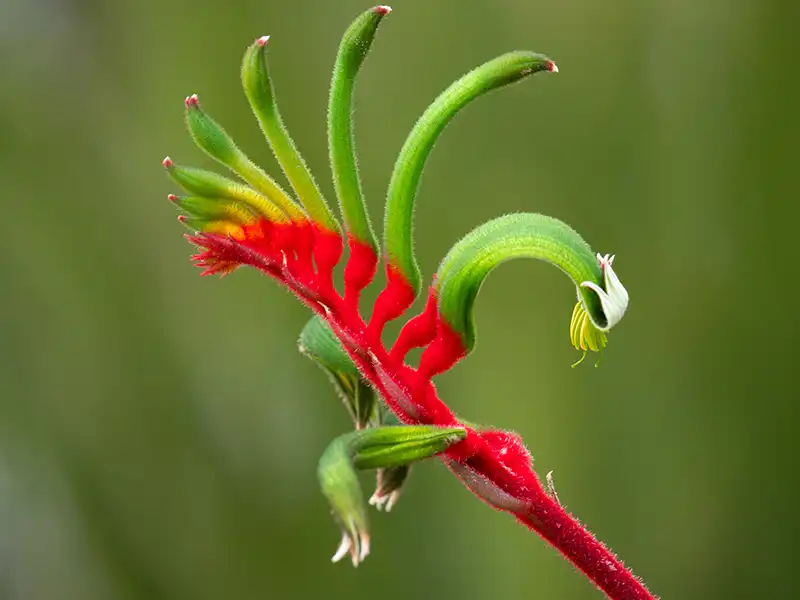
Grow one of Australia’s most recognisable native wildflowers with the spectacular Red & Green Kangaroo Paw, the floral emblem of Western Australia. Red & Green Kangaroo Paw (Anigozanthos manglesii) is a distinctive Australian native perennial producing upright flowering stems covered in velvety red and brilliant green flowers.
The unusual tubular flowers curve at their tips to create the characteristic paw-like shape that gives Kangaroo Paw its common name. Flowering stems rise above clumps of strap-like grey-green leaves, creating an architectural display that works particularly well in native gardens, feature plantings and large containers.
Native to Western Australia, Anigozanthos manglesii naturally occurs in heath, woodland and open forest, particularly on sandy and freely draining soils. It performs best in sunny positions with excellent drainage and good airflow.
Red & Green Kangaroo Paw Seed Details
| Botanical name | Anigozanthos manglesii |
|---|---|
| Common names | Red & Green Kangaroo Paw, Mangles Kangaroo Paw |
| Family | Haemodoraceae |
| Plant type | Australian native herbaceous perennial |
| Approximate height | Foliage approximately 30 cm; flowering stems commonly reach 60–100 cm |
| Flower colour | Deep red and vivid green |
| Position | Full sun to light or dappled shade; good airflow preferred |
| Soil | Free-draining sandy, sandy-loam or gravelly soil |
| Sowing depth | Surface sow or cover lightly with approximately 2–3 mm of fine seed-raising mix |
| Typical germination | Approximately 3–6 weeks under suitable conditions; germination can be variable |
| Approximate seeds per gram | Approximately 1,400 seeds |
| Seed treatment | Smoke treatment is recommended to help encourage germination |
| Uses | Australian native gardens, feature plantings, wildlife gardens, pots and containers, mass plantings and cut flowers |
Why Grow Red & Green Kangaroo Paw?
- Iconic Australian native wildflower and the floral emblem of Western Australia.
- Produces spectacular velvety flowers in contrasting red and green.
- Architectural upright flower stems create a striking garden feature.
- Excellent for Australian native and wildlife-friendly gardens.
- Flowers attract nectar-feeding birds including honeyeaters and wattlebirds.
- Suitable for garden beds, feature plantings and large containers.
- Can be grown from seed for an interesting native propagation project.
- Performs particularly well in sunny positions with freely draining soil.
How to Grow Red & Green Kangaroo Paw from Seed
Red & Green Kangaroo Paw can be propagated successfully from seed, although germination may be slower and less uniform than many common garden annuals. Good drainage, warmth and careful moisture management are particularly important.
- Use smoke treatment if available.
Smoke treatment is recommended for Anigozanthos manglesii and can help stimulate germination. Follow the directions supplied with commercial smoke water, smoke granules or other native-seed smoke treatments. - Prepare a free-draining propagation mix.
Use a quality seed-raising medium with excellent drainage. A sandy native seed-raising mix is particularly suitable. Avoid dense or waterlogged growing media. - Sow the seeds shallowly.
Scatter the fine seed over the surface and cover with only approximately 2–3 mm of fine seed-raising mix, coarse sand or another suitable free-draining material. - Water gently.
Use a fine spray or gentle watering method so the small seeds are not displaced. Moisten the growing medium thoroughly without leaving it saturated. - Provide warmth and good light.
Place trays in a bright, protected position with warm conditions. Temperatures around approximately 18–24°C are suitable for germination. - Keep moist but never waterlogged.
Maintain consistent moisture while the seed is germinating. Allow excess water to drain freely and avoid continuously saturated conditions. - Allow time for germination.
Seedlings may begin emerging after approximately 3–6 weeks under suitable conditions, although germination can be irregular and some seed may take longer. - Transplant carefully.
Once seedlings are large enough to handle and have developed a useful root system, transplant them into individual pots or their final position while minimising root disturbance.
Distinctive Red and Green Kangaroo Paw Flowers
The extraordinary flowers are the main attraction of Anigozanthos manglesii.
Tall reddish flowering stems carry clusters of tubular flowers covered in fine velvety hairs. The lower portion of the flower is generally deep red before changing dramatically to brilliant green towards the curved tip.
As the flower opens, the upper portion divides and curls backwards, creating the unusual paw-like form responsible for the common name Kangaroo Paw.
The combination of vivid colour, fuzzy texture and upright growth makes Red & Green Kangaroo Paw one of the most distinctive flowers in the Australian native garden.
Western Australia’s Floral Emblem
Red & Green Kangaroo Paw is not simply an attractive Australian native plant. Anigozanthos manglesii has been the official floral emblem of Western Australia since 1960.
The species occurs naturally only in Western Australia and is strongly associated with the wildflowers of the south-west of the state.
Its combination of intense red and green colouring, unusual flower shape and uniquely Australian appearance has made it one of the country’s most recognisable native wildflowers.
Growing Kangaroo Paw for Native Birds
Kangaroo Paws are particularly useful in wildlife-friendly gardens because their flowers provide nectar for native birds.
- Honeyeaters: are attracted to the nectar-rich tubular flowers.
- Wattlebirds: can perch on the strong flowering stems while feeding.
- Native garden planting: Kangaroo Paws combine well with other flowering Australian natives.
- Seasonal food source: flowering plants can contribute nectar during the main flowering season.
For a stronger wildlife effect, Kangaroo Paws can be planted in groups rather than as isolated specimens.
When Does Red & Green Kangaroo Paw Flower?
In its natural Western Australian range, Anigozanthos manglesii produces its main floral display from late winter through spring, with flowering commonly occurring between approximately August and November.
Flowering time will vary with climate, rainfall, establishment and local growing conditions.
Established plants grown in favourable conditions can produce tall flowering stems carrying numerous blooms that open progressively along the stem.
Removing old flower stems after flowering helps keep established plants tidy and encourages healthy new growth.
What Soil Is Best for Red & Green Kangaroo Paw?
Red & Green Kangaroo Paw naturally grows in sandy and other freely draining soils, and drainage is one of the most important considerations when growing the species in cultivation.
Sandy soil, sandy loam and gravelly soils are particularly suitable. In heavier garden soils, raised beds or improved drainage may help prevent excess moisture accumulating around the root system.
Avoid planting into permanently wet areas or soils that remain waterlogged after rainfall.
For containers, choose a pot with generous drainage holes and use a quality free-draining potting medium suitable for Australian native plants.
Does Red & Green Kangaroo Paw Need Full Sun?
A sunny, open position generally produces the strongest growth and flowering.
Red & Green Kangaroo Paw can tolerate some light or dappled shade, but plants grown with insufficient light may produce weaker growth and fewer flowers.
Good airflow is also valuable, particularly where summers are humid or rainfall is high.
Avoid overcrowding plants with dense surrounding vegetation that keeps the foliage continuously shaded or damp.
Growing Red & Green Kangaroo Paw in Humid Climates
Anigozanthos manglesii originates from Western Australia and is generally better suited to dry or Mediterranean-style climates than persistently humid environments.
Gardeners in humid subtropical and tropical regions should pay particular attention to drainage and airflow.
- Choose the sunniest, best-ventilated position available.
- Use raised beds or containers where natural drainage is poor.
- Avoid overhead watering wherever practical.
- Water around the base of the plant rather than wetting the leaves.
- Avoid dense planting that restricts airflow.
- Remove damaged, heavily spotted or deteriorating foliage to maintain plant hygiene.
In high-humidity climates, Red & Green Kangaroo Paw may be shorter-lived than some of the hardier modern Kangaroo Paw hybrids.
Reducing Ink Spot and Fungal Problems
Kangaroo Paws can be susceptible to fungal problems commonly described as ink spot, particularly when foliage remains wet for prolonged periods.
Good garden hygiene and growing conditions can help reduce the likelihood of problems.
- Provide excellent soil drainage.
- Grow plants in an open position with good airflow.
- Water around the root zone rather than routinely wetting foliage.
- If overhead watering is unavoidable, water early enough for foliage to dry quickly.
- Remove old flowering stems and deteriorating leaves.
- Avoid persistently wet or heavily shaded positions.
Can Red & Green Kangaroo Paw Grow in Pots?
Yes. Red & Green Kangaroo Paw can be grown successfully in containers, and pots can be particularly useful where garden soil is heavy or local conditions are humid.
Choose a sufficiently large container with excellent drainage and use a free-draining native potting mix.
Position the container in a sunny location and avoid leaving the pot standing in water.
Container plants should be watered thoroughly when required and then allowed to drain. Avoid keeping the growing medium continuously saturated.
Growing in containers also allows plants to be moved into a more protected or better-ventilated position when conditions become excessively wet.
Red & Green Kangaroo Paw as a Cut Flower
The unusual upright stems and brightly coloured flowers make Kangaroo Paw an excellent addition to Australian native floral displays.
Flowering stems can be harvested once several flowers have developed while additional buds remain available to open.
Use clean cutting tools and place harvested stems into clean water soon after cutting.
The strong vertical form works particularly well when combined with other Australian foliage and wildflowers.
Where to Grow Red & Green Kangaroo Paw
Red & Green Kangaroo Paw is particularly effective where its unusual flowers can be viewed closely or grown as an architectural garden feature.
- Australian native gardens.
- Western Australian wildflower gardens.
- Bird and wildlife-friendly gardens.
- Sunny garden borders.
- Feature and specimen plantings.
- Mass native plantings.
- Cut-flower gardens.
- Large pots and containers with excellent drainage.
Tips for Growing Red & Green Kangaroo Paw Successfully
- Use smoke treatment before sowing where available.
- Sow into a light, freely draining seed-raising medium.
- Cover the fine seed only lightly.
- Maintain gentle, consistent moisture during germination.
- Do not leave propagation trays continuously waterlogged.
- Choose a sunny position with good airflow.
- Avoid overhead watering once plants are established.
- Improve drainage before planting into heavy soils.
- Remove old flower stems at the base after flowering.
- In humid climates, consider containers or particularly open, well-drained positions.
Frequently Asked Questions
What is Red & Green Kangaroo Paw?
Red & Green Kangaroo Paw is an Australian native perennial botanically known as Anigozanthos manglesii. It produces tall flower stems carrying distinctive velvety red and green flowers.
Is Red & Green Kangaroo Paw native to Australia?
Yes. Anigozanthos manglesii is native to Western Australia and occurs naturally in woodland, heath and open forest, often on sandy soils.
Is Red & Green Kangaroo Paw Western Australia’s floral emblem?
Yes. Anigozanthos manglesii was proclaimed the floral emblem of Western Australia in 1960.
Is Kangaroo Paw annual or perennial?
Red & Green Kangaroo Paw is botanically a herbaceous perennial. In difficult climates, particularly very humid areas, it may be shorter-lived and is sometimes grown more like an annual or biennial.
How tall does Red & Green Kangaroo Paw grow?
The strap-like foliage is commonly around 30 cm high, while flowering stems can reach approximately 60–100 cm depending on growing conditions.
How long do Red & Green Kangaroo Paw seeds take to germinate?
Germination commonly takes approximately 3–6 weeks under suitable conditions, although Kangaroo Paw germination can be variable and some seeds may take longer.
Do Kangaroo Paw seeds need smoke treatment?
Smoke treatment is recommended for Red & Green Kangaroo Paw and may help improve germination. Commercial smoke water, smoke granules or other treatments designed for Australian native seed can be used according to their directions.
How deep should Kangaroo Paw seeds be planted?
Sow Kangaroo Paw seeds shallowly. Cover them with approximately 2–3 mm of fine seed-raising mix, coarse sand or another suitable free-draining material.
How many Red & Green Kangaroo Paw seeds are in a gram?
There are approximately 1,400 seeds per gram. Seed size varies naturally between harvests and seed lots, so this should be treated as an approximate guide.
What soil does Kangaroo Paw prefer?
Red & Green Kangaroo Paw performs best in freely draining sandy, sandy-loam or gravelly soils. Good drainage is particularly important.
Does Red & Green Kangaroo Paw need full sun?
Full sun is generally preferred for vigorous growth and strong flowering. Light or dappled shade can be tolerated provided drainage and airflow remain good.
Can Kangaroo Paw grow in pots?
Yes. Kangaroo Paw can be grown in containers using a freely draining native potting medium and a pot with generous drainage holes.
Can Red & Green Kangaroo Paw grow in Queensland?
It can be grown in Queensland, but Anigozanthos manglesii is less tolerant of persistent humidity than many modern Kangaroo Paw hybrids. Excellent drainage, full sun, good airflow and avoiding regularly wet foliage are particularly important in humid regions.
Does Kangaroo Paw attract birds?
Yes. Kangaroo Paw flowers provide nectar and are attractive to nectar-feeding native birds, particularly honeyeaters and wattlebirds.
Can Kangaroo Paw be used as a cut flower?
Yes. Its tall stems, distinctive shape and vivid colours make Kangaroo Paw useful for fresh floral arrangements.
When does Red & Green Kangaroo Paw flower?
The main flowering period is generally from late winter through spring, with plants in their natural Western Australian range commonly flowering from approximately August to November.
Grow Red & Green Kangaroo Paw from Seed
With its striking red and green velvety flowers, upright architectural stems and status as Western Australia’s floral emblem, Anigozanthos manglesii is one of Australia’s most distinctive native wildflowers.
For best results, sow shallowly into a freely draining propagation medium, consider smoke treatment to encourage germination, provide warmth and consistent moisture during establishment, and grow mature plants in a sunny position with excellent drainage and airflow.
Red & Green Kangaroo Paw makes a spectacular feature for Australian native gardens, wildlife plantings, large containers and colourful native flower displays.
Reviews
There are no reviews yet.